

An ancient meteorite, four times the size of Mount Everest, caused the largest tsunami in Earth's history and boiled the oceans, but this same meteorite may also have brought life to Earth.
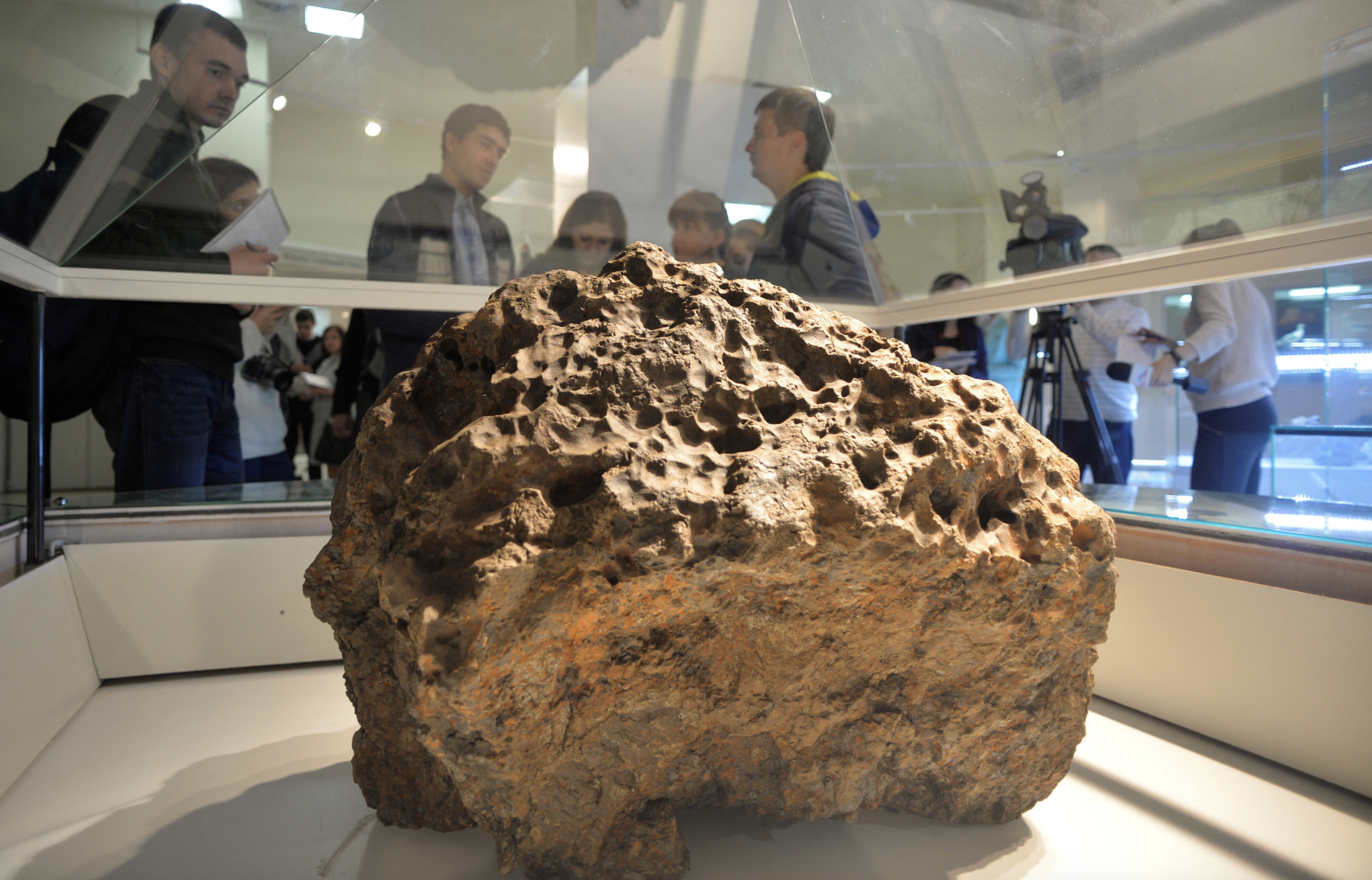
A meteorite fragment recovered from the bottom of Chebarkul Lake was displayed at the Chelyabinsk regional museum (Russia) in 2013.
First discovered in 2014, the S2 asteroid crashed into Earth approximately 3.26 billion years ago and is estimated to be more than 200 times larger than its "younger sibling" asteroid that later wiped out the dinosaurs.
New findings, published in the journal Proceedings of the National Academy of Sciences , suggest that the catastrophic collision billions of years ago not only brought about the destruction of Earth, but also helped life to flourish on our planet's surface.
"We know that collisions with giant asteroids occurred frequently during the early stages of Earth's history, and that these events must have impacted the evolution of life on Earth in its early stages. But we didn't have much information until recently," NBC News quoted geologist Nadja Drabon, the report's author, from Harvard University.
The team of experts spent three seasons conducting field research in the Barberton Greenstone Belt of South Africa to collect on-site samples.
Based on years of experience in the laboratory, they determined that the meteorite struck Earth at the time of the planet's formation and when it was in the state of a water world with a few continents emerging from the sea.
What extraterrestrial life forms have ever reached Earth?
During their field trips, geologist Drabon and his colleagues wanted to search for spherical particles or fragments of rock left over from meteorite impacts.
They collected a total of 100 kg of rocks and brought them back to the laboratory for analysis.
The team of experts found evidence suggesting that the tsunami stirred up nutrients such as iron and phosphorus.
Professor Jon Wade, a planetary materials expert at the University of Oxford (UK), stated that the distribution of iron-rich water plays a crucial role in the emergence of life.
According to expert Wade, iron is the most abundant element by mass on Earth, but most of it is locked tightly in the Earth's core, at a depth of about 2,900 km.
Despite this fact, life forms had to rely on iron to survive. As a result, the Earth experienced a temporary iron-induced microbial boom, creating conditions for life to emerge.
Source: https://thanhnien.vn/thien-thach-co-dai-lon-gap-4-lan-nui-everest-da-mang-su-song-den-trai-dat-185250124110434422.htm


![[Photo] Prime Minister Pham Minh Chinh holds a phone call with the CEO of Russia's Rosatom Corporation.](/_next/image?url=https%3A%2F%2Fvphoto.vietnam.vn%2Fthumb%2F1200x675%2Fvietnam%2Fresource%2FIMAGE%2F2025%2F12%2F11%2F1765464552365_dsc-5295-jpg.webp&w=3840&q=75)

![[Photo] Closing Ceremony of the 10th Session of the 15th National Assembly](/_next/image?url=https%3A%2F%2Fvphoto.vietnam.vn%2Fthumb%2F1200x675%2Fvietnam%2Fresource%2FIMAGE%2F2025%2F12%2F11%2F1765448959967_image-1437-jpg.webp&w=3840&q=75)








































![[OFFICIAL] MISA GROUP ANNOUNCES ITS PIONEERING BRAND POSITIONING IN BUILDING AGENTIC AI FOR BUSINESSES, HOUSEHOLDS, AND THE GOVERNMENT](https://vphoto.vietnam.vn/thumb/402x226/vietnam/resource/IMAGE/2025/12/11/1765444754256_agentic-ai_postfb-scaled.png)








































Comment (0)