

There will be six approaches to handling renewable energy projects under inspection to resolve difficulties and obstacles, especially regarding planning amendments and procedures.
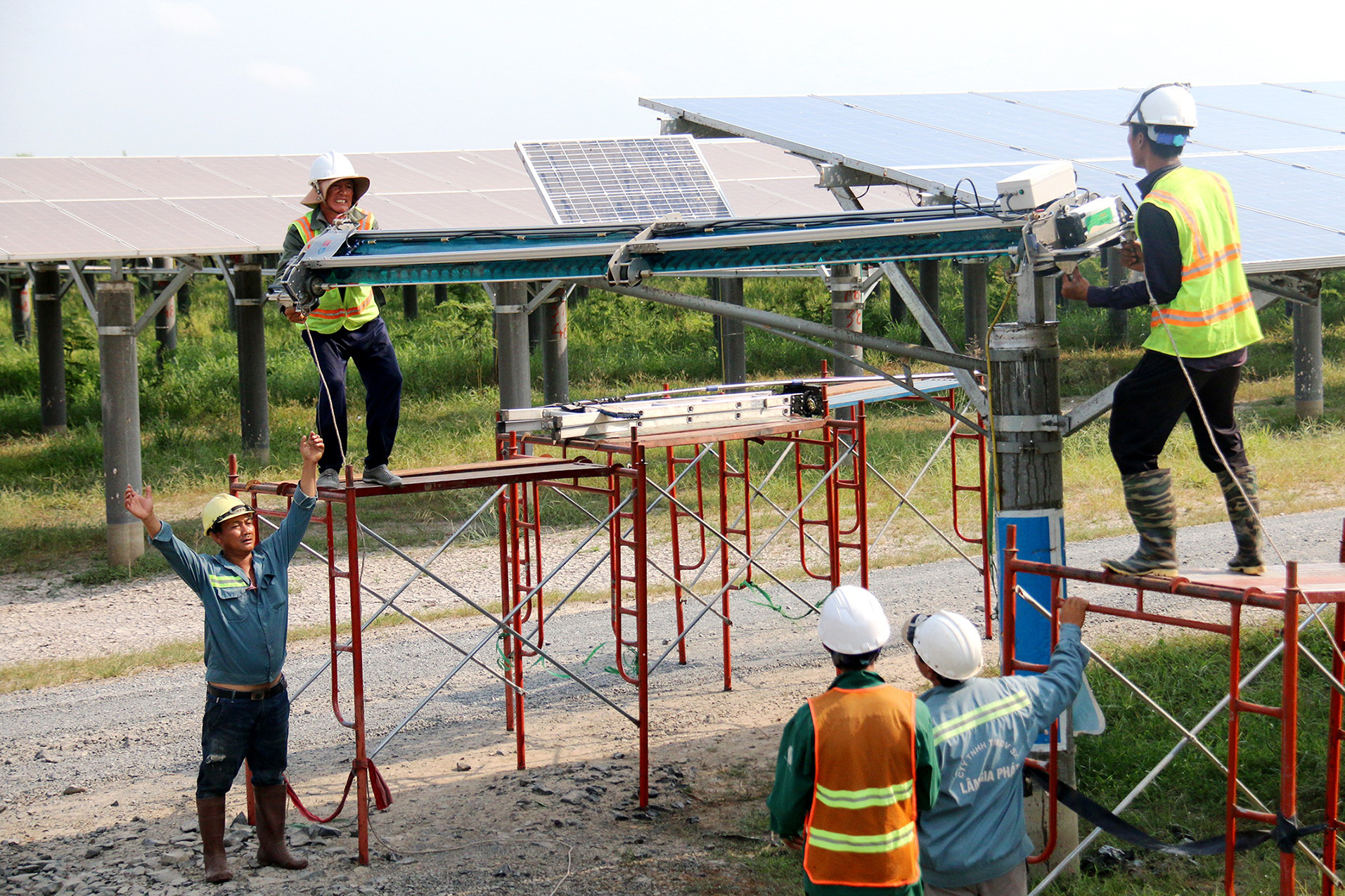
Removing obstacles and difficulties for renewable energy businesses - Photo: NH
The government has just issued a resolution from its regular November 2024 meeting, which includes an important provision agreeing to remove obstacles and difficulties for renewable energy projects.
Agree on the principles for resolving difficulties and obstacles.
Information regarding this resolution is being announced at the online conference to announce and implement the Government's resolution on policies and directions for resolving obstacles and difficulties for renewable energy projects, taking place this afternoon, December 12th, chaired by the Prime Minister .
According to the recently adopted resolution, considering Report 1070 of the Ministry of Industry and Trade on difficulties and obstacles in the process of handling solar and wind power projects as per Conclusion 1027 of the Government Inspectorate , and based on the vote of the Government members, the Government has decided...
We agree with the principles, solutions, and guidelines for resolving difficulties and obstacles for renewable energy projects as presented in the Ministry of Industry and Trade's report. This includes aspects such as: supplementing planning, land-related procedures, construction project acceptance, FIT (Feed-in Tariff) benefits, and rooftop solar power projects. The Ministry of Industry and Trade is responsible for the objectivity of the data in the report.
The government has assigned the Ministry of Industry and Trade to research and review the difficulties and obstacles faced by renewable energy projects, and to propose solutions to the competent authorities for each type of obstacle, ensuring that no corruption, vested interests, or waste occurs.
According to Tuoi Tre Online , the Ministry of Industry and Trade's report on the implementation of the Government's resolution on policies and directions for resolving difficulties and obstacles for renewable energy projects has outlined solutions for individual projects and groups of projects.
These include six groups of solutions to address difficulties and obstacles for renewable energy projects. These include allowing the addition of projects to the planning for implementation, provided the project does not violate regulations related to national security and defense, or the planning of key national projects.
For projects with violations of procedures related to land and construction, completion is permitted in accordance with the law.
Specific handling procedures: Projects in violation must rectify the situation.
For projects that violate planning regulations regarding minerals, irrigation, national defense, etc., an assessment of the socio-economic effectiveness of implementing the plan and the project will be conducted. Based on this, overlapping plans will be adjusted accordingly, or the renewable energy project and related plans will be integrated and implemented simultaneously (dual-use planning).
For projects currently benefiting from FIT rates that have been found to be in violation by competent authorities due to not fully meeting the conditions, they will no longer be eligible for preferential FIT rates. The project's electricity purchase price will be recalculated according to regulations; any improperly received preferential FIT rates will be recovered through offsetting payments for electricity purchases.
For large-scale rooftop solar power projects built on agricultural or forestry land under a farm investment model where the land is not yet suitable for farming, investors are required to comply with regulations.
This includes completing all necessary procedures for constructing and investing in a farm for integrated farming and cultivation, combined with the implementation of a renewable energy project in accordance with the law. It also requires immediate fulfillment of all financial obligations to the State as stipulated by law.
If the competent authority determines that there are violations regarding land use for the farm, the project will not be eligible for the preferential FIT rate, and the electricity purchase price must be recalculated according to regulations. Any improperly received preferential FIT rates will be recovered through offsetting electricity purchase payments. The project must also fully carry out all registered farming and cultivation activities.
In certain cases, such as projects benefiting from FIT rates that violate regulations and rooftop solar power projects built on agricultural or forestry land, the competent authority shall issue regulations on electricity trading when the competent authority determines that the project's preferential FIT rate has been revoked, to serve as a basis for offsetting payments for electricity purchases.
Source: https://tuoitre.vn/thong-qua-huong-xu-ly-cac-du-an-nang-luong-tai-tao-bi-vuong-mac-tu-ket-luan-thanh-tra-20241212152022919.htm

























































































Comment (0)