 |
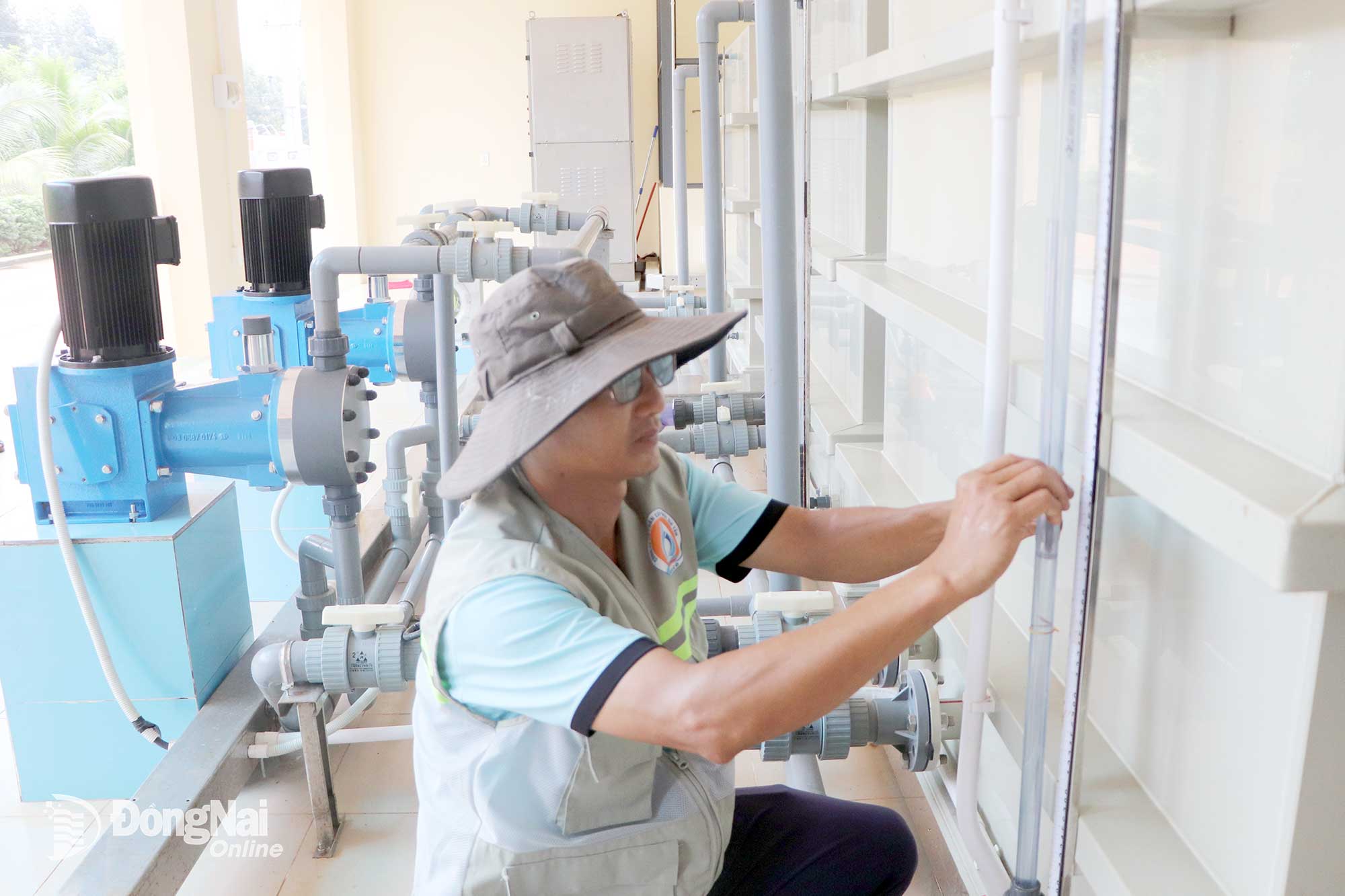
| Water treatment system at Gia Tan Water Supply Joint Stock Company, Dau Giay commune. Photo: Binh Nguyen |
This objective is even more important in the current context, with groundwater depletion, pollution, and increasingly evident climate change. Accordingly, in the period 2026-2030, the province will continue to identify this as one of its key tasks, prioritizing investment resources for rural clean water, especially in remote and border communes.
Investment priority
During the period 2021-2025, Dong Nai province (formerly) invested in the construction of 26 rural clean water supply projects. Of these, 15 projects have been completed and put into operation, while 11 projects are in the project preparation phase. The total length of water supply pipelines connecting and expanding the water supply coverage from centralized water supply systems is 1,048 km. The total investment cost for these water supply projects reached over 2.3 trillion VND.
Binh Phuoc province (formerly) did not invest in rural clean water infrastructure from the state budget; instead, urban water supply enterprises mainly expanded their investments in water pipelines to some rural communes adjacent to urban areas. During the period 2021-2025, these water supply enterprises invested in approximately 320km of water pipelines serving over 5,800 households.
As a result, Dong Nai province (formerly) has 91 rural centralized water supply projects, including 52 operational and 39 non-operational projects. Binh Phuoc province (formerly) has 48 projects, with 32 operational and 16 non-operational. Many of these centralized water supply projects have poor operational efficiency. The main reason is that most of these projects were built many years ago, with many components damaged or degraded.
According to Vo Van Dinh, Deputy Director of the Department of Agriculture and Environment, by December 2025, the percentage of rural households in Dong Nai province using hygienic water will reach 100%. Of these, 79% of households will use clean water meeting standards, 43% will use water from centralized water supply systems, and 36% will use water from household water supply systems or water filtration equipment.
During the period 2026-2030, Dong Nai province continues to set high targets for rural clean water. Specifically, by 2030, the percentage of rural households using clean water meeting standards in the province will reach 85%. Of this, 68% will use water from centralized water supply systems, and 17% will use water from household water supply systems and water filtration equipment.


Attracting investment through policy support.
To achieve the goal of rural clean water supply, in the period 2026-2030, Dong Nai province must continue to strongly attract investment resources for rural clean water infrastructure. Specifically, the province will continue to implement projects carried over from 2025. In addition, localities will invest in 10 new projects, providing water to approximately 137,200 people with an investment of over 680.7 billion VND. Furthermore, the province will continue to invest in upgrading, repairing, and expanding water supply routes with a total cost of over 2.5 trillion VND.
This is a difficult problem for localities, as investment capital from the budget for rural irrigation and clean water projects is still very low compared to actual needs. Meanwhile, integrating other funding sources is difficult due to differences in mechanisms. At the same time, attracting businesses to invest in rural clean water supply projects, especially in remote and border communes, remains challenging due to the large investment required. Furthermore, rural populations are scattered, and low water prices mean low profits, discouraging investment.
According to feedback from businesses investing in rural clean water supply projects, investment still faces many obstacles and difficulties. Businesses hope for the removal of these obstacles in terms of mechanisms and policies, as well as more practical support from departments, agencies, and localities in guiding them to expedite and improve the efficiency of investment procedures and documentation.
Mr. Ha Anh Tong, Deputy Director of Binh Phuoc Water Supply and Drainage Joint Stock Company (BPWACO), Binh Phuoc ward, said: The company faced some difficulties because after the merger, the water supply areas in some regions overlapped. When the company proceeded with the procedures to apply for a water supply construction permit, the local authorities were still confused in determining the water supply scope. In addition, the complicated and lengthy application procedures were also obstacles for the company in implementing the investment.
Mr. Dang Dinh Thuan, Director of Dong Nai Irrigation Company Limited, commented: "In reality, in rural areas, people still habitually use water from drilled and dug wells. Where there are no water sources, they mainly use water during the dry season and rainwater during the rainy season. The province needs a policy to support investment in rural clean water supply for remote, mountainous, and border areas. To ensure sustainability, large-scale projects are needed, guaranteeing the right to use water from surface water sources such as reservoirs. At the same time, policies on public land allocation and credit policies are needed to encourage investors."
Following proposals from several investors in rural water supply projects, businesses are seeking to increase the supply of domestic water from irrigation reservoirs. Many irrigation reservoirs previously primarily supplied water for agriculture. However, due to crop diversification and a decrease in irrigated area, businesses are requesting that water levels in these reservoirs be regulated to increase domestic water supply.



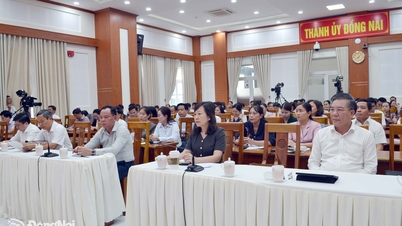
Provincial Party Committee member and Vice Chairman of the Provincial People's Committee Nguyen Thi Hoang instructed the Department of Agriculture and Environment to coordinate with the Department of Construction to develop a plan for investing in rural clean water supply in the province for the period 2026-2030, based on feedback from communes and wards to ensure it aligns with actual needs. Specifically, communes and wards need to review and zone investment areas; if a project already exists, no further investment should be attracted to avoid overlapping projects; areas without projects should be encouraged to attract investment; and areas with sparse populations should install household water filters.
Plains
Source: https://baodongnai.com.vn/xa-hoi/202512/thu-hut-dau-tu-cho-nuoc-sach-nong-thon-b2a00b2/