

In the early morning of May 9, Vietnam time, the US Department of Commerce listened to the debate of the parties on recognizing Vietnam as a market economy . This is an important discussion session for the US to consider upgrading Vietnam to market economy status on July 26.
According to Reuters , a Vietnamese representative affirmed that Vietnam has met six criteria set by the US Department of Commerce for becoming a market economy.
Retailers and many groups in the US are supportive.
Representing the Vietnamese Ministry of Industry and Trade , lawyer Eric Emerson from Steptoe LLP, a Washington-based law firm, affirmed that Vietnam has met all six criteria used by the US Department of Commerce to assess whether a country has a market-oriented economy. Therefore, Vietnam should be upgraded to a market economy.
The six criteria stipulated by the US include: the degree of currency convertibility; wage and salary negotiations between employees and employers; the level of foreign investment in economic activities; the issue of state and private ownership; the degree of government control over certain resources and prices; and other factors.
According to Eric, Vietnam has demonstrated better or often better performance on these criteria than other countries that have been granted market economy status. Vietnam intervenes less in state-owned enterprises than India, and is more open to foreign investment than Indonesia, Canada, and the Philippines.
More importantly, Vietnam and the US upgraded their relationship to a comprehensive strategic partnership in September 2023. Opportunities for economic cooperation between the two sides are wider than ever before. According to many US newspapers, Vietnam is the most attractive investment destination in ASEAN in the coming years.
A recent article on Mondaq.com made this assessment, based on factual and valid grounds such as increased economic diversification, international integration, investment law reform, and effective economic policies.
US Treasury Secretary Janet Yellen has also repeatedly mentioned Vietnam as a strategic destination for bringing investment and supply chains to friendly (friend-shoring) countries.
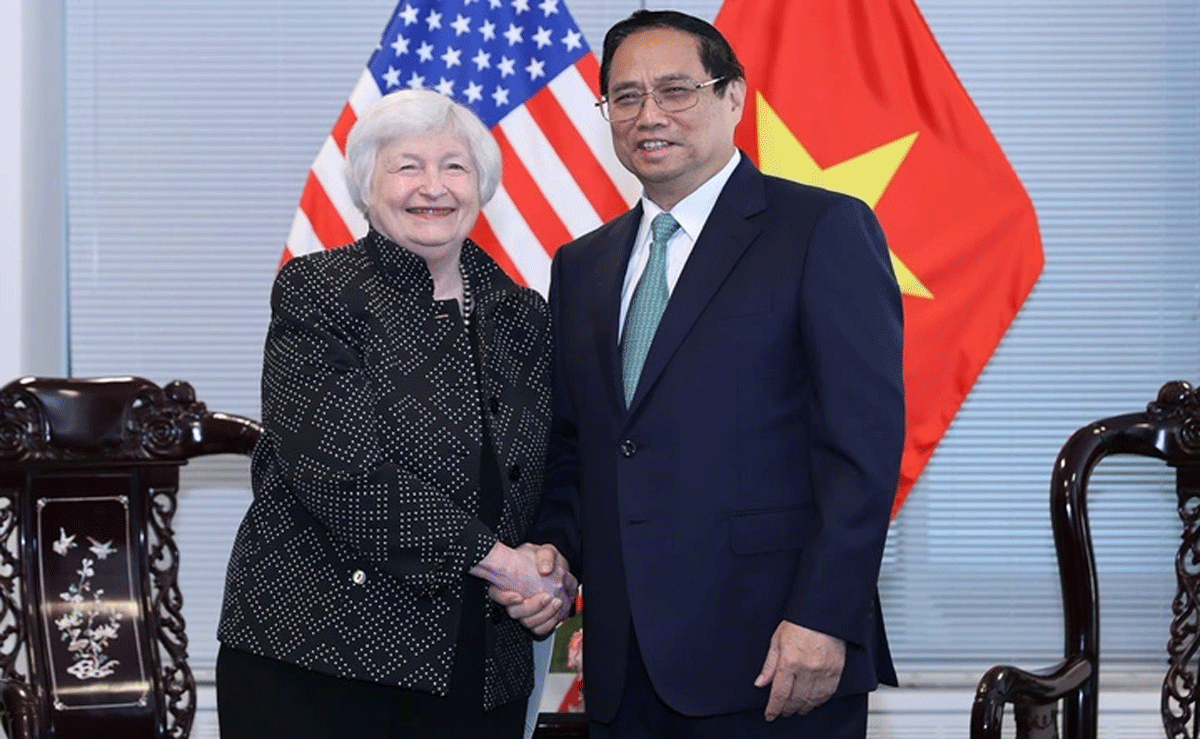
Prime Minister Pham Minh Chinh met with US Treasury Secretary Janet Yellen during his visit to the US in September 2023. Photo: VNA
In mid-March, another US business delegation, with a record number of representatives, visited Vietnam following the upgrading of relations between Vietnam and the US. The delegation was led by former Ambassador Ted Osius, President and CEO of the US-ASEAN Business Council (USABC), and included US Ambassador to Vietnam Marc Knapper, representatives from US Eximbank, and the Special Representative for Trade and Business from the US Department of State.
According to Reuters , USABC is a strong supporter of upgrading Vietnam's status. Ted Osius affirmed that Vietnam already has a market economy. Therefore, "they have met important criteria such as currency convertibility and are ready to be recognized as a full market economy."
According to the USABC representative, American businesses have invested significantly in Vietnam because they recognize the country's development potential. The actual amount of "American-origin" FDI flowing into Vietnam is very large.
Which groups are concerned?
According to Reuters , US steel producers, shrimp farmers along the Gulf Coast, and honey producers are currently opposing Vietnam's elevation to "market economy" status. However, retail corporations and many other business groups support the move.
The reason American shrimp farmers are protesting is that they believe such an upgrade in status would reduce anti-dumping duties on Vietnamese imports.
In addition, there are concerns about Vietnam's heavy reliance on investment and imported inputs from China. Many of its products are subject to anti-dumping duties imposed by the US.
Jeffrey Gerrish, representing steel producer Steel Dynamics, argued that the upgrade would lead to a surge in imports from Vietnam to the US and provide a loophole for China to circumvent US tariffs.
What benefits does Vietnam get?
According to Reuters , upgrading Vietnam to "market economy" status is an effort to strengthen US-Vietnam economic relations. This move is supported by many US businesses, including members of the US-ASEAN Business Council.
According to a representative of a foreign investment fund in Vietnam, if Vietnam is upgraded to a market economy, Vietnamese exporters will be the first to benefit. Among them, shrimp exporting businesses will be the most prominent beneficiaries.
Currently, Vietnamese shrimp is subject to high taxes. This year, the US International Trade Commission extended the 25.76% anti-dumping duty on frozen farmed shrimp imported from Vietnam, while the duty on shrimp from Thailand (which the US has recognized as a market economy) is only 5.34%.
Accordingly, if upgraded to a "market economy," shrimp exporting businesses to the US would gradually see this tax rate reduced over time, thereby increasing their competitiveness in the US market.
During the trading session on May 9th, many Vietnamese seafood stocks saw significant gains. Companies like Vinh Hoan Seafood (VHC) and shrimp exporters such as MPC and FMC are expected to benefit.
During a visit by a high-level US business delegation in March, US Ambassador to Vietnam Marc Knapper emphasized that this marks a new era between the two countries, with a comprehensive relationship and numerous cooperation frameworks. This promotes prosperity for the region, including Vietnam, the US, and other APEC members. The US representative expressed confidence in Vietnam's development and its strategic position in the world.
Assessing Vietnam in this new era, US Ambassador to Vietnam Marc Knapper stated that Vietnam is playing an increasingly larger and more important role in the global supply chain. Vietnam is a major trading partner of the US and has a dynamic economy.
Regarding US FDI into Vietnam, Ted Osius predicted that there would be an increase in FDI flows into Vietnam. The current FDI flow is not only reflected in statistics, but in reality, many US businesses invest in Vietnam through other countries such as Singapore, as in the case of Coca-Cola.

Source: https://vietnamnet.vn/toan-canh-tranh-luan-de-my-cong-nhan-viet-nam-la-nen-kinh-te-thi-truong-2279038.html


![[Photo] Explore the US Navy's USS Robert Smalls warship](/_next/image?url=https%3A%2F%2Fvphoto.vietnam.vn%2Fthumb%2F1200x675%2Fvietnam%2Fresource%2FIMAGE%2F2025%2F12%2F10%2F1765341533272_11212121-8303-jpg.webp&w=3840&q=75)













































































Comment (0)