

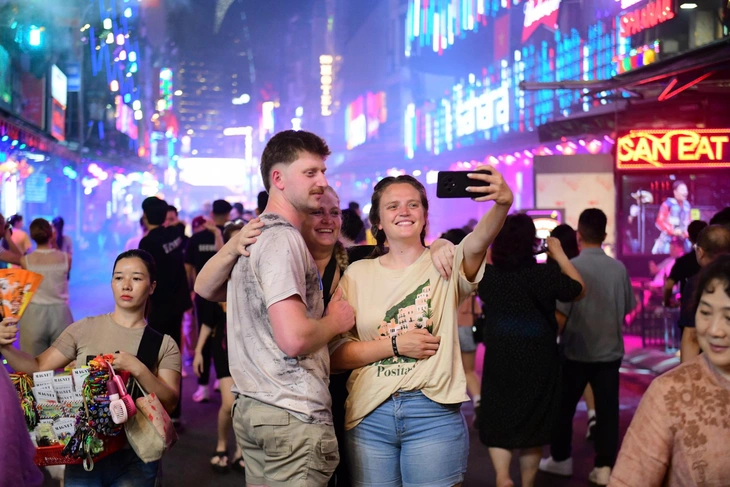
Tourists enjoy nightlife in Ho Chi Minh City - Photo: QUANG DINH
The important difference between Ho Chi Minh City and the above mentioned cities lies in the starting point: the size of Vietnam's middle class is still thin, transport infrastructure and public spaces do not really support "lifestyle-based cities", and especially tourism - an important source of life for many lifestyle models, is not strong enough to become a stable foundation...
What does Ho Chi Minh City lack to catch up with Seoul and Tokyo?
If you look at developed cities like Seoul, Tokyo, Copenhagen or Bangkok, lifestyle economy is an important part of the urban appearance. Art streets, local design shops or creative hubs are all symbols that create the cultural and aesthetic personality of the city.
The world is witnessing an explosion in the consumption of experiences, rather than products. That is why models like Lululemon, Muji, Gentle Monster or %Arabica can spread globally: they sell a lifestyle, not just goods.
In Vietnam, especially in Ho Chi Minh City, the lifestyle boom creates a similar feeling. Many beautiful cafes, unique studios or pottery – candle – acrylic workshops attract young people. These models reflect the desire of urban people to change their pace of life and seek more diverse spiritual experiences.
However, the important difference between Ho Chi Minh City and the above mentioned cities lies in the starting point: the size of Vietnam's middle class is still thin, transport infrastructure and public spaces do not really support "lifestyle-based cities", and especially tourism, which is an important source of life for many lifestyle models, is not strong enough to become a stable foundation.
A deeper analysis reveals that this difference is not only about economic scale but also about cultural depth. Seoul has K-pop, K-drama and K-aesthetics driving the lifestyle industry; Tokyo has centuries of design culture that creates wabi-sabi or omotenashi; Copenhagen has hygge, a lifestyle that permeates design – architecture – consumption.
These cities do not only develop lifestyles in form, but also take culture as the core. Meanwhile, many models in Vietnam today are still heavily influenced by foreign styles such as Korea and Japan, making local identity easily diluted.
It can be seen that the international reference system sets much higher requirements for Ho Chi Minh City if it wants to consider lifestyle as a strategic advantage. A megacity cannot export culture without its own identity - story - philosophy of life. This is also the intersection that raises the question: Can technology, especially AI, help fill those gaps?
AI Applications for Lifestyle Economics
In the context of a rapidly changing urban economy and constantly rotating consumer tastes, AI has become a tool to help lifestyle businesses adapt and optimize their operating models. In Ho Chi Minh City, where small models are the majority, space costs are high and business risks are always present, AI acts as a “soft skeleton” to help models survive longer.
Around the world, AI is reshaping the lifestyle industry in a completely personalized way. In the US, fitness boutiques use AI body scans to suggest exercises. In Korea, major cosmetic companies use AI to analyze skin to create personalized care routines. In Singapore, retail stores use AI to track customers’ movement in-store to optimize product display. These applications show that AI is no longer a science fiction technology, but a “living toolkit” for modern lifestyle businesses.
AI also helps reduce marketing pressure – which is a vital factor for the lifestyle industry in Ho Chi Minh City. Instead of needing an expensive creative team, AI can suggest content ideas, create viral videos, write captions, plan communications or recreate virtual spaces for promotion.
However, AI cannot solve the biggest problem of the lifestyle economy: sustainability. It can optimize costs, increase experiences, expand customer base, but it cannot create “identity” – the fundamental element of all cultural economic sectors. This is a point to note to avoid the illusion that “AI is enough”, leading to underestimating cultural depth or homogenizing the model in the direction of “AI-driven but soulless”. Thanks to AI, lifestyle can be an important piece of the urban puzzle, but it cannot be considered a magic wand for all economic problems.
Lifestyle is not a magic wand

International visitors choose to buy domestic Vietnamese fashion - Photo: HUU HANH
Lifestyle is a visually appealing industry but has very high economic risks. It cannot become a pillar of development for a city of more than 10 million people like Ho Chi Minh City. A city cannot develop based on cafes, decorative parties or decor shops, beautiful models but low profit margins, low labor productivity and no clear industrial or export value. It cannot rely on branded real estate projects - which are only suitable for the income of a small number of residents.
However, lifestyle still plays an important role: it contributes to shaping the image of the city, creating a sense of livability, stimulating consumption, attracting young professionals, creating a launching pad for the creative industry and making the city more “soulful”. Lifestyle is like the spiritual coat of the city - not a growth machine but a condition for the city to maintain its vitality.
Therefore, the question for Ho Chi Minh City is not "should we develop lifestyle or not", but "where to develop lifestyle in the overall urban area so as not to deviate".
The right way is to consider lifestyle as the “front-end” (user interface) – the cultural and aesthetic interface of the city, while the real pillars must still be technology, logistics, finance, import and export, high-quality services and innovation. Only when these pillars are strong, lifestyle will have a solid economic foundation to develop.
Exporting culture from lifestyle economy when there is enough uniqueness
So if it cannot be an economic pillar, can lifestyle be a "cultural export product" of Ho Chi Minh City?
The idea of “exporting culture” may sound far-fetched, but it has already happened in many countries. South Korea exports Hallyuwood; China exports Guochao culture; Bangkok exports its culinary style and night markets; Bali exports its slow-paced, natural, Zen lifestyle. The common denominator of these successful cases is that the lifestyle in these places is not only beautiful, but also unique and reflects the depth of the local culture.
So does Ho Chi Minh City have this ability? The answer is yes, but with many conditions. First of all, the city’s lifestyle must have a clear “cultural signature”. That could be the spirit of Saigon, a liberal blend of East and West, fast energy, creativity, warmth and street character. If it knows how to distill those identity elements into design, cuisine, crafts, decor, coffee or service models, Ho Chi Minh City can completely create products with its own style.
Some easy-to-imagine suggestions could be Saigon Retro style, Tropical Modernism, or lifestyle products that honor Vietnamese materials such as ceramics, rattan, lacquer, natural wood... combined with the modern living spirit of urban youth. When these values are packaged carefully and spread through media, art, music or tourism, they can become something that international tourists seek out and bring back.
It is no coincidence that many tourists when coming to Saigon remember the sidewalk coffee, the lively street corners, the cultural mix, or the characteristic energetic spirit, the "materials" that can completely become export products.
However, to achieve that, Ho Chi Minh City must develop lifestyles according to the ecosystem, not following trends. The cultural story must come from within, not through copying foreign styles. The city needs businesses with enough capacity to standardize products, expand the chain, and bring Vietnamese identity to the world. At the same time, it needs a connection between art, design, cuisine, technology and marketing to create sustainable spread.
Just look at it and you know "this is Saigon"
The most important thing for successful cultural export is that Ho Chi Minh City’s lifestyle must become a “language”, something that makes people know “this is Saigon” just by looking at it. And to reach that threshold, AI tools, digital platforms, communication capabilities and strong urban pillars must converge.
Lifestyle economics is not the answer to every development problem, but if positioned correctly as part of cultural, innovation and tourism urban planning, it can become a unique identity and even an export product.
Ho Chi Minh City is facing a rare opportunity: either to become a lifestyle city with its own depth and personality, or to get lost in the spiral of copycat models and quickly become outdated. The answer lies in the city's choice to develop "lifestyle" as part of its cultural - technological - urban strategy, not just a short-term trend.
At that time, lifestyle economy not only beautified the city, but also told a story about Saigon that the world wanted to hear.
Source: https://tuoitre.vn/tp-hcm-can-gi-de-buoc-vao-cuoc-dua-kinh-te-lifestyle-20251202161408961.htm

























![[Photo] Parade to celebrate the 50th anniversary of Laos' National Day](/_next/image?url=https%3A%2F%2Fvphoto.vietnam.vn%2Fthumb%2F1200x675%2Fvietnam%2Fresource%2FIMAGE%2F2025%2F12%2F02%2F1764691918289_ndo_br_0-jpg.webp&w=3840&q=75)


















































Comment (0)