

Towards a vocational education and training system that is competitive at the regional and international levels.
According to Ho Chi Minh City's orientation, the goal by 2030 is for the city's vocational education and training system to strive to meet the national demand for skilled labor, proactively participate in the national labor training market; and for some professions, to reach the level of countries in the ASEAN-4 group.
By 2045, vocational education and training (VET) in the city will meet the demand for highly skilled workforce. Ho Chi Minh City aims to become a leading locality in VET development in Vietnam and the ASEAN region, catching up with advanced global standards and possessing superior competitiveness in certain training fields, sectors, and professions.
The specific targets have also been clearly established by Ho Chi Minh City:
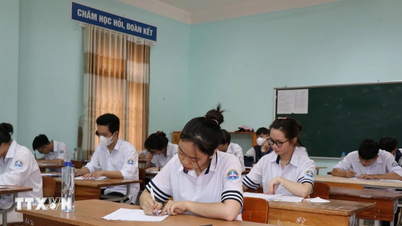
- The goal is to attract 45-50% of junior and senior high school graduates into the vocational education and training system; female students should account for over 35% of the total new enrollment target.
- Approximately 60% of the workforce receives retraining or ongoing training.
- Approximately 70% of vocational training institutions meet quality accreditation standards; there are about 10 high-quality schools.
- 100% of teachers meet the required standards; 100% of management staff receive training and professional development to enhance their modern management and administrative skills.
- 100% of training programs and occupations have their learning outcomes developed and updated according to the national qualifications framework.
This step affirms Ho Chi Minh City's determination to build a high-quality workforce to meet the requirements of socio -economic development in the context of the Fourth Industrial Revolution and deep international integration.
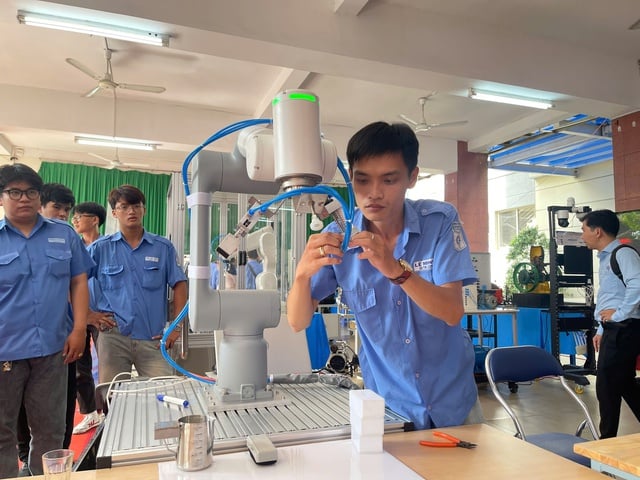
Students from Cao Thang Technical College with a model of an automated robotic arm.
PHOTO: YEN THI
8 key areas for human resource development
According to the plan for 2030, Ho Chi Minh City has identified 8 key areas for developing human resources after vocational education and training by 2025, with a vision to 2030.
The eight fields include: information and communication technology, mechanical engineering and automotive, mechatronics and automation, accounting, finance, banking and business administration, logistics, healthcare, tourism , and construction, environment and urban planning.
Specifically, the occupations fall into the following 8 fields:
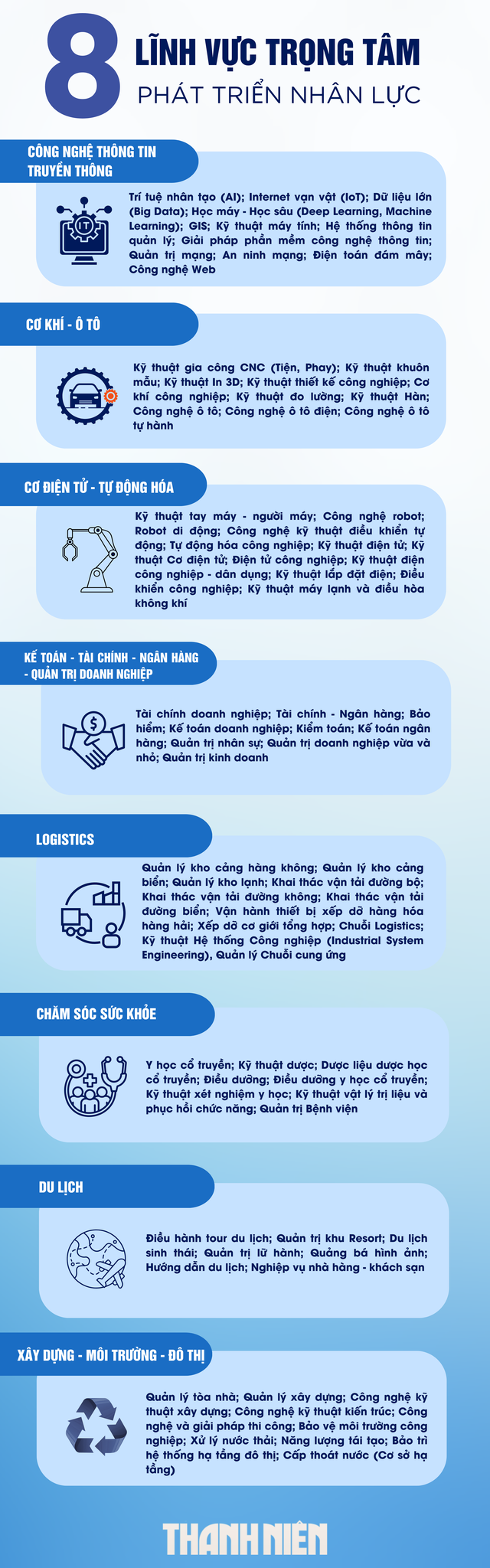
Key areas for developing human resources after vocational education and training in Ho Chi Minh City until 2025, with a vision to 2030.
GRAPHICS: YEN THI
Source: https://thanhnien.vn/tphcm-dat-muc-tieu-tro-thanh-trung-tam-gdnn-hang-dau-asean-185251015223600806.htm


























































![[Video] Sunset at Lap An Lagoon – Where the sun sets over the fishing nets](https://vphoto.vietnam.vn/thumb/1200x675/vietnam/resource/IMAGE/2026/05/31/1780192137701_beach-landscape-sea-water-nature-grass-745871-pxhere-com.jpeg)




































Comment (0)