

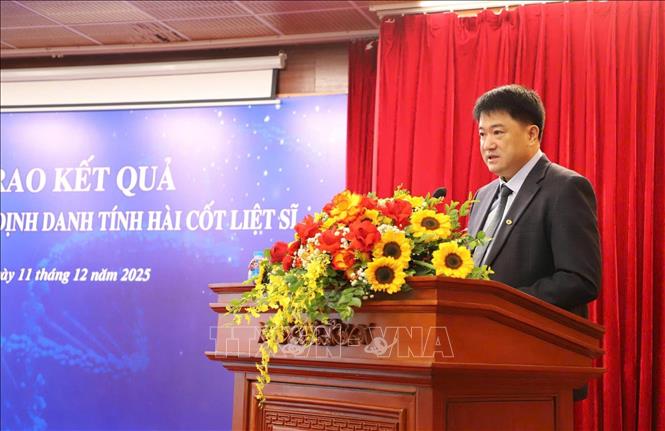
Attending the ceremony were Professor, Dr. Chu Hoang Ha, Vice President of the Vietnam Academy of Science and Technology; Mr. Marc E. Knapper, US Ambassador to Vietnam, along with scientists from the International Commission on Missing Persons (ICMP); representatives from agencies under the Ministry of Public Security and the Ministry of National Defense; representatives from the Vietnam Agency for Searching for Missing Persons (VNOSMP); and family members of fallen soldiers.
Speaking at the ceremony, Professor, Dr. Chu Hoang Ha, Vice President of the Vietnam Academy of Science and Technology, stated that over the years, Vietnam has strived to apply DNA testing methods, with mitochondrial DNA analysis being a crucial technology contributing to the identification of many fallen soldiers. However, over time, the technical limitations of this method have gradually become apparent due to several factors such as: the remains are often decomposed due to the hot and humid tropical climate; the genetic data obtained is limited and the segregation is not high enough; the probability of random coincidence in a large population; and in many cases, close relatives of the fallen soldiers have passed away, lacking supporting evidence. These factors make identification difficult, resulting in a large backlog of cases that the currently used testing technology cannot handle.
As the leading research institution in the country, scientists from the DNA Testing Center, Institute of Biology, Vietnam Academy of Science and Technology, have collaborated with international experts and forensic geneticists from the International Commission on Missing Persons (ICMP) to research, select, and refine a new DNA testing technology process suitable for the practical conditions of Vietnam.
The new DNA identification technology process combines optimized DNA extraction methods, the use of single nucleotide polymorphism (SNP) markers of the nuclear genome, next-generation sequencing (NGS) techniques, and a software system for data management and matching. This technology allows for accurate determination of kinship along both paternal and maternal lines up to 4 to 5 generations, and is particularly suitable for samples of remains of fallen soldiers buried long ago, where only poor-quality and fragmented DNA can be recovered, often failing with currently used identification methods.
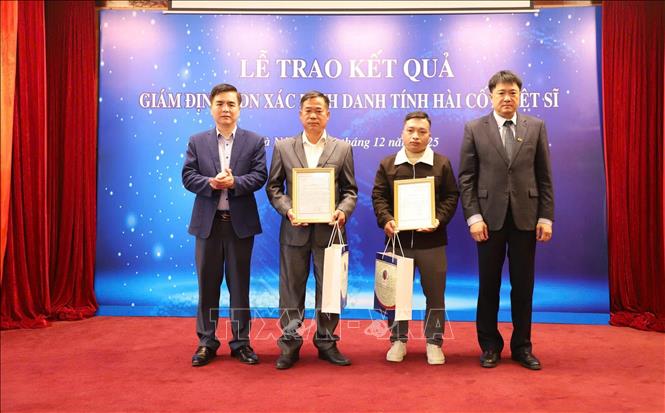
This new identification technology process was applied at the Tra Linh Martyrs' Cemetery ( Cao Bang province) to 58 remains samples. Nearly 90% of the total samples yielded SNP marker data that met the criteria for comparison and matching to aid in identification. In the first matching analysis, the identities of two martyrs, Hoang Van Hoa and Tran Van Can, were accurately determined.
“The significance of these two cases lies not only in the results of the identification but also in their groundbreaking nature, confirming that Vietnam has been able to overcome the long-standing ‘technical bottleneck’ in the identification of the remains of fallen soldiers. This is a special milestone, opening up prospects for gradually resolving large outstanding cases that science has not been able to effectively address before,” Professor, Dr. Chu Hoang Ha emphasized.
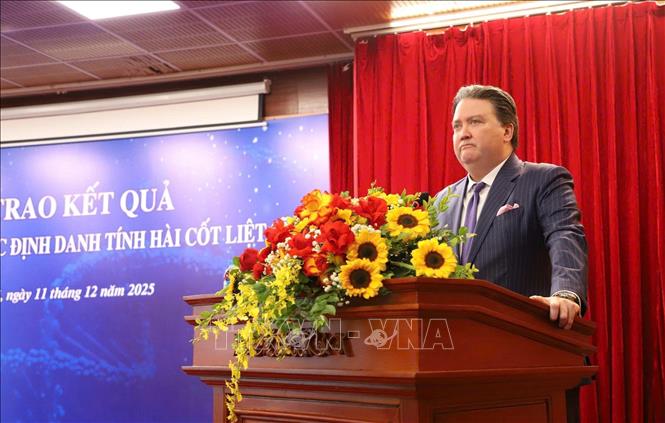
Expressing his delight at the results of the cooperation with the Vietnam Academy of Science and Technology and the Vietnam Agency for Searching for Missing Persons (VNOSMP), Mr. Marc E. Knapper, the U.S. Ambassador to Vietnam, shared: "This is extremely meaningful work for us. DNA analysis technology plays a central role in this process. We are working with the International Committee for Searching for Missing Persons to bring joy to the families of fallen soldiers in Vietnam, helping them close the chapter on their past, just as Vietnam has helped American families."
Speaking emotionally at the ceremony announcing the identities of two martyrs confirmed by new DNA technology, Mr. Tran Van Trung, younger brother of Martyr Tran Van Can (Cao Bang province), said: "Our family has waited many years, longing every day to know the exact location where our loved one is buried. Today, we can finally bring my brother back to his homeland. For our family, the accurate identification of the martyr using scientific methods is an immeasurable joy, affirming our faith and bringing peace of mind to the whole family that the difficult search has ended."
According to the National Steering Committee on the Search, Collection, and Identification of Martyrs' Remains (National Steering Committee 515), there are currently over 300,000 unidentified remains of martyrs nationwide, and nearly 200,000 martyrs whose remains have not yet been collected. Vietnam aims to complete DNA testing for approximately 20,000 samples of martyrs' remains by 2030. The Vietnam Academy of Science and Technology is continuing to closely coordinate with the Ministry of National Defence, the Ministry of Public Security, the Ministry of Interior, the Ministry of Health, and other relevant agencies to expand the application of new technologies at many cemeteries nationwide, contributing to the achievement of the Party and Government's goal of identifying martyrs whose information is incomplete.
Source: https://baotintuc.vn/thoi-su/trao-ket-qua-xac-dinh-danh-tinh-liet-si-bang-quy-trinh-cong-nghe-giam-dinh-adn-20251211165721539.htm

![[Photo] Prime Minister Pham Minh Chinh holds a phone call with the CEO of Russia's Rosatom Corporation.](/_next/image?url=https%3A%2F%2Fvphoto.vietnam.vn%2Fthumb%2F1200x675%2Fvietnam%2Fresource%2FIMAGE%2F2025%2F12%2F11%2F1765464552365_dsc-5295-jpg.webp&w=3840&q=75)


![[Photo] Closing Ceremony of the 10th Session of the 15th National Assembly](/_next/image?url=https%3A%2F%2Fvphoto.vietnam.vn%2Fthumb%2F1200x675%2Fvietnam%2Fresource%2FIMAGE%2F2025%2F12%2F11%2F1765448959967_image-1437-jpg.webp&w=3840&q=75)




































![[OFFICIAL] MISA GROUP ANNOUNCES ITS PIONEERING BRAND POSITIONING IN BUILDING AGENTIC AI FOR BUSINESSES, HOUSEHOLDS, AND THE GOVERNMENT](https://vphoto.vietnam.vn/thumb/402x226/vietnam/resource/IMAGE/2025/12/11/1765444754256_agentic-ai_postfb-scaled.png)











































Comment (0)