


Leveraging the strengths of each locality
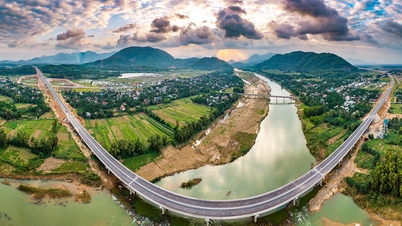
Two years ago, in July 2022, the Eastern Expressway Economic Connectivity Agreement (VEHEC) was signed between the Vietnam Chamber of Commerce and Industry (VCCI) and four localities: Quang Ninh, Hai Phong, Hai Duong , and Hung Yen. This is the first sub-regional connectivity model, aiming to establish a coordination mechanism to optimize resources, exploit the strengths of each province, and enhance inter-provincial cooperation within the VEHEC region, thereby maximizing the economic potential of the area.
VEHEC is a key economic driver in Northern Vietnam, with the entire VEHEC region achieving high GRDP growth rates in recent years, ranging from 9% to 12% annually, higher than the average GRDP of the 63 provinces and cities.
According to Dr. Phan Huu Thang, although the VEHEC agreement has only been in effect for a little over a year, it is clear that effective steps and methods, through specific economic cooperation and connectivity, have initially brought benefits to people and businesses in the four localities.
Building on this initial success, the economic connectivity activities of the four localities in the sub-region will contribute to enhancing the region's competitiveness by mobilizing diverse resources (especially from foreign direct investment - FDI) to support and facilitate sub-regional linkage activities and projects, taking advantage of all the internal and external strengths of each locality.
At the recent Eastern Expressway Industrial Park Forum held in Quang Ninh with the theme "Linking and promoting smart manufacturing supply chains," Mr. Pham Tan Cong, Chairman of the Vietnam Chamber of Commerce and Industry (VCCI), emphasized that Vietnam, as a new manufacturing link in Asia, is increasingly playing an important role in the global smart manufacturing supply chain.
Smart manufacturing is becoming the new trend of Industry 4.0. Two years ago, Ericsson Group predicted that more than two-thirds of global manufacturers would relocate to the Asia-Pacific region by 2025, and Vietnam is considered an attractive destination.
In this context, according to Dr. Tran Thi Hong Minh, Director of the Central Institute for Economic Management Research, industrial parks in VEHEC must also quickly familiarize themselves with, keep pace with, and adapt to new investment trends.
In this context, sustainable development is becoming an urgent, even "irreversible," requirement. Therefore, policy changes cannot stop at the commitment of leaders and action plans, but must be realized at the enterprise and industrial facility levels. This is where the development of eco-industrial parks and the transformation of existing industrial parks into eco-industrial parks becomes crucial.
Industrial park development in general, and along the eastern expressway axis in particular, must contribute more directly and strongly to green growth. It must also significantly improve linkages between businesses, especially between domestic and foreign businesses.
Mr. Pham Duc An, Chairman of the Quang Ninh Provincial People's Committee, also pointed out: Actively participating in global smart supply chains and production chains, and optimizing production and supply chains are essential to enhancing the competitiveness of industrial parks. With the development of digital technology, artificial intelligence, and automation, traditional models are no longer sufficient. A shift in mindset is needed, moving from isolated production to developing interconnected ecosystems that share information and resources, and building smart supply chains.
However, more coordinated policies are needed to develop a smart manufacturing supply chain, according to Mr. Nguyen Le Huy, Permanent Vice Chairman of the People's Committee of Hung Yen province.
And on the business side, it is also necessary to familiarize oneself with and adapt to new trends and prepare thoroughly to firmly establish a foothold in the global arena – Dr. Phan Huu Thang, Chairman of the Vietnam Industrial Park Finance Association (VIPFA), noted.
The entity is a Vietnamese enterprise.
Dr. Phan Huu Thang emphasized: Enhancing the production capacity of Vietnamese enterprises is a prerequisite for them to quickly and firmly enter the global arena in manufacturing and supplying input products to foreign businesses.
The VIPFA chairman noted that the demands of the global supply chain require close collaboration among participating businesses, while these businesses must also effectively manage the flow of information, products, and financial matters to avoid losses and maximize profits throughout the chain.
Another fundamental element in building a robust supply chain now and in the future is the digitalization of the relationships between buyers and suppliers. To achieve this, both buyers and suppliers must have the foundation and conditions to effectively utilize AI (artificial intelligence) and IoT (Internet of Things) technologies, so that the supply chain can quickly pivot to alternative suppliers when disruptions occur.
This also requires Vietnamese businesses wishing to participate in global production and supply chains to possess sufficient high-tech capabilities to meet the demands of the current digitalization phase of the economy.
Another condition that Vietnamese businesses need to meet in order to participate in global production and supply chains is the high-quality workforce with sufficient qualifications to immediately undertake assigned tasks, which is currently severely lacking.
There are currently favorable opportunities for Vietnamese businesses to participate in global production and supply chains. What Vietnamese businesses need to do immediately is overcome existing weaknesses (production capacity, technology, and human resources). Furthermore, businesses need support from the government in terms of appropriate policies and financial mechanisms.
According to Dr. Phan Huu Thang, it is important to recognize that the key players in developing industrial parks along the eastern expressway, linked to global production and business chains, are Vietnamese enterprises. This includes infrastructure investors in industrial parks, businesses within the industrial parks, and even those with foreign direct investment (FDI).
However, most FDI businesses investing in Vietnam already have established markets for their products. But FDI businesses in Vietnam also serve as inputs for the global production and supply chains of Vietnamese businesses. Recognizing this will help shorten the time it takes for Vietnamese businesses to find opportunities to participate in global production and supply chains.
Therefore, Vietnamese businesses focusing on producing and supplying input products for FDI enterprises in Vietnam will be one of the right development directions for Vietnamese businesses to quickly participate in global production and supply chains right here in Vietnam. Thus, improving the production capacity of Vietnamese businesses is a prerequisite for them to quickly and firmly enter the global arena in producing and supplying input products for foreign businesses.
The fact that industrial parks are filling up their allocated land with FDI capital will open up greater opportunities for Vietnamese businesses to participate in production and supply chains right here in Vietnam.
Solutions to quickly fill industrial parks with FDI capital need to be considered specifically and seriously at the local and sub-regional levels, avoiding unhealthy competition among businesses within the sub-region.
NT (according to Cong Luan newspaper)Source: https://baohaiduong.vn/truc-cao-toc-phia-dong-lien-ket-thuc-day-chuoi-san-xuat-thong-minh-401045.html


![[Photo] Prime Minister Pham Minh Chinh holds a phone call with the CEO of Russia's Rosatom Corporation.](/_next/image?url=https%3A%2F%2Fvphoto.vietnam.vn%2Fthumb%2F1200x675%2Fvietnam%2Fresource%2FIMAGE%2F2025%2F12%2F11%2F1765464552365_dsc-5295-jpg.webp&w=3840&q=75)


![[Photo] Closing Ceremony of the 10th Session of the 15th National Assembly](/_next/image?url=https%3A%2F%2Fvphoto.vietnam.vn%2Fthumb%2F1200x675%2Fvietnam%2Fresource%2FIMAGE%2F2025%2F12%2F11%2F1765448959967_image-1437-jpg.webp&w=3840&q=75)




























![[OFFICIAL] MISA GROUP ANNOUNCES ITS PIONEERING BRAND POSITIONING IN BUILDING AGENTIC AI FOR BUSINESSES, HOUSEHOLDS, AND THE GOVERNMENT](https://vphoto.vietnam.vn/thumb/402x226/vietnam/resource/IMAGE/2025/12/11/1765444754256_agentic-ai_postfb-scaled.png)



































Comment (0)