

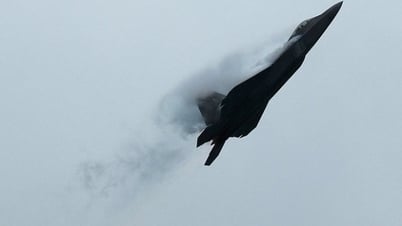
Amidst the escalating race between China and the US to develop stealth aircraft, a Chinese research team has simulated a dogfight between the two superpowers to find ways to win if a real air battle were to occur in the future.
The results show that, with a combination of advanced heavy weaponry and new tactics, China can detect its adversaries first and successfully shoot them down.
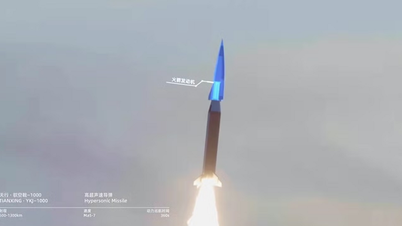
Specifically, in a war-themed computer game, a stealth bomber platform similar to the American B-21 Raider and its accompanying unmanned aerial vehicle (UAV) were both shot down by Chinese air-to-air missiles capable of reaching speeds of Mach 6.
The findings, led by a research team led by Associate Professor Chen Jun at Northwestern Polytechnic University in Xi'an, were published in a report last month in the Chinese aviation journal Acta Aeronautica et Astronautica Sinica.
The report added that if the U.S. launched a counterattack, the battle for control of the airspace between the world's two most powerful nations would be so fierce that "it would take hours for the dust to settle."
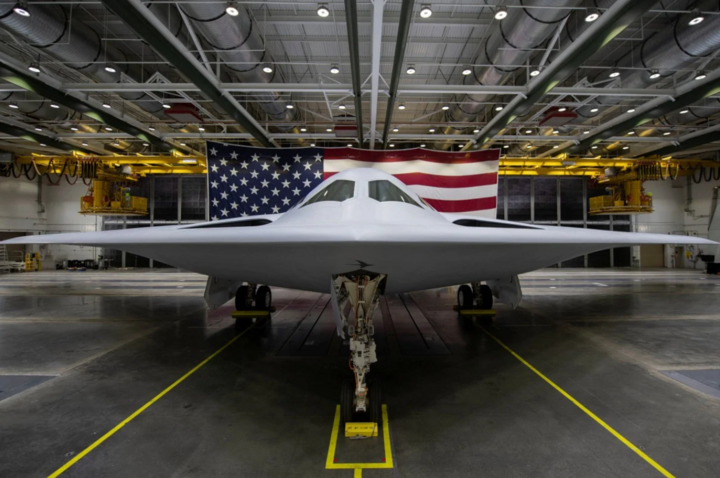
Chinese researchers are seeking ways to counter the new U.S. B-21 Raider stealth bomber. (Photo: U.S. Air Force)
After months of delays, the US Air Force's B-21 Raider stealth bomber, developed by Northrop Grumman, made its maiden flight on November 10th.
The B-21 Raider is incredibly expensive, costing nearly $700 million per aircraft. It has a length of 20m, a height of 5m, a wingspan of 50m, a maximum takeoff weight of 170 tons, a cruising speed of 750 km/h, a top speed of 999 km/h, and a service ceiling of 15,000m.
Although slightly slower than the speed of sound, the B-21 Raider is virtually invisible to all radar systems thanks to its distinctive shape and the advanced polymer coating on its surface.
The B-21 Raider is expected to serve as the "backbone" of the U.S. Air Force's future strategic bomber force.
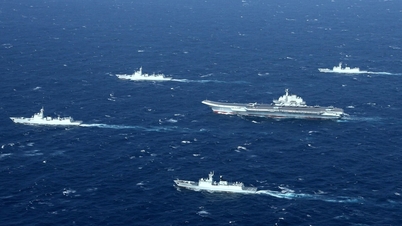
China has established a robust regional anti-access capability, including a large radar network and supersonic anti-ship missiles, to deter foreign interference in the South China Sea.
However, the B-21 Raider is said to have a radar signature as small as a mosquito's. This is considered a serious threat to China's air defenses, which rely heavily on land-based, sea-based, or airborne radar warning systems.
In a conflict, it could penetrate deep behind enemy lines and drop large numbers of missiles or bombs onto the coast, crippling the core defense infrastructure of the Chinese military.
In the team's simulations, the researchers also demonstrated several new capabilities being developed by China. For example, when approaching a virtual conflict zone, a Chinese stealth aircraft switched off its radar and maintained radio silence, but it still surveyed its surroundings using advanced technologies that can pick up electrical or thermal signals from distant targets.
Hua Yu (Source: SCMP)
Source



















































![[OFFICIAL] MISA GROUP ANNOUNCES ITS PIONEERING BRAND POSITIONING IN BUILDING AGENTIC AI FOR BUSINESSES, HOUSEHOLDS, AND THE GOVERNMENT](https://vphoto.vietnam.vn/thumb/402x226/vietnam/resource/IMAGE/2025/12/11/1765444754256_agentic-ai_postfb-scaled.png)















































Comment (0)