

As mentioned, the specific capabilities of China's sixth-generation fighter jet (tentatively called the J-36), which was showcased at the end of December, are still unclear.
Generation 5 is still not complete.
To date, with the J-20 and J-35 variants, China is among the few countries producing fifth-generation stealth fighter jets.
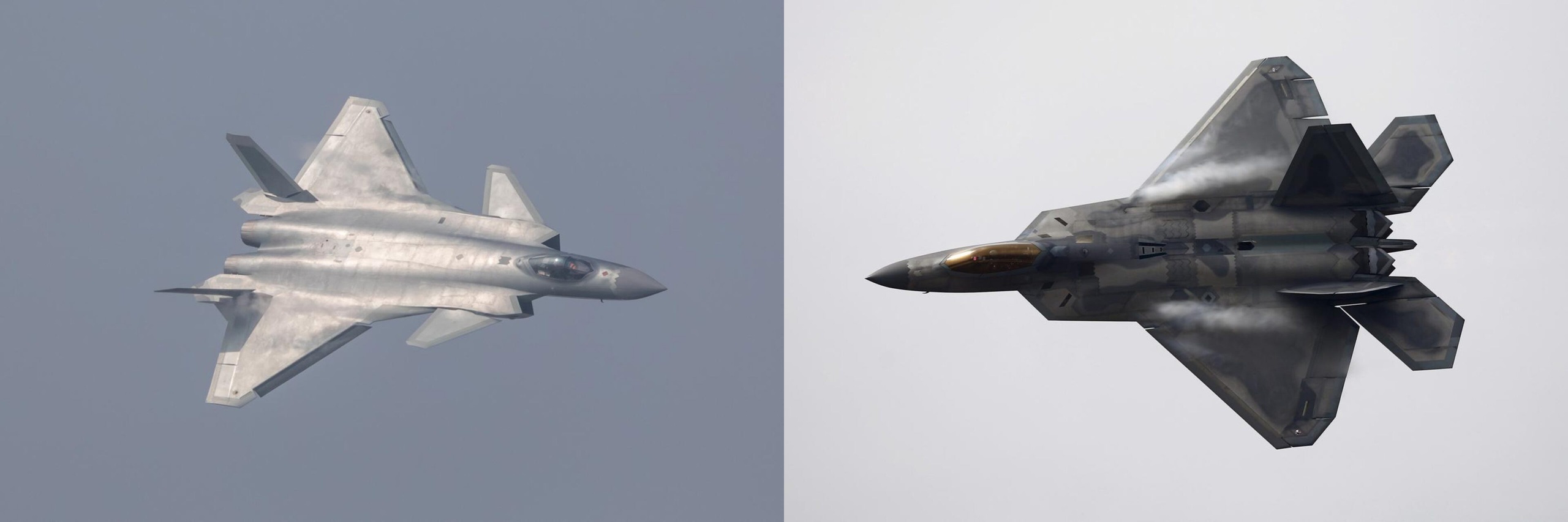
The J-20 (left) and F-22 fighter jets both belong to the 5th generation.
Among these, the J-35 series has yet to be mass-produced. In fact, the J-35 was developed from the FC-31 prototype, which underwent flight testing in 2012. However, it wasn't until nine years later, in 2021, that the J-35 finally underwent flight testing. Considered a naval version, the J-35 features foldable wings and can utilize carrier-based thrusters for takeoff. The J-35A version, intended for the air force, only underwent flight testing at the end of 2023. Therefore, if the timeline from first flight testing to mass deployment takes at least 5-7 years, China still needs more time to reach the stage of mass deployment of the J-35. On the US side, the country has developed three versions of the F-35: a basic version for conventional take-off and landing, a short-take-off/vertical-landing version, and a carrier-based version for short-take-off and landing with boosters.
Moreover, while fifth-generation fighter jets like the US F-22 and F-35 have seen combat for many years, and the Russian Su-57 has recently seen combat in Ukraine, China's J-20 has yet to participate in any combat.
Notably, the American F-22 is the only fighter jet with a supersonic cruising mode, reaching speeds of up to Mach 1.5 (1.5 times the speed of sound). Specifically, to achieve supersonic speed, conventional fighter jets must activate afterburners, which consume a lot of fuel and reduce their combat radius. However, the F-22 can reach Mach 1.5 without activating afterburners, resulting in significant fuel savings compared to other fighter jets, while still maintaining high speeds to quickly approach targets. Due to these significant advantages, the F-22 has not been sold by the United States to other countries to this day.
Therefore, the capabilities of China's fifth-generation fighter jets are still not fully developed according to the goals set by the country, and can hardly be compared to those of the United States.
Air force limitations of the navy
Overall, despite possessing three aircraft carriers to date, their practical capabilities remain limited, resulting in the Chinese navy not yet achieving a breakthrough in air power.
Because a carrier-based version of the J-35 has not yet been developed, China's aircraft carriers still only carry J-15 fighter jets. Of the three aircraft carriers, the Liaoning and Shandong do not yet have aircraft catapults and therefore still rely on upward-sloping takeoff ramps, while the Fujian aircraft carrier, equipped with an electromagnetic catapult system, is still undergoing testing.
Meanwhile, in an interview with Thanh Nien newspaper, Dr. Satoru Nagao (Hudson Institute, USA) assessed that the J-15 still has many issues to overcome when deployed with the Liaoning and Shandong aircraft carriers. The reason is that the J-15 aircraft is too heavy to take off and land on aircraft carriers, while both China's Liaoning and Shandong aircraft carriers are not equipped with aircraft boosters.
Specifically, the J-15 has a maximum takeoff weight of up to 33 tons, while the F/A-18 on a US aircraft carrier has a maximum takeoff weight of 23 tons.
Meanwhile, in addition to being equipped with aircraft catapults, the US Nimitz-class and Ford-class aircraft carriers have a displacement of over 100,000 tons and are more than 330 meters long, which is significantly larger and longer than the Liaoning and Shandong carriers, which have a displacement of approximately 70,000 tons and lengths of 300 and 315 meters respectively. Furthermore, with its short-takeoff and vertical-landing (VTOL) version, the US F-35 fighter jet is also deployed on Wasp-class and America-class amphibious assault ships to operate like aircraft carriers.
Therefore, despite nominally having the second-largest number of aircraft carriers in the world , after the United States, China still lags far behind its rival in terms of naval air force combat capabilities.
Source: https://thanhnien.vn/trung-quoc-co-vuot-qua-my-thong-tri-bau-troi-185250105225550485.htm
![[Photo] Prime Minister Pham Minh Chinh holds a phone call with the CEO of Russia's Rosatom Corporation.](/_next/image?url=https%3A%2F%2Fvphoto.vietnam.vn%2Fthumb%2F1200x675%2Fvietnam%2Fresource%2FIMAGE%2F2025%2F12%2F11%2F1765464552365_dsc-5295-jpg.webp&w=3840&q=75)


























































Comment (0)