

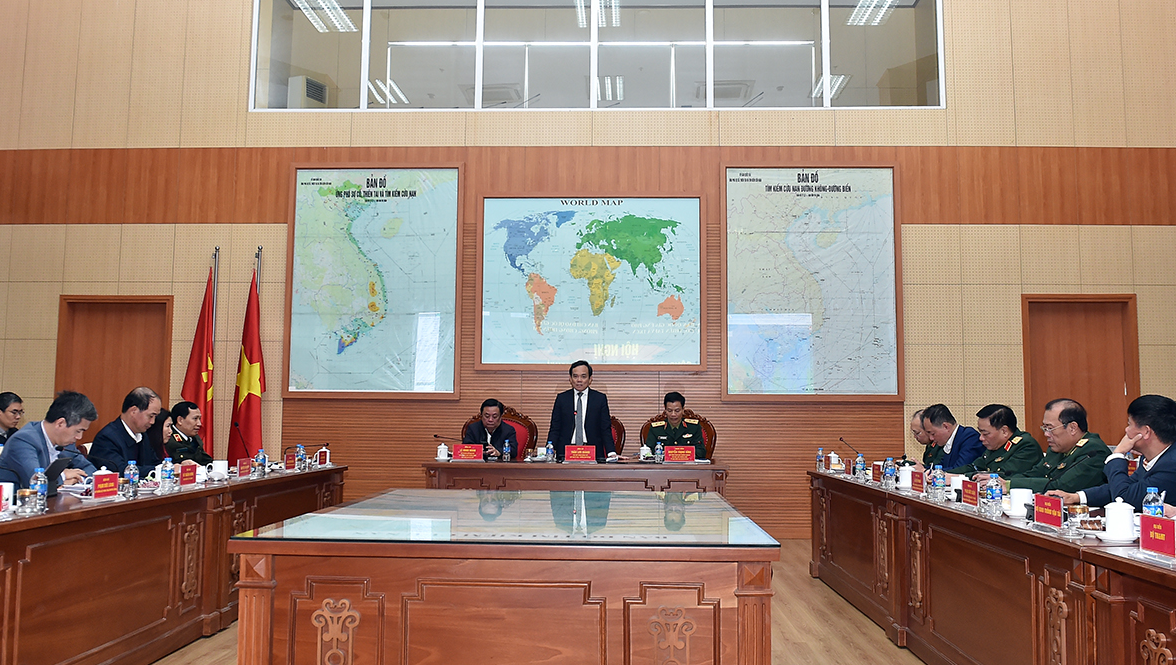
Deputy Prime Minister Tran Luu Quang chaired the conference summarizing the work on disaster prevention, response, and search and rescue in 2023 and outlining key tasks for 2024 - Photo: VGP/Hai Minh
Also attending the conference were Minister of Agriculture and Rural Development Le Minh Hoan; Lieutenant General Nguyen Trong Binh, Deputy Chief of the General Staff of the Vietnam People's Army; leaders of ministries and branches who are members of the National Committee for Natural Disaster Response and Search and Rescue, and the National Steering Committee for Natural Disaster Prevention and Control.
Damage caused by natural disasters is estimated at over 8,200 billion VND.
According to reports presented at the conference, in 2023, the world and the region experienced many major incidents and natural disasters, causing very serious damage to people and property, such as: an earthquake in Turkey; a dam collapse in Libya; historic floods in Beijing, China; and unusually hot weather in the southern United States, the Mediterranean, North Africa, the Middle East, and some Asian countries.
In Vietnam, extreme weather and climate conditions are occurring across all regions, with 21 out of 22 types of natural disasters happening, especially heavy rains causing landslides, flash floods, and widespread flooding, resulting in significant damage to people, property, and infrastructure, and affecting the lives and production of the people.
Statistics from the beginning of 2023 to January 10, 2024 show that nationwide there were 5,331 incidents and natural disasters, resulting in 924 deaths, 205 missing persons, and 977 injuries; 555 vehicles sunk, burned, or damaged; 1,740 houses, factories, market stalls, and 1,346 hectares of forest and vegetation burned.
The incident and natural disaster also damaged 15,977 houses; 115.56 km of dykes, embankments, canals, 711 irrigation works, swept away 179 temporary bridges; damaged 151,279 hectares of rice and crops, 3,547 hectares of aquaculture, 104 cages; killed 75,357 livestock and poultry.
The total economic damage caused by the incident and natural disaster is estimated at approximately 8,236 billion VND, according to the report.
During the same period, ministries, departments, and localities mobilized 204,507 personnel and 23,132 vehicles to effectively respond to and handle 4,336 incidents and natural disasters, rescuing 3,968 people and 207 vehicles.
Ministries, departments, and localities also guided and supported the relocation of more than 962,000 people and over 201,000 vehicles from dangerous areas to safe places; they also called upon, counted, and guided 328,227 vessels/1,608,015 workers to be aware of the developments and movement direction of storms and tropical depressions so that they could proactively take preventive measures.
2023 was the hottest year in recorded history.
According to the General Department of Meteorology and Hydrology (Ministry of Natural Resources and Environment), 2023 was the hottest year in observation history, with global temperatures exceeding pre-industrial levels by 1.45 degrees Celsius. degrees Celsius, approaching the set limit of 2. degrees Celsius in the Paris Agreement adopted in 2015. The rate of global warming is so rapid that the UN Secretary-General has exclaimed that the world is entering an era of global warming.
In Vietnam, 21 out of 22 types of natural disasters have occurred, notably with many short-duration extreme rainfall events where 24-hour rainfall in some areas exceeded 800 mm.
Severe flash floods and landslides occurred in Sa Pa and Bat Xat districts, Lao Cai province; and landslides occurred at Bao Loc Pass and Da Lat City, Lam Dong province.
A scorching heatwave with record-breaking temperatures was recorded in Tuong Duong (Nghe An province) at 44.2°C. degrees Celsius, this is also the highest daily temperature ever recorded in the entire country.
In 2024, more typhoons may form directly over the South China Sea.
The General Department of Meteorology and Hydrology forecasts that the El Nino phenomenon (warm phase) will continue until mid-2024 and reach its peak, meaning that 2024 could be the 10th consecutive year with the highest global average temperatures and more unusual natural disasters.
The General Department of Meteorology and Hydrology warns of the risk of water shortage in the Northern, Central Highlands, and Southern regions during the first half of the year, and in the Central region during June, July, and August. Heatwaves in the Southern, Northwest, and Central regions are likely to arrive earlier and occur more frequently than the multi-year average.
The El Niño phenomenon will shift to a neutral state in the middle of the year, followed by the emergence of La Niña, therefore, storm and tropical depression activity is likely to be more concentrated in the latter half of the year.
In particular, storms and tropical depressions will form more frequently in the East Sea, with the storm structure in the East Sea forecast to account for 1/3 of the total number of storms. This means that storm prevention and control will have to be carried out more quickly and urgently because storms in the East Sea will impact the mainland very quickly.
Along with that, thunderstorms and short heavy rains appear more frequently, causing landslides in mountainous areas and urban flooding.
Cold fronts are not very active, but there are periods of strong cold air, causing severe cold and frost over a wide area, with ice and snow in the mountainous regions of Northern Vietnam.
Severe cold weather will last until the end of January.
Due to the influence of the strongest cold air mass of the 2023-2024 winter season, widespread severe cold weather is currently occurring in Northern Vietnam and the central provinces, with average daily temperatures below 13°C. With temperatures dropping to 6 degrees Celsius, frost has occurred in many mountainous areas in the north, such as Lang Son, Cao Bang, and Quang Ninh.
The forecast indicates that this period of intense cold may last until around January 28th, with the lowest temperatures in Northern Vietnam generally ranging from 8-10 ° C, and in mountainous areas of Northern Vietnam from 3-6°C. degrees Celsius, with temperatures in some high mountainous areas dropping below 0 degrees. degrees Celsius; temperatures in the North Central region commonly range from 9-11 degrees. degrees Celsius; Central Vietnam region: 12-15 degrees Celsius degrees Celsius.
Additionally, due to the influence of the cold air mass, the sea areas in the East Sea region will experience strong easterly winds of force 6-7, in some places force 8, gusting to force 9; waves will be 2-5 meters high, and rough seas will persist for several days.
Speaking at the conference, leaders of ministries and sectors focused on highlighting difficulties, obstacles, and limitations, while also proposing solutions to improve disaster prevention, control, and rescue efforts in 2024 and subsequent years.
Ministries and agencies emphasized the need for a roadmap to invest in and procure equipment for disaster prevention, response, and rescue operations; to provide more timely information to the press so that information and communication work can be one step ahead; to have solutions to increase the coverage and quality of forests to conserve water; and to decentralize fire prevention and control to local levels.
Minister of Agriculture and Rural Development Le Minh Hoan proposed strengthening the application of science and technology, including remote sensing, artificial intelligence, and big data, in disaster prevention, response, and search and rescue operations.
We must absolutely not be complacent in disaster prevention and control.
Concluding the conference, Deputy Prime Minister Tran Luu Quang assessed that the National Committee, the National Steering Committee, and its members proactively implemented and directed the tasks, successfully completing the assigned duties and contributing to minimizing damage to people and property.
Agreeing with the key tasks of the National Committee and the Steering Committee for 2024, the Deputy Prime Minister once again emphasized the absolute need to avoid complacency in disaster prevention and control, given the forecast of continued unpredictable weather changes, with hot weather at the beginning of the year and storms at the end of the year.
The Deputy Prime Minister requested ministries, branches and units to focus on reviewing institutional problems related to assigned functions and tasks in the work of preventing, combating and overcoming the consequences of natural disasters, and search and rescue in order to promptly amend them to suit practical requirements.
Ministries, departments, and localities must adhere to the principle of prevention over response. To achieve this, they must provide timely information and guidance to the public, including via text messages, so that people can protect themselves and gradually build awareness to participate in disaster prevention, mitigation, and search and rescue efforts.
At the same time, regular inspections and monitoring must be conducted at the grassroots level; attention should be paid to training basic skills for functional forces at the grassroots level; and good coordination should be ensured in drills, disaster prevention and control, and rescue operations. Drills must be realistic, economical, and avoid ostentation and formality.
Ministries and sectors strengthen international cooperation to learn from experience and mobilize external resources; increase the application of science and technology to improve the effectiveness of natural disaster prevention, mitigation, and search and rescue.
Agencies and units must manage, allocate, and utilize equipment rationally, economically, and efficiently, while proactively proposing the procurement of necessary equipment; and proactively proposing amendments and additions to regulations related to the management, allocation, and use of equipment.
Source
























![[Photo] Prime Minister Pham Minh Chinh holds a phone call with the CEO of Russia's Rosatom Corporation.](/_next/image?url=https%3A%2F%2Fvphoto.vietnam.vn%2Fthumb%2F1200x675%2Fvietnam%2Fresource%2FIMAGE%2F2025%2F12%2F11%2F1765464552365_dsc-5295-jpg.webp&w=3840&q=75)















































Comment (0)