When teachers face legal consequences due to a lack of legal knowledge.
Mr. Tran Van Tam, Principal of Tam Giang Tay Secondary School in Ca Mau , received a 7-year prison sentence for embezzling 10.7 million VND while making thrift-saving supplies for the school. Mr. Le Van Hiep, a teacher at Vi Thanh Specialized High School in Can Tho, received a 3-year prison sentence for stealing his own vehicle after the person who hired him took it to pawn it.
Mr. Tran Van Tam only took over as principal in July 2022. Seeing the school's lack of facilities, and with a sense of responsibility and welding skills, he personally purchased materials and hired additional workers to make filing cabinets, TV stands, wire ladders, etc. The clear purpose was to save money for the school, as making things by hand is always cheaper than buying finished products. These items are still in use at the school today.
However, the problem was that the teacher did not have a valid invoice. To legitimize the payment procedure, he purchased a fake invoice from an external business. According to the investigating agency, the difference between the actual cost and the amount on the invoice, which was 10.7 million VND, was determined to be embezzlement of property under Article 353 of the Penal Code.
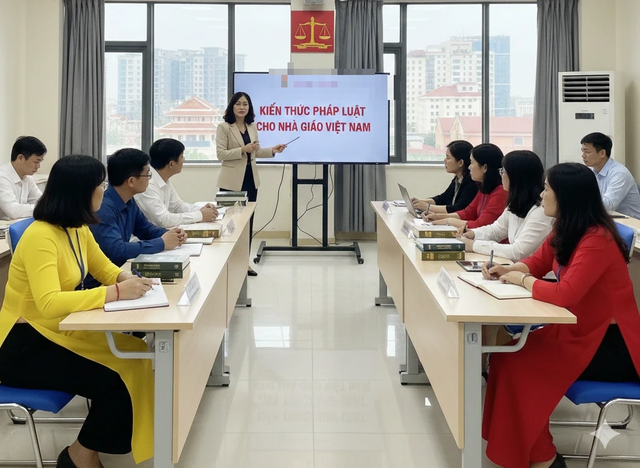
Protecting teachers is not just about increasing salaries and allowances, but also about equipping them with legal "armor" to protect themselves in their daily work.
Photo: TN created using AI
Mr. Le Van Hiep is a master's degree holder and a long-time model worker. To improve his life, he started a self-drive car rental business. The tragedy began when a renter failed to return the car and instead pawned it for 100 million VND. Upon discovering his car had been dismantled and was at someone else's house, due to anxiety and a lack of legal knowledge, he took matters into his own hands and asked someone to retrieve the car instead of reporting it to the police. This act was deemed by the prosecuting authorities as illegal trespass and theft of property under Article 173 of the Criminal Code, even though the car was his own property. After two trials, Mr. Hiep was sentenced to 3 years in prison.
Both teachers excelled in their teaching expertise. They possessed a thorough understanding of textbook knowledge and were proficient in pedagogical methods, but they lacked knowledge of basic legal regulations in everyday life.
Mr. Tâm was unaware that, according to regulations on state financial management, all expenditures must be supported by valid invoices and documents. Purchasing fictitious invoices, even with the intention of legitimizing legitimate expenses, is considered a serious violation and could constitute embezzlement if the perpetrator holds a position of authority managing state assets.
Mr. Hiep doesn't understand that even though the car is his property, if it's in the hands of a third party (even if that person is possessing it illegally), taking it back without going through the authorities can still be considered appropriation and trespass. The law requires reporting to the police so that the competent authorities can handle the matter according to the proper procedures.
These are not highly specialized or complex legal concepts, but rather basic regulations that anyone involved in managing public assets or conducting business needs to know. However, reality shows that there is a significant gap in legal knowledge among teachers.
Heavy losses



The 2012 Law on Dissemination and Education of Law clearly stipulates the responsibilities of agencies and organizations in disseminating and educating about the law. The 2025 Law on Teachers (effective from January 1, 2026) also emphasizes the training and professional development of teachers. However, in reality, teacher training programs mainly focus on pedagogical skills and teaching methods. Meanwhile, content on law, especially regulations on public financial management and property rights, is very limited.
Teachers are highly trained in teaching methods and student psychology, but they lack specific guidance on proper school procurement procedures, how to create valid invoices and documents, and how to handle theft or misappropriation of assets. For teachers holding managerial positions such as principals and vice-principals, this lack of knowledge regarding public finance law is even more serious. They manage the budget and approve expenditures but lack the necessary knowledge to follow the correct procedures. The result is either cumbersome and difficult processes, or shortcuts that lead to legal trouble, as in the case of Mr. Tâm.
It is undeniable that both teachers violated the law. Teacher Tam purchased fake invoices, and Teacher Hiep took the vehicle without reporting it; these are both wrongful acts that need to be addressed.
But are a 7-year prison sentence with a fine of 10.7 million VND, or a 3-year sentence for reclaiming one's own property, appropriate to the nature of the act, its motives, and the actual consequences? National Assembly representative Vu Trong Kim used the phrase "right in principle, wrong in law" to describe these two cases, where people did what was morally right but wrong legally because they didn't understand the regulations.
Fortunately, the law also recognized this. The Ca Mau Provincial People's Court overturned the initial verdict against Mr. Tam, ordering a reinvestigation, emphasizing the need to appraise all the products he produced and verify the purpose of the money. Mr. Tam was released on bail after more than a year in detention. As for Mr. Hiep's case, after a National Assembly representative made a recommendation, it received attention from the Can Tho National Assembly delegation to consider a fair and reasonable solution. However, the losses suffered by the two teachers, such as the time spent in detention, the damage to their reputation, and the interruption of their careers, cannot be remedied.

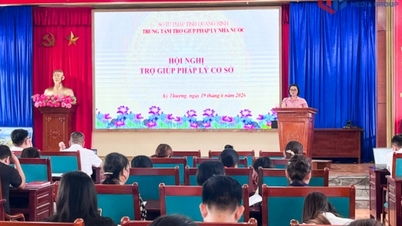
There is a need for legal advisory departments at provincial Departments of Education and Training, ready to support teachers when they encounter legal issues.
Photo: TN created using AI
Teachers need to be equipped with legal "armor" to protect themselves.
The cases of Mr. Tam and Mr. Hiep serve as a wake-up call, highlighting that protecting teachers is not just about increasing salaries and allowances, but also about equipping them with legal "armor" to protect themselves in their daily work. When a teacher is sentenced to 7 years in prison for trying to save money for the school, and another to 3 years for reclaiming his vehicle, it's clear that something in the current legal education system is lacking.
Teachers are the ones who impart knowledge and guide the values of the younger generation. But how can they educate students about legal awareness when they themselves lack basic legal knowledge? It's time we placed legal education for teachers on par with pedagogical training, making it a mandatory and indispensable subject in every teacher's professional development.
Several urgent solutions need to be implemented.
Firstly , make legal education a mandatory component of teacher training courses, especially for management staff. The content should focus on regulations concerning public financial management; procedures for asset procurement; how to prepare and manage invoices and supporting documents; regulations on property rights and how to protect those rights legally.

![Exam Questions and Answers for the 2026 National High School Graduation Exam in Physics [Hints]](https://vphoto.vietnam.vn/thumb/192x108/vietnam/resource/IMAGE/2026/06/12/1781231854009_de-thi-dap-an-mon-vat-ly-tot-nghiep-thpt-2026-nongnghiep-093136.jpeg)

Secondly , develop a specific set of legal guidance materials for teachers using easy-to-understand language, practical examples, and typical scenarios.
Thirdly , establish legal advisory departments at provincial Departments of Education and Training, ready to support teachers when they encounter legal issues. Many violations occur because teachers don't know who to ask for help or are afraid of trouble, so they handle things themselves in a way they think is right.
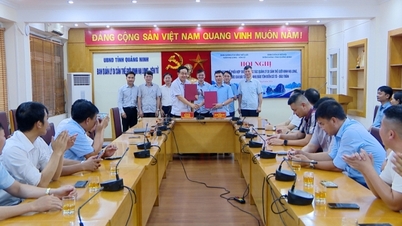
Fourth , there needs to be close coordination between the education and judicial sectors in the dissemination of legal education. This is not only the responsibility of the education sector but also requires the participation of lawyers and judicial officials to ensure accurate and up-to-date content.
Fifth , simplify administrative procedures in school financial management. Many current procedures are too cumbersome, discouraging teachers from following them correctly and leading them to seek shortcuts. When procedures are simple, clear, and easy to implement, the rate of violations will decrease significantly.
Source: https://thanhnien.vn/vi-sao-nha-giao-can-trang-bi-kien-thuc-phap-luat-185251204100014171.htm
![[Image] Paris's oldest bridge goes viral after transforming into a giant cave.](https://vphoto.vietnam.vn/thumb/1200x675/vietnam/resource/IMAGE/2026/06/24/1782283441197_ndo_br_dsc05314-jpg.webp)


![[Photo] Prime Minister Le Minh Hung presides over the thematic session on promoting science and technology development and innovation.](https://vphoto.vietnam.vn/thumb/1200x675/vietnam/resource/IMAGE/2026/06/23/1782207872934_ndo_br_dsc-1724-jpg.webp)