

They diligently carried blackboards, bags of chalk, and a set of patchwork toys and opened a class under the stilt house. They were considered the “first people to teach” in the movement to popularize preschool education at a time when only a few children in the village knew about the class.
Strange story in the village
In the morning in Chuong Cai village (Van Nho commune, Thanh Hoa province), the fog still covers the hillside. Under the stilt house of a household, the babbling of children can be heard mixed with the crowing of roosters and the babbling of a stream in the distance. In the corner of the classroom, a tall and thin teacher, holding a piece of white chalk, writes on a wooden board: "A - Ă - Â".
There were mornings when the cries of the new children in class echoed throughout the mountains. The teacher patiently held one child in his left hand and the other in his right, coaxing and singing at the same time. That was the image of teacher Luong Van Sang (born in 1972, Van Nho commune, Ba Thuoc mountainous district (old), Thanh Hoa province), a teacher at Van Nho Kindergarten more than 30 years ago.
The teacher's classroom was empty on all sides. The children sat close together, wearing thin shirts, barefoot, and holding short pencils. The teacher and students taught and learned amidst the squealing of pigs and the running of chickens nearby.
On rainy days, the water blew inside, so the teacher made the children sit in a corner. On cold days, the teacher lit a charcoal stove in the middle of the classroom, and taught while drying the students' clothes.
At that time, young teacher Luong Van Sang had just finished high school. He diligently went from house to house, crossing several streams and hills, convincing parents to let their children go to school. He fell many times because the mountain road was slippery, it was raining heavily, and leeches clung to his feet. No one expected that this classroom would be the first place to sow the dream of literacy for the entire village.
“Many people say that children don’t know anything, so why go to school? I laugh and say, ‘If they know how to read and write, they will be free from suffering in the future.’ Not only should we teach them how to read and write, but we should also teach adults to believe in them,” he said, his voice dropping.
Then the teacher told me that when he first opened the class, every morning he used bamboo as chairs for the children to sit and study. It was called a classroom for show, but it was actually just a corner under the stilt house. One day, when the mother was busy working in the fields, the teacher carried the child to class. “When he slept, I used my coat as a pillow. When he woke up, I taught him to sing 'Con chim non',” Mr. Sang said, his voice both proud and nostalgic.
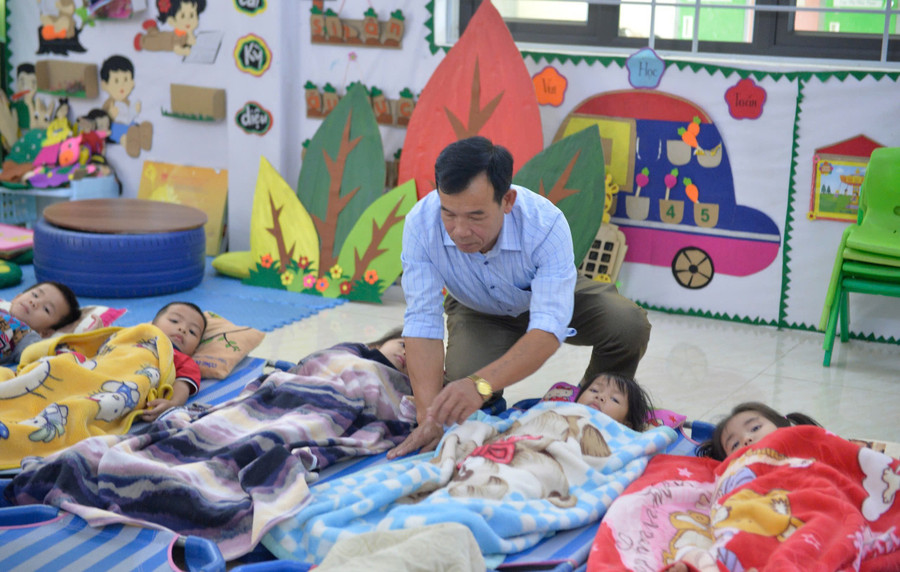
After two years of volunteering to teach preschool children, Mr. Sang mobilized the youth in the commune to teach. Then, in a short time, 16 villages with 15 classes were established, mainly taught by male teachers.
In those days, people were used to seeing men working in the fields and women taking care of the housework. So, when young men like Mr. Luong Van Sang opened a kindergarten class, the whole village was surprised. At first, people were hesitant, but gradually, seeing the children clinging to the teacher and the teacher taking care of them like his own children, everyone wanted to send their children to class.
Being persuaded by his nephew to teach, Mr. Ha Van Hac (born in 1970, uncle of teacher Sang) immediately accepted. "At that time, I just thought that if I did not volunteer to teach, the children would grow up uneducated, so I agreed to follow my nephew to class", teacher Ha Van Hac - teacher of Van Nho Kindergarten recalled.
“The classrooms were located under the floors of local houses, with wooden pillars, low floors, damp ground, and a few old planks used as desks. The blackboard was a burnt piece of wood that had been wiped clean with soot. In those days, it was rainy and windy, and the cold was piercing. But just hearing the children’s voices made me feel warm inside,” said Mr. Hac.
The children came to class barefoot, with patched clothes. Some fell asleep while studying, but the teacher patiently taught them each letter and song every day. The village teachers, some of whom had not yet finished high school, went to school one day and taught the other. Many days, the teacher taught while cooking rice mixed with cassava to share with the students.
In the early 1990s, not only Mr. Sang and Mr. Hac in Van Nho commune, teachers in remote villages of Thanh Hoa mountainous region such as Ky Tan, Thanh Xuan, Thanh Son, Dien Ha... also volunteered to teach preschool children.
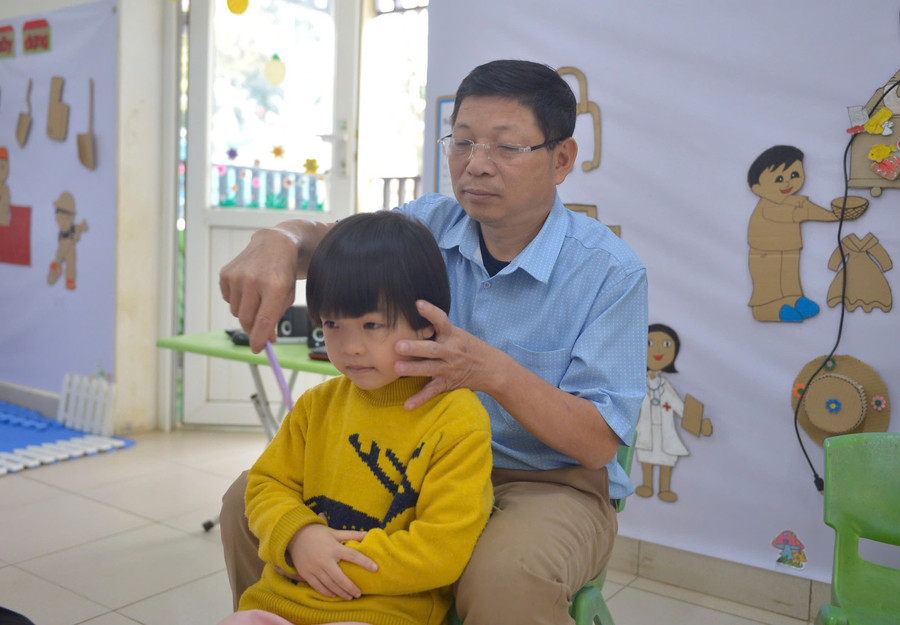
Being a teacher and a father
In the village, many people still affectionately call the teachers "classroom fathers" because outside of teaching hours, they also put children to sleep and mend torn clothes for them.
With more than 30 years of experience in teaching preschool children, teacher Ha Van Anh - a teacher at Ky Tan Kindergarten (Van Nho commune, Thanh Hoa) cannot forget the first days he was sent to teach. That year, teacher Ha Van Anh was not yet married, but every day he sewed torn clothes for his students, comforted the new children who were not used to the class, and asked for each shirt for his students in the cold weather...
“There was a 3-year-old child whose parents worked in the fields all day long, and he only had one old shirt. I asked people in the village to donate fabric to make him a new shirt. Seeing him wear it to class, smiling broadly, I felt so sorry for him,” Mr. Anh recalled.
Then the story of dirty children coming to class without sandals. Every day, Mr. Vi Van Duong - a teacher at Thanh Quan Kindergarten (Thanh Xuan commune, Thanh Hoa province) walked a kilometer through the forest to get water to bring back to bathe his students, which he still remembers to this day.
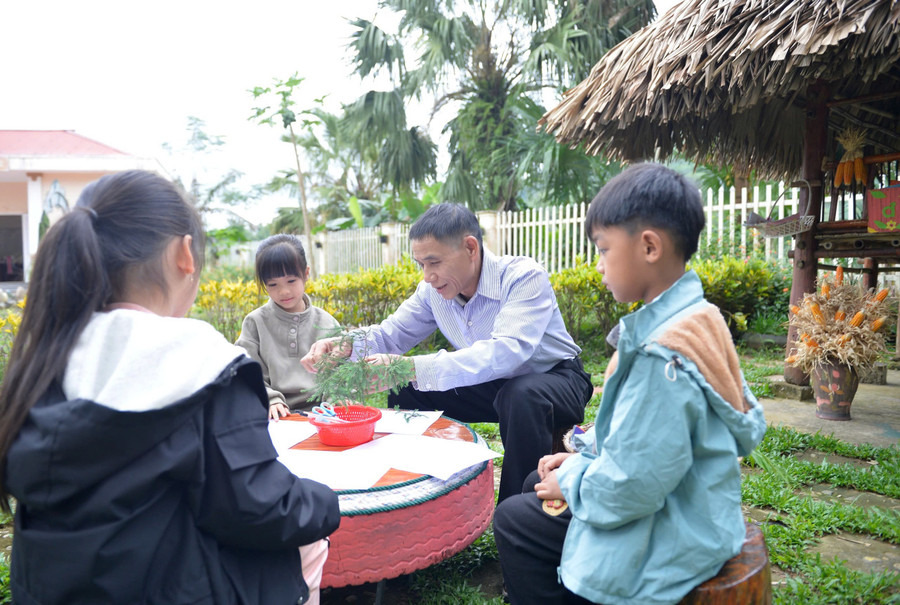
The story of babysitting from morning until night before the parents came to pick him up is something Mr. Duong will never forget.
“Over the past 30 years, I have never forgotten the hardships and difficulties. Back then, I was poor, and my students were also poor. There were days when I felt sorry for my students who came to class hungry, so I cooked porridge and brought it along, and each child had a little to warm their stomachs and stop crying. There was a time when parents went to the fields until dark and still did not pick up their children. I brought my students home to look after them, feed them, and let them sleep until 9-10pm before seeing their parents come to pick them up. We, the preschool teachers, are not only teachers but also fathers,” Mr. Duong sadly recalls.
A preschool teacher's job is not only songs and stories, but also wiping away tears, holding feverish children in their arms, running back and forth when it rains and windy so parents are late to pick them up, shouldering the responsibility of "being both a teacher and a parent".
It was those difficult days that illuminated the image of the teacher who not only imparted knowledge, but was also a loving support for the childhood of poor children.
Even though decades have passed, the stitches of mending clothes, the baths for students in the cold weather… are still proof of devotion. And in the memories of many generations, preschool teachers are always the silent “fathers”, sowing the seeds of love and kindness in life.
“When I went to primary preschool, I also received a notice of admission to Thanh Hoa Pedagogical College. If I went to college, I would teach secondary school. But I did not change my mind and still chose preschool. At that time, I did not think that teaching preschool children was special, hard, difficult, and more suitable for women. I only thought about how to help children in the village go to school, learn to read and write, and at any level, I would be the teacher to convey the knowledge to the students,” said teacher Luong Van Sang.
Source: https://giaoducthoidai.vn/nhung-ong-bo-mam-non-giua-dai-ngan-gioi-chu-duoi-gam-nha-san-post759144.html

![[Photo] Cat Ba - Green island paradise](/_next/image?url=https%3A%2F%2Fvphoto.vietnam.vn%2Fthumb%2F1200x675%2Fvietnam%2Fresource%2FIMAGE%2F2025%2F12%2F04%2F1764821844074_ndo_br_1-dcbthienduongxanh638-jpg.webp&w=3840&q=75)































![[VIMC 40 days of lightning speed] Hai Phong Port determined to break through, reaching the target of 2 million TEUs by 2025](https://vphoto.vietnam.vn/thumb/402x226/vietnam/resource/IMAGE/2025/12/04/1764816441820_chp_4-12-25.jpeg)








































Comment (0)