

Continuing the cultural and religious traditions of their ancestors from centuries past, when a king died, regardless of the reason, the Champa dynasty had the responsibility to sculpt a statue of the monarch to commemorate his contributions for future generations.
Statues of kings were placed in temples and, in later periods, in shrines; therefore, Cham sculpture was closely linked to architecture, serving architectural works and religious activities. One of these beautiful and valuable stone sculptures is the statue of King Po Nrop (1651 - 1653) located in the shrine of Tuy Tinh 2 village, Phong Phu commune, Tuy Phong district.
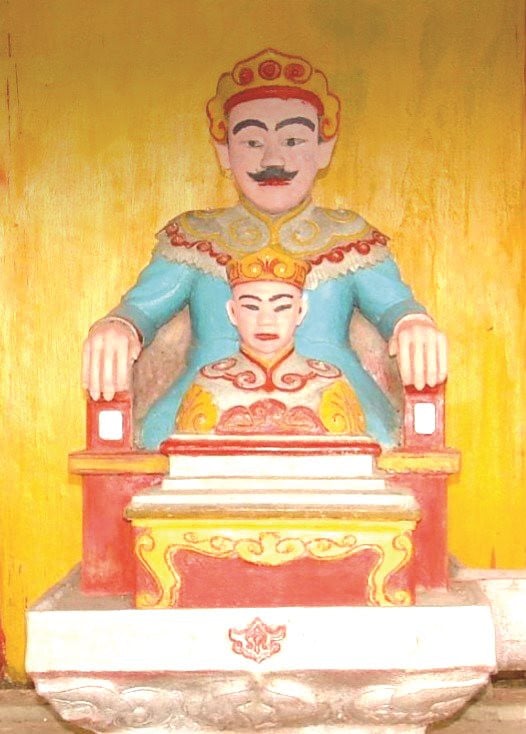
Temple of the Cham king Po Nrop
In the 1980s, few people knew about this temple because the road to get there was very difficult, and accessing the temple itself was challenging. I've been there three times, but only managed to enter the temple once with my old black-and-white Seagull camera from 1960. Even then, I could only find limited and somewhat confusing information because the folk legends of the Cham people in this area varied greatly, and there wasn't much information in books or about this king.
Combining field surveys and accounts from local Cham elders and intellectuals with folklore and handwritten documents, it is known that the temple is located on the top of a hill more than 10 meters above the Tuy Tinh residential area, where the Cham descendants of the deity live. Before 1945, the Cham people here resided in an old village called Bah Plom, about 1.5 km from the current Cham village.
Po Nrop was the half-brother of King Po Rome (1627-1651) – when speaking of Po Nrop, one must mention King Po Rome. Because he ruled the Champa kingdom for 27 consecutive years (1627-1651), Champa history through generations has never forgotten and praised him as a king with many achievements in the development of the nation in all fields such as: economic development, politics , diplomacy, and culture... Because of his great contributions, after his death, he was worshipped as a deity by the Champa community.
After King Po Rome's death, his younger brother, Po Norp, ascended the throne. During his lifetime, he had served as a general under the reign of King Po Nit (1603-1613). He reigned from 1652 to 1653. Po Norp's short reign coincided with fierce and continuous warfare with Lord Nguyen Phuc Tan of Dai Viet.
Because he intended to reclaim the territories previously lost to the Nguyen lords, primarily Phu Yen, Po Nrop, despite not having fully recovered his strength from previous defeats, quickly led his army across Dai Lanh to attack and harass Phu Yen province after only one year as Champa king in the year of Quy Ty (1653). Being in a position of strength, Lord Nguyen Phuc Tan sent Hung Loc, a talented general, to Phu Yen to quell the rebellion. The Champa army was defeated and forced to retreat. General Hung Loc pursued them across the border via Ho Duong Pass (Thach Bi Mountain), chasing them all the way to the Champa capital.
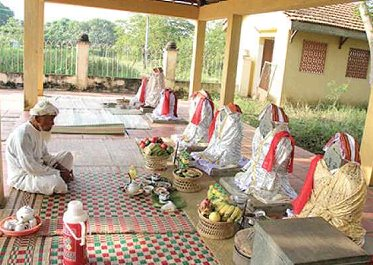
King Po Nrop and his unique statue.
Almost all the ancient architectural relics of the Champa kingdom in Central Vietnam, such as My Son Sanctuary, the tower complexes and museums displaying statues in Quang Nam , Binh Dinh, Khanh Hoa, Phu Yen, Ninh Thuan... are places where many types of sandstone, terracotta, and bronze statues have been discovered and displayed. These materials are carved into extremely sophisticated and vivid patterns, reflecting the unique culture of ancient times, dating from the 7th to the 17th centuries. Absolutely no statue has a concept and style as unique as the statue of King Po Nrop (1651 - 1653) in Panduranga (Ninh Thuan - Binh Thuan). Here, I want to emphasize this unique and rare statue.
In contrast to the temple's architecture and exterior, the interior houses a statue of Po Nrop and his son on a stone Yoni pedestal; behind it are shrines to his grandparents and parents; the right side faces the temple dedicated to Queen Kaphir, and the left side is dedicated to those in his family who died "unfortunate deaths."
The strange thing about the statue is that it shares a single base but depicts two figures: King Po Nrop, who is taller, and his son, Cei Sit Kahôông, in front of his stomach. All the details of the two statues are the same, the only difference being that the father has a mustache.
While researching the scientific history of the temple and the statue, during small workshops, the village elders and dignitaries revealed that King Po Norp had the ambition that his son would be the successor to the throne, a fact that would not be debated, and this ambition had to be openly expressed in this unusual pair of statues. The local Cham elders and dignitaries added that in 1947, after demolishing the temple, the French tried to use chains to lift the statue of the king and the prince with a helicopter, but they were unable to do so because the two refused to leave. They took away the beautifully carved stone statues of the king's mother and Queen Kaphia instead.
After consulting the documents of many researchers and visiting Champa relics exhibitions, I have never seen a pair of statues like the one of King Po Norp and his son. King Po Norp's ambition was for Prince Cei Sit Kahôông to succeed him, but this did not materialize, as the successor was King Po Thot (1653-1659). Nevertheless, this was the idea behind the unique and rare statue in the ancient Champa stone sculpture art.
In a published study (Inventaire descriptif des monuments cams de l'Annam), the French archaeologist Henri Parmentier described: “The statue is carved on a vertical slab of stone decorated with floral patterns along the edges, a line of four-leaf roses. The slab has the shape of a common kút (a type of bamboo basket), with a sharp edge on the back. A particularly attractive feature of this statue is that in front of it is a part of the body, a smaller half-body, but the head is identical; according to the Cham people, this is a symbolic representation of a son…”
According to documents by Cham cultural researcher Kinh Duy Trinh: “Po Norp ascended the throne in the year of the Water Dragon (1652-1653), reigning for two years in the capital Pangduranga. Inside the temple is a statue of Po Norp seated on a high pedestal, with a statue of his son, Cei Sit Kahôông, in front of him. In front of the temple entrance is a set of Linga and Yoni dedicated to the deity Ginôr Patri. According to ancient texts, Po Norp was born in the year of the Ox and was the younger brother of Po Rome.”
Visiting the temple and statues at any time, people will admire the skill of the Champa artists, who brilliantly demonstrated their intellectual prowess in these stunning sculptures with intricate patterns reaching the pinnacle of artistic creation, offered to their revered king. Many researchers have commented that the statues of King Po Norp and his son are as large and beautiful as those from the Champa kingdom's heyday.
Source











































































Comment (0)