

On the afternoon of October 23, the Chairman of the Economic Committee, Vu Hong Thanh, presented to the National Assembly the mid-term review report on the implementation of the socio-economic development plan and the economic restructuring plan for the period 2021-2025.
Lending to "backdoor" businesses is still complicated.
Looking back at the first half of the term, Vietnam has basically overcome difficulties and challenges, achieving important and fairly comprehensive results, which have been recognized both internationally and domestically.
However, according to the Economic Committee, the economic structure has not changed much; productivity, quality, efficiency, and competitiveness remain low, with average labor productivity increasing by 4.36-4.69% in the three years from 2021 to 2023, lower than the 6.26% of the three years from 2016 to 2018. The self-reliance and resilience of the economy are still limited.
The auditing agency suggested that the Government pay more attention to and make a clearer assessment of the continued difficulties in industrial production, noting that the average Industrial Production Index (IIP) for the manufacturing sector in 2021-2023 was approximately 5.3%, significantly lower than the 12.5-13% target of the five-year plan.
The quality of state budget revenue collection still lacks sustainability, with revenue surpluses mainly coming from land use fees and crude oil; compared to the budget, revenue from crude oil exceeded the target by VND 21,400 billion in 2021 and VND 49,800 billion in 2022; revenue from land use fees in both 2021 and 2022 exceeded the target by approximately VND 74,000 billion. Attracting new FDI, high technology, core technologies, and technology transfer faces many difficulties. Public investment disbursement did not meet the plan.
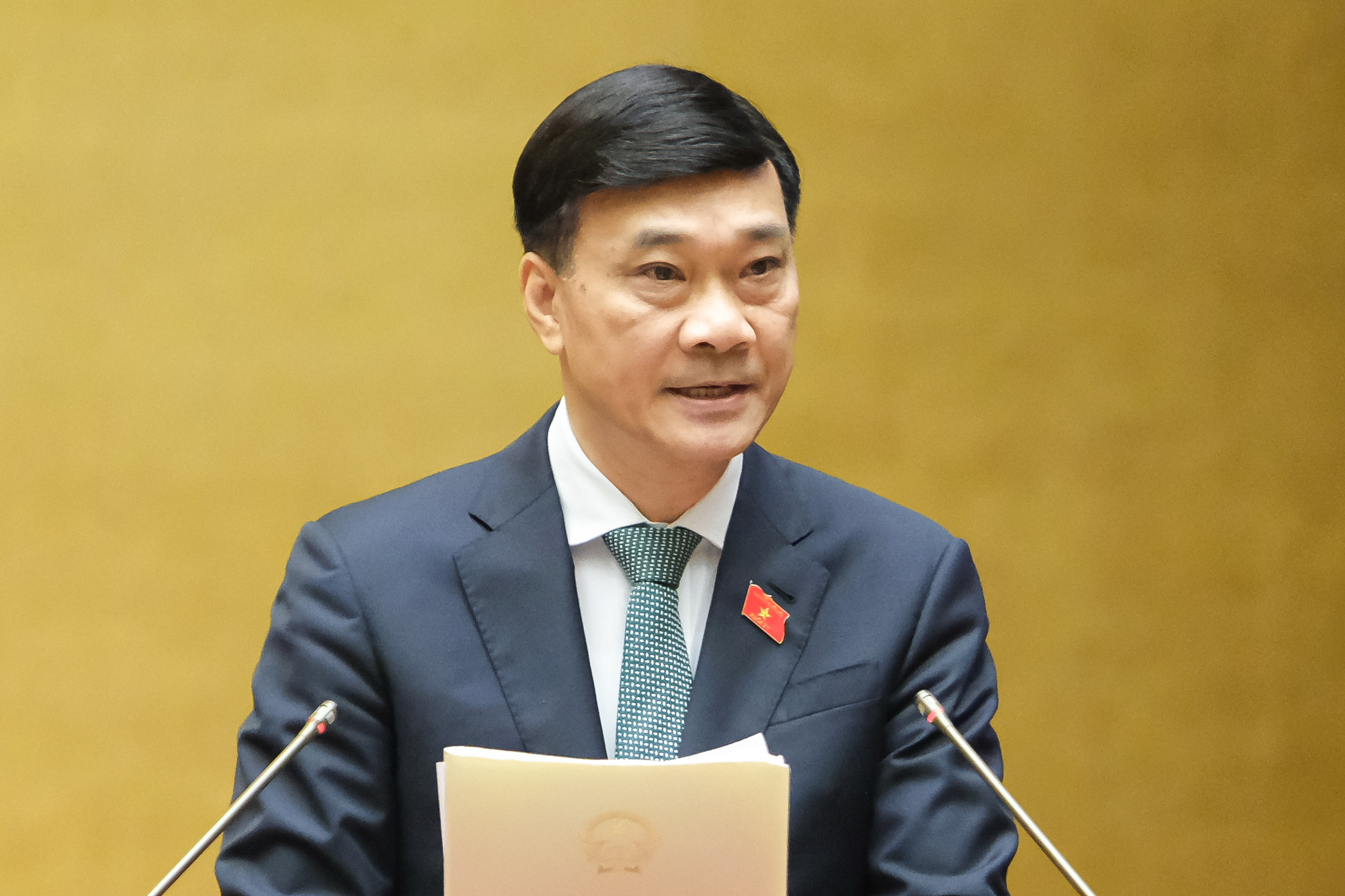
Chairman of the Economic Committee Vu Hong Thanh (Photo: Quochoi.vn).
Institutional development and improvement remain limited, and the backlog of detailed regulations for laws and ordinances has not been completely resolved. Institutional frameworks for new issues and business models, including the digital economy, circular economy, and green growth, need to be reported more clearly, according to the reviewing agency.
During the mid-term review of the implementation results of the Economic Restructuring Plan for the period 2021-2025, Chairman Vu Hong Thanh requested the Government to pay attention to and evaluate several issues.
In particular, the tasks and solutions for restructuring the economy have not been widely implemented, have not brought about significant changes, and risk missing development opportunities; in particular, 36.3% of the tasks have not yet completed the issuance of documents, programs, and projects for implementation.
The coordination mechanisms among ministries, sectors, and localities in implementing some assigned tasks are still inadequate; some tasks, although implemented, yield measurable results that are not yet clearly visible, such as human resource development, development and promotion of technology transfer, innovation, development of the private sector, and restructuring of the public sector.
The auditing agency also pointed out that the management capacity and efficiency of credit institutions are still limited; the situation of "cross-ownership," misvaluation of collateral assets, and lending to "internal" or "backdoor" businesses remains complex. The process of handling weak banks and restructuring banks through "mandatory acquisition" faces many difficulties regarding the legal framework and support mechanisms.
"The task of developing various types of markets and improving the efficiency of resource allocation and utilization is still limited, largely due to the slow completion of institutional frameworks for the markets of factors of production, which have not yet served as signals for resource allocation in the economy. We propose that the Government further clarify these issues," Mr. Vu Hong Thanh stated, expressing the viewpoint of the reviewing agency.
Complete the restructuring of 4 key areas.
For the remaining years of the 2021-2025 term, the Economic Committee emphasized several key tasks and solutions, such as closely monitoring the international economic and financial situation; proactively analyzing and forecasting developments in international markets to have appropriate and proactive response scenarios.
Focus on and accelerate the process of institutional reform, including removing barriers, emphasizing policy implementation and coordination; organize the rapid and effective implementation of laws, resolutions, mechanisms, and policies after their promulgation.

According to the Economic Committee, the process of handling weak banks and restructuring banks through "mandatory acquisition" is facing many difficulties.
Implement decisively appropriate solutions to promote the disbursement of public investment capital, the socio-economic recovery and development program, the three national target programs, national key projects, and key infrastructure projects.
Accelerate the preparation of the North-South high-speed railway project, develop energy and digital infrastructure in conjunction with enhancing internal capacity. Ensure robust national energy security, encourage the development of smart grids, renewable energy, and strong participation from the non-state economic sector.
The Chairman of the Economic Committee emphasized the task of effectively and substantively implementing the restructuring of the economy according to the key tasks set out in Resolution No. 31, including resolutely completing the restructuring of four key areas: restructuring public investment, the state budget, credit institutions, and public service units.
“Improve operational efficiency in conjunction with restructuring the business system. Strengthen regional linkages. Build international and regional financial centers in Ho Chi Minh City and Da Nang . Implement decisively the plan to restructure the system of credit institutions associated with handling bad debts in the 2021-2025 period. Focus on implementing plans to address weak credit institutions; loss-making and inefficient projects and businesses,” the auditing agency requested .
Source




















![[Photo] Prime Minister Pham Minh Chinh holds a phone call with the CEO of Russia's Rosatom Corporation.](/_next/image?url=https%3A%2F%2Fvphoto.vietnam.vn%2Fthumb%2F1200x675%2Fvietnam%2Fresource%2FIMAGE%2F2025%2F12%2F11%2F1765464552365_dsc-5295-jpg.webp&w=3840&q=75)
















































Comment (0)