

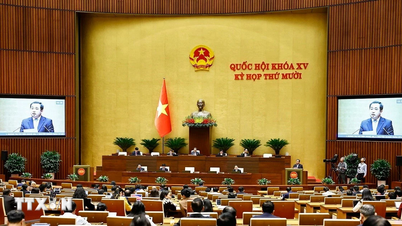
On the morning of December 5, in the discussion session at the 10th Session of the 15th National Assembly, chaired by National Assembly Chairman Tran Thanh Man and directed by National Assembly Vice Chairman Vu Hong Thanh, delegates focused on analyzing the investment policy of the National Target Program (NTPP) on new rural areas, sustainable poverty reduction and socio-economic development in ethnic minority and mountainous areas by 2035.
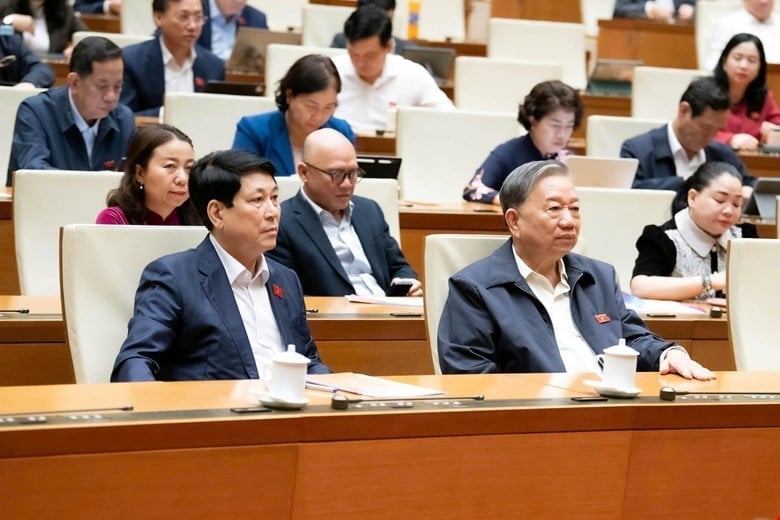
General Secretary To Lam and President Luong Cuong with National Assembly deputies at the session. Photo: Quochoi.vn.
The consolidation of three current target programs into one comprehensive program is considered an institutional breakthrough, helping to overcome the situation of resource dispersion and budget overlap. However, the problem of structure and the ability to allocate capital sources is creating many concerns, especially when the counterpart burden is at risk of being placed on the shoulders of poor localities - which are the core areas of difficulty.
The central budget is not commensurate with its "leading" role.
According to the Government 's Report, the total capital demand for the 2026-2030 period is estimated at about 500 trillion VND. However, the way the capital is allocated is causing many delegates to worry about the leading role of the central budget, especially for the main beneficiary areas such as mountainous areas and ethnic minority areas, where the budget is always tight.
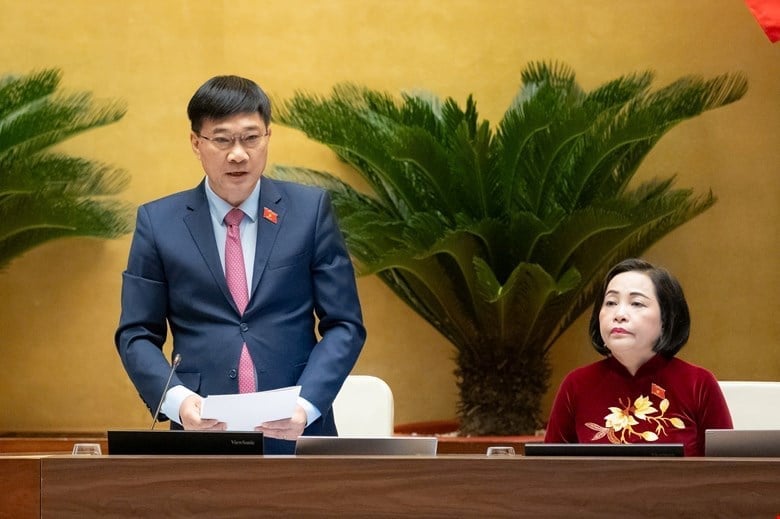
Vice Chairman of the National Assembly Vu Hong Thanh moderated the discussion. Photo: Quochoi.vn.
Delegate Ha Sy Huan (Thai Nguyen) pointed out: of the 500 trillion VND in state support capital, the central budget only accounts for 20% (100 trillion VND), while the local budget must cover up to 80% (400 trillion VND). "This ratio puts a heavy burden on disadvantaged provinces, especially ethnic minority and mountainous areas with high poverty rates," he said.
Delegate Mai Van Hai (Thanh Hoa) also compared: the central budget capital for the new period is only half of that for the 2021-2025 period (over 190 trillion VND), while the local capital portion increased sharply from nearly 180 trillion VND to 400 trillion VND. He said that many mountainous provinces "do not have enough revenue to cover expenses", and land revenue has decreased as the province only receives 80-85% of land use fees.
Debt concerns and the feasibility of the counterparty ratio
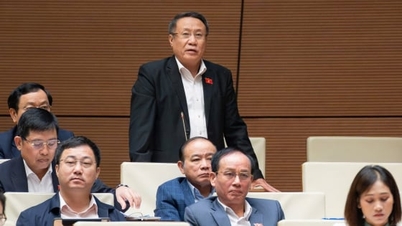
Many delegates warned that the current capital structure is difficult to implement, especially for poor localities. Delegate Ho Thi Minh (Quang Tri) cited: the total capital of the program is expected to reach 1.23 million billion VND, but the central capital only accounts for 8%, the local capital 33%, the rest depends on mobilizing people and businesses up to 28%. "For the provinces in the Central and Central Highlands, which still receive subsidies from the central government, the requirement of 33% is too much and can easily lead to outstanding debts for basic construction," she said and proposed to exempt the counterpart fund for poor communes and areas prone to natural disasters.
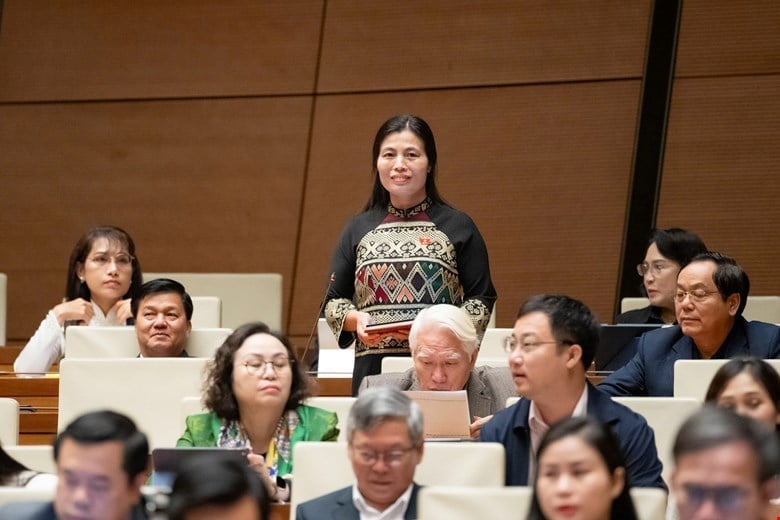
Delegate Ho Thi Minh (Quang Tri). Photo: Quochoi.vn.
Delegate Ha Sy Dong (Quang Tri) added: the minimum demand is 240,000 billion VND but only 100,000 billion VND has been balanced, reaching only 41.5%. "Mobilizing 33% from the local budget and 28% from businesses and the community is very difficult", he emphasized.
Delegate Dieu Huynh Sang (Dong Nai) said that the local counterpart rate four times higher than the central level is "inappropriate", suggesting that the central level play the role of the main resource to ensure focused investment.
Faced with this reality, many delegates agreed that it is necessary to adjust in the direction of increasing the proportion of the central budget, reducing the counterpart burden for poor provinces, remote areas and localities that often suffer from natural disasters.
Need to "quantify" the allocation principle to avoid spreading
Not only concerned about capital structure, delegates are also interested in the principle of allocating central capital to limit dispersion, leveling and focusing on the core poor areas.
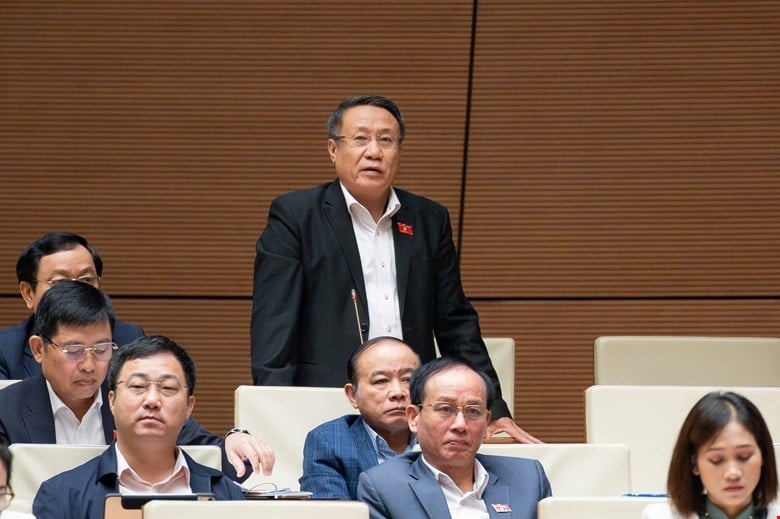
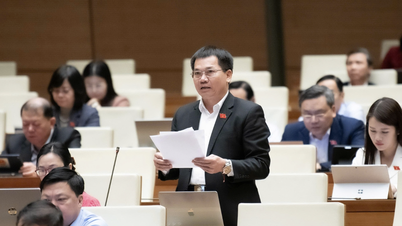
Delegate Ha Sy Dong (National Assembly Delegation of Quang Tri province) speaks. Photo: Quochoi.vn.
Delegate Hoang Quoc Khanh (Lai Chau) emphasized that limited resources must be focused on the right needs and "bottlenecks" to create clear changes. He noted that allocation should be based on the level of shortage, practical needs and absorption capacity of each locality, avoiding fragmentation leading to slow progress.
However, according to delegate Ha Sy Huan, many current allocation principles are still general and lack quantitative criteria, which can easily lead to widespread allocation. Many delegates suggested quantifying them using criteria such as the level of difficulty, the rate of poor households, and the progress of implementing new rural criteria.
Delegate Ha Sy Dong proposed clearly stipulating that at least 70% of central capital must be allocated to ethnic minority and mountainous areas, of which at least 40% must be allocated to particularly difficult areas. The assignment of local authorities to self-review and determine investment focus was also supported by many delegates to overcome the shortcomings of the previous period.
Some opinions emphasized the need to continue mobilizing legal resources from businesses, cooperatives and people. However, delegate Ho Thi Minh was also frank: mobilizing 28% from people and businesses in the core poor areas "is really very difficult".
The merger of the three target programs is a big step forward in management thinking. However, in order for the resolution on investment policy for the National Target Program for the 2026-2035 period to truly come into life and achieve sustainable effectiveness, many delegates believe that the National Assembly and the Government need to soon adjust the capital structure in the direction of increasing the central budget, reducing counterpart pressure for poor provinces.
At the same time, quantifying allocation criteria is an urgent requirement to ensure that resources are focused on the right target, creating breakthroughs for the most difficult core areas of the country.
Source: https://nongnghiepmoitruong.vn/von-chuong-trinh-muc-tieu-quoc-gia-2026-2035-can-xem-xet-ty-le-doi-ung-cho-dia-phuong-ngheo-d787968.html

![[Photo] Cat Ba - Green island paradise](/_next/image?url=https%3A%2F%2Fvphoto.vietnam.vn%2Fthumb%2F1200x675%2Fvietnam%2Fresource%2FIMAGE%2F2025%2F12%2F04%2F1764821844074_ndo_br_1-dcbthienduongxanh638-jpg.webp&w=3840&q=75)



































































Comment (0)