

Kinhtedothi - The 2024 Capital City Law has stipulated new specific mechanisms for developing the capital's culture. These are important legal foundations for building Hanoi into a true center for the convergence and crystallization of national culture...
Hanoi is a pioneer and leader in cultural development.
According to the presentation titled "Achievements in the struggle, construction and development of Hanoi as the capital city" by the Hanoi People's Committee at the scientific conference "95 years of the founding of the Hanoi Party Committee - historical significance and importance (March 17, 1930 - March 17, 2025)", Hanoi is the largest cultural and artistic center in the country, and a locality that has always been a pioneer and leader in cultural development.
Throughout its history, Thang Long - Hanoi has been directly and strongly influenced by the cultural spaces of four sub-regions: the North, the West, the East, and the Son Nam Thuong region. Modern Hanoi has inherited, preserved, and adapted the cultures of these sub-regions; at the same time, it has absorbed external cultural elements to meet the needs of developing into a cultured, civilized, and modern city.
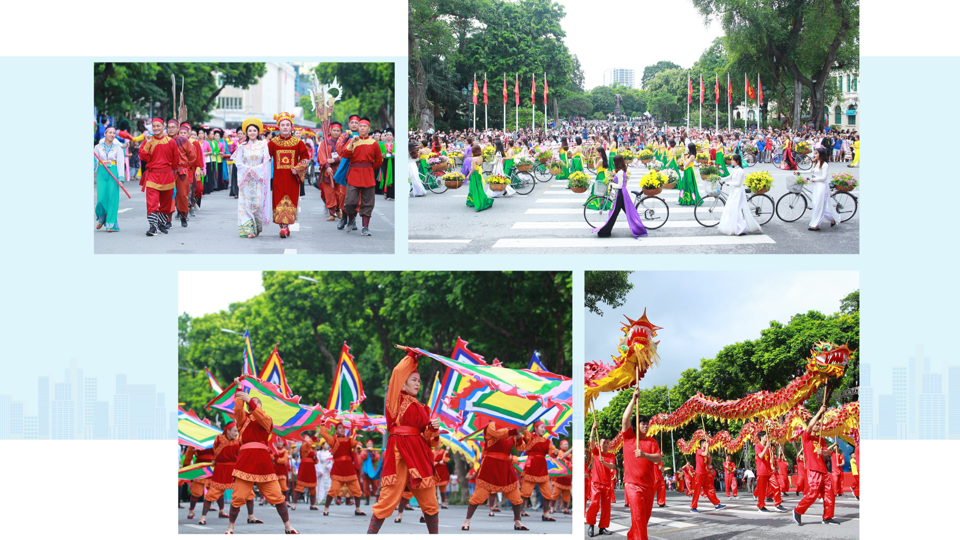
This is what gives Hanoi the ability to accumulate and spread culture and civilization, serving as both a repository of the nation's vast cultural heritage and a magnet for the finest cultural and civilizational values of humanity. From this, it has made significant contributions to the development of the country, the region, and the world , with 5,922 inventoried relics, of which 2,668 are classified (accounting for approximately one-third of the total number of classified relics nationwide).
Among them, there is 1 World Heritage site; 2 World Documentary Heritage sites; 21 Special National Monuments; 1,163 national-ranked monuments/complexes (accounting for ¼ of the total number of national-ranked monuments nationwide); and 1,484 city-level ranked monuments/complexes. Hanoi has 3,507 intangible cultural heritage items inventoried, equivalent to 5.32% of the national total and 76.16% of the Red River Delta region. It has 1 UNESCO "Creative City" title, 32 intangible cultural heritage items on the National Intangible Cultural Heritage List; 2 UNESCO-recognized World Documentary Heritage sites, and 4 UNESCO-inscribed intangible cultural heritage items, including 3 representative intangible cultural heritage items of humanity.
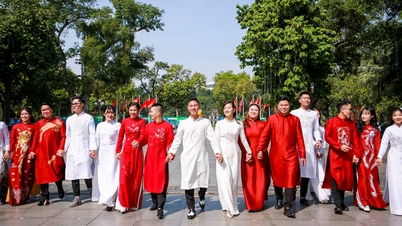
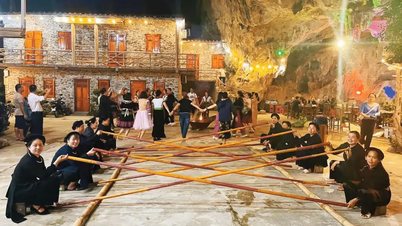
Furthermore, Hanoi boasts 1,350 traditional craft villages and 1,661 preserved folk festivals. The unique and captivating culinary culture of Hanoi is a source of pride for the people of the capital city in particular and the Vietnamese nation in general. Around the world, few capital cities possess such a convergence of traditional culture, long-standing educational history, diverse forms of religion, beliefs, rituals, traditional festivals, traditional craft villages, and folk performing arts as Hanoi.
Hanoi has always thoroughly grasped and flexibly and creatively applied the Party's viewpoints and policies on cultural development and human development, adapting them to the conditions of the capital city. After liberation, Hanoi had only one library with 90,000 books, but by 1965, it had eight libraries with 177,000 books. From 19 film and art troupes in 1955, Hanoi had 31 cultural and artistic troupes by 1965, serving a large number of people.
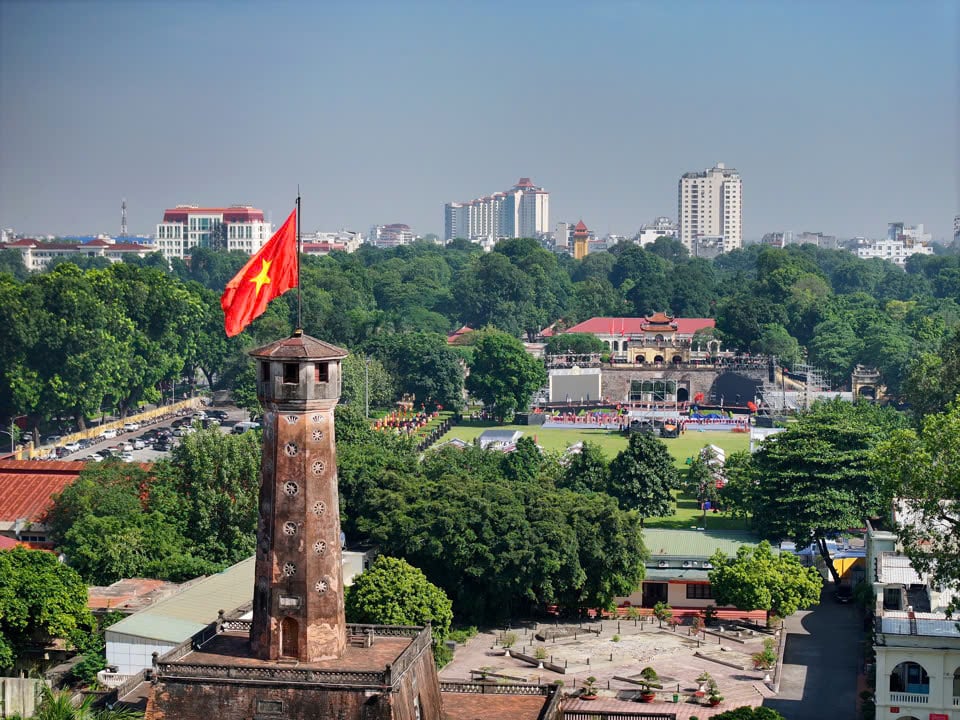
Throughout its development, Hanoi has added cultural facilities. In the period after the Liberation of the Capital, during the restoration and renovation phase (1954-1960), Hanoi put into use 6 new public and residential facilities, and 8 cultural and educational facilities. In the period 1961-1965, Hanoi continued to complete and put into use 30 more public and residential facilities. After 1975, Hanoi paid close attention to cultural development and cared for the spiritual life of its people. Several major projects were completed, such as Thu Le Park and the Youth Cultural Palace (now the Children's Cultural Palace).
Currently, according to statistics, Hanoi leads the country in the number of museums (49 public museums, 19 private museums), the number of libraries (1 National Library, nearly 200 libraries of universities, academies, and research institutes, 1,085 libraries managed by Hanoi, with 620,101 thousand books); the number of theaters (23 professional performing arts theaters under the management of ministries and agencies, accounting for 94% of the total number of national performing arts facilities and 6 performing arts theaters managed by Hanoi); the number of exhibition centers, cinemas, digitized databases of cultural heritage and works of art, cultural centers/houses, cultural creative spaces, and art entertainment areas...
Comprehensive development of cultural industries
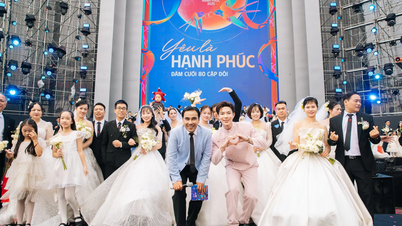
The discussion also highlighted that Hanoi's cultural and artistic activities are extremely vibrant, including many cultural and artistic events of regional and international significance. This is a huge resource for Hanoi to exploit in order to improve the quality of spiritual life for its people and contribute to the development of the cultural industry.
In 2019, Hanoi was honored as a member of UNESCO's "Creative Cities Network," aiming to use cultural resources and cultural creativity as the foundation for the sustainable development of the capital city. New factors and contexts in the digital age and the Fourth Industrial Revolution create opportunities for Hanoi to unlock its cultural resources and values, contributing to better exploitation and promotion of these resources.
In recent years, Hanoi has been determined to comprehensively develop cultural industries in terms of scale, product and service quality, and market, ensuring sustainable development and making them a key economic sector.
Hanoi has recently been honored to receive numerous prestigious awards from international organizations, including: "Asia's Leading City Tourism Destination"; "World's Best Golf City Destination 2024" awarded by the World Travel Awards; being included in the "Top 100 Most Attractive Cities in the World 2024" selected by Euromonitor International; "Vietnam's Leading Cultural Destination 2024"; "World's Leading City Tourism Authority 2024"; "Asia's Leading City Tourism Destination 2024"; "Asia's Leading City for Short Holidays 2024" awarded by the World Travel Awards for the third consecutive year (2022, 2023, 2024)...
Hanoi possesses a complete and comprehensive system of basic cultural institutions. The Politburo has issued three resolutions on "Directions and Tasks for the Development of the Capital City" for the periods 2001-2010, 2011-2020, and 2021-2025, consistently emphasizing and prioritizing the cultural element. In particular, Resolution No. 15-NQ/TW dated May 5, 2022, is of special significance for the construction and development of the Capital City. It identifies "Culture and people as both the goal and the foundation, resources, and driving force for the development of the Capital City," and sets forth the requirement and task of "Focusing on developing the Capital City's culture to be commensurate with the thousand-year tradition of Thang Long - Hanoi; building Hanoi into a true center for the convergence and crystallization of national culture, becoming a new driving force for the Capital City's development." Hanoi is the first locality in the country to issue a separate specialized resolution on the development of the cultural industry.
In particular, building upon the provisions of Article 11 of the 2012 Capital City Law, the 2024 Capital City Law has stipulated new specific mechanisms for the development of the capital's culture. These are important legal foundations for building Hanoi into a true center for the convergence and crystallization of national culture, creating a civilized, elegant cultural environment that exemplifies the national cultural identity and the thousand-year-old tradition of civilization.
Hanoi is the capital of the country, the political, economic, cultural, and diplomatic center of Vietnam, with one of the largest urban populations in the country and a renowned intellectual and artistic community. Hanoi is also where the central government's headquarters are located. The central government is immediately aware of the daily activities and developments of the locality.
Words of encouragement or reminders, even daily and hourly, are common, unlike in other localities. Some jokingly say, "Hanoi is close to the sun," so it's hot all year round. In reality, these are significant advantages for Hanoi.
The period from 1991 to 2000, when the Party Committee and people of Hanoi continued to implement industrialization and modernization, and carried out the Resolution of the 11th Congress of the Hanoi Party Committee, required the Hanoi Party Committee to constantly improve and elevate itself to meet very high demands.
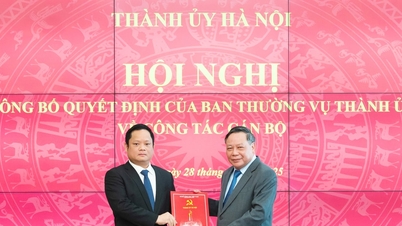
The success or failure of any work is, to a significant extent, determined by the cadres. This requires each cadre to have a plan to regularly improve their theoretical and practical skills. On the other hand, Party committees should have a plan to send cadres for training at central and local Party schools to enhance their qualifications.
The Hanoi City Party Committee also assigned the City Party Committee's Organization Department to organize specialized training courses.
In selecting officials for key positions, there are cases where foresight, early identification, and subsequent training are necessary. This is the case when a district of the city needs a competent Chairman of the People's Committee. Many opinions have been put forward from different perspectives...
But there is an important standard: the leadership and management capacity of the cadres... In fact, with the leadership and management of the comrade and the assistance and support of the Party committee, the district has made many changes in the process of building new rural areas.
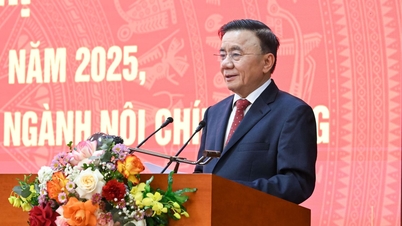
Professor Le Xuan Tung - former Secretary of the Hanoi City Party Committee
Source: https://kinhtedothi.vn/xay-dung-ha-noi-la-trung-tam-hoi-tu-ket-tinh-van-hoa-cua-ca-nuoc.html



























































Comment (0)