

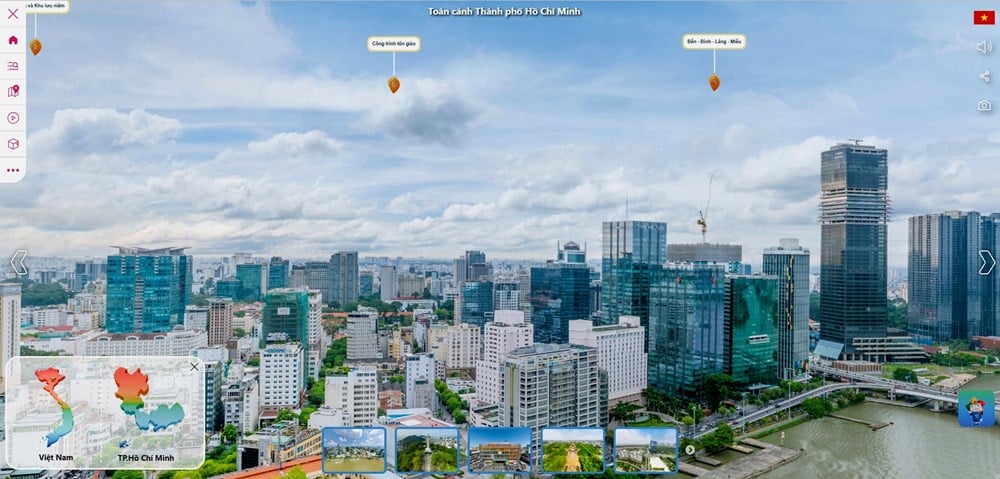
Dispersed travel data is the industry's biggest challenge.
As Vietnam embarks on a comprehensive digital transformation process, Resolution 57-NQ/TW of the Politburo sets out a strategic requirement: By 2030, state management activities must operate in a digital environment, seamlessly connected based on a "system of accurate, complete, clean, and active data".
This is not only a general guideline for the government apparatus, but also a mandate for transformation in the tourism industry – a sector heavily reliant on data, experiences, and real-time interaction.
In this digital transformation landscape, the digital tourism map platform holds a central position. It is a crucial component of the smart tourism ecosystem, where data is integrated, standardized, and visualized to serve management, operation, forecasting, and policy planning. However, reality shows that Vietnam is facing numerous bottlenecks.
From a practical standpoint, tourism data currently exists in a " каждый за себя" (everyone for themselves) model: Each locality develops its own management software, each business develops its own system, and each unit operates according to different criteria, structures, and presentation methods.
According to Pham Van Thuy, Deputy Director of the Vietnam National Tourism Administration, this is a reality that must be frankly acknowledged: "Vietnam's tourism data is currently fragmented, lacks standardization, and is inconsistent between the central government, local authorities, and businesses."
This fragmentation makes it difficult for management agencies to get a comprehensive picture of tourism activities; destinations lack tools to monitor carrying capacity, visitor flow, and environmental conditions; and businesses have difficulty accessing shared data sources to upgrade products and optimize the visitor experience.
Many local digital maps serve only as promotional tools, lacking administrative data, regional connectivity, and integration capabilities. Furthermore, many products completely fail to reflect the core elements of sustainable tourism, from tourist flow to environmental warnings and social impacts.
In the context of Resolution 57-NQ/TW requiring all state management activities to operate in a digital environment, such a fragmented data structure is a major obstacle to the progress of the tourism industry.

Digital tourism maps - a management tool, not just a destination information app.
Experiences shared by various localities and experts have pointed to a common understanding: Digital tourism maps are not just navigational maps. They are digital infrastructure that helps manage destinations, support forecasting, monitoring, and policy planning.
Hoang Hoa Quan, Deputy Head of the Travel Department of the Vietnam National Tourism Administration, emphasized the core requirement of a sustainable platform: "For sustainability, the map must integrate destination management data and control the issue of destination overcrowding."
He also argued that all processes must begin with standardized, consistent data: "Data standardization must be ensured, developing from the source data to the localities; clearly identifying the entities involved in the process of updating information and data."
This opinion highlights a crucial requirement: Digital maps cannot be developed haphazardly or as short-term projects. They must become a long-term platform, operating based on a unified data standard, ensuring a seamless flow of information between the central government, local authorities, and businesses.
From a local perspective, the Deputy Director of the Hanoi Department of Tourism, Nguyen Tran Quang, issued a very clear warning: "Without a unified platform, data connectivity will be impossible... Therefore, it is necessary to build a shared data system and integrate multiple utilities."
Meanwhile, Mr. Hoang Son, representing the Ministry of Science and Technology, viewed the issue from a long-term perspective, proposing that digital maps should integrate traffic density, "low-altitude sky" data, intelligent traffic data, and artificial intelligence – factors that will shape the tourism experience in the near future.
These opinions suggest that Vietnam's digital tourism map needs to go beyond mere promotion and become a comprehensive platform integrating spatial, economic, social, and environmental data to serve sustainable development.

Directions and solutions for establishing a national digital map platform.
From the above analysis, it is possible to identify the mandatory solutions for Vietnam to build a modern digital tourism map platform, in line with the spirit of Resolution 57-NQ/TW and Resolution 82/NQ-CP.
To build a modern digital tourism map platform, the first crucial solution is to standardize data and establish a comprehensive industry-wide data system.
This requires Vietnam to promptly issue a unified national tourism data standard, ensuring that all information is digitized in the same structure and is capable of connectivity and sharing.
The requirements of Resolution 57-NQ/TW on "accurate, complete, clean, and active data" must become a guiding principle throughout the data collection and system operation process.
Simultaneously, it is necessary to clearly define the responsibilities for data updating among central agencies, local authorities, and businesses, ensuring that each entity fulfills its role in maintaining a complete and reliable data source, creating a foundation for state management operations in the digital environment.
Besides standardizing data, Vietnam needs to develop a unified digital mapping platform based on WebGIS and MobileGIS, capable of integrating and sharing data nationwide.
This system must operate as an “open infrastructure framework,” allowing all existing software and databases at the local level to connect directly without having to be rebuilt from scratch.
Only when platforms operating in provinces and cities can "plug in" to a common system can the tourism industry avoid technological fragmentation and obtain a consistent data source.
On that unified platform, data for sustainable development needs to be integrated systematically and continuously.
Information such as destination carrying capacity, real-time passenger flow, environmental conditions, culture, and social impact must be digitized alongside intelligent transportation data and safety alerts.
In this new phase of development, digital maps also need to take into account modern spatial data layers, including "low-altitude sky" data, which will become essential infrastructure for many future tourism models.
Furthermore, the formation of a digital technology ecosystem for tourism is a prerequisite. Authorities need to create mechanisms for businesses to participate in developing services based on open data, while also encouraging the application of artificial intelligence in itinerary suggestion, visitor flow analysis, and destination load forecasting.
When technology operates on the same underlying data, new digital products will have a greater chance of spreading and serving tourists more effectively.

For these guidelines to be implemented effectively, pilot models need to be deployed in localities with strong digital capabilities such as Ho Chi Minh City, Hanoi, Da Nang, Quang Ninh, Ninh Binh, etc.
The results of the trial must be comprehensively evaluated according to sustainability criteria before being scaled up nationwide to ensure feasibility and viability for the next phase.
Digital tourism maps can only fully realize their potential when connected to related sectors. Integrating data with land use planning, transportation, environmental resources, and cultural heritage protection and promotion systems will help build a multi-dimensional picture, opening up possibilities for smart, synchronized, and sustainable destination management.
This is also the requirement clearly stated by Deputy Director Pham Van Thuy: "Close coordination with localities is needed, standardizing data for digitization, and connecting databases with relevant sectors and units."
The digital tourism map platform serves not only tourists, supports businesses, and is not just a management tool.
It is the national digital infrastructure for sustainable tourism development, where all data is collected, processed, and operated in real time; where policies, governance, and services are planned based on open, transparent, and standardized data.
When the tourism data system is standardized, interconnected, and dynamic, the Vietnamese tourism industry can operate in accordance with the spirit of Resolution 57-NQ/TW, ushering in a period of smart, sustainable development and deeper integration into the global tourism flow.
Source: https://baovanhoa.vn/du-lich/yeu-cau-cap-bach-de-phat-trien-du-lich-ben-vung-185153.html

![[Photo] General Secretary and President To Lam meets with National Assembly delegates from ethnic minorities.](https://vphoto.vietnam.vn/thumb/1200x675/vietnam/resource/IMAGE/2026/04/20/1776696701056_a1-bnd-8331-3342-jpg.webp)

![[Image] National Assembly discusses the implementation of the socio-economic development plan.](https://vphoto.vietnam.vn/thumb/1200x675/vietnam/resource/IMAGE/2026/04/20/1776696707422_ndo_br_img-20260420-185419-jpg.webp)
































































































Comment (0)