

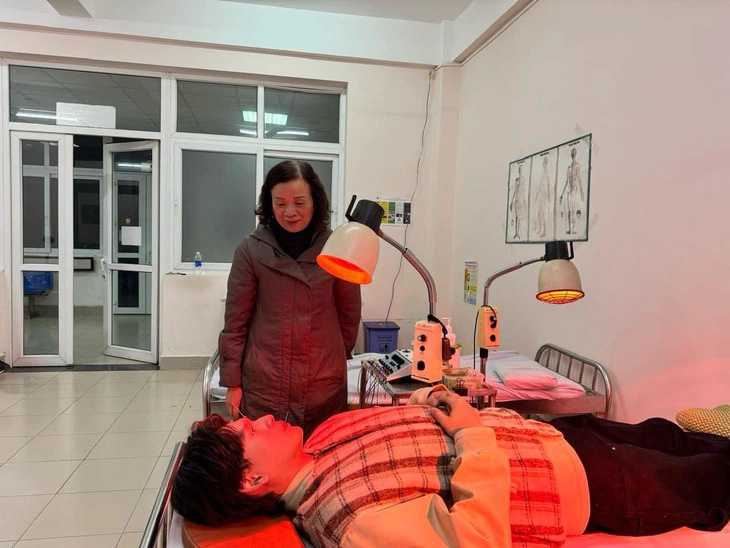
Nguyen Tran Trung Quan suffered facial nerve paralysis (paralysis of the 7th cranial nerve) and had to be hospitalized for treatment - Photo: Provided by the interviewee.
On February 26th, Trung Quân's representative announced that the singer had experienced a health issue while performing in Hai Phong on the evening of February 25th.
Specifically, singer Nguyen Tran Trung Quan suffered from facial stiffness on one side and a distorted mouth.
Singer Trung Quân was admitted to the emergency room at a hospital in Hai Phong. Doctors advised that transferring him to Military Hospital 108 ( Hanoi ) would be the best option.
Here, after undergoing tests and examinations, the male singer was then taken to Duc Giang General Hospital for acupuncture treatment.
The singer's representative revealed that doctors diagnosed him with peripheral nerve paralysis of cranial nerve VII (facial paralysis).
According to the singer's representative, after two treatment sessions, Quân's health has improved; he is eating, sleeping, and talking normally, although one side of his face is still distorted.
Regarding the facial asymmetry, Nguyen Tran Trung Quan will need long-term treatment; it cannot be resolved overnight.
Dr. Huynh Tan Vu, a lecturer in the Traditional Medicine Department at the Ho Chi Minh City University of Medicine and Pharmacy, said that during the changing seasons, many people suffer from facial nerve paralysis, also known as facial paralysis, and both adults and children can experience this condition.
The main causes of facial paralysis include cold, sudden temperature changes (after rain, cold weather, etc.), infections (facial paralysis accompanied by fever), and trauma (possibly after maxillofacial surgery, mastoid surgery, etc.).
Although not life-threatening, it causes aesthetic and psychological problems for patients, affecting their work, eating habits, daily activities, and quality of life.
During treatment, the recovery time depends on the patient's age; younger people usually recover quickly in 2-4 weeks, while older people recover more slowly due to reduced skin elasticity.
However, some patients, due to improper treatment or folk remedies, suffer from atrophy and permanent facial paralysis.
Doctor Vu advises against sudden changes from hot to cold temperatures (air conditioning) and vice versa, as the sudden shift in body temperature from high to low can cause dizziness.
When using air conditioners or fans for young children, parents should absolutely avoid directing the airflow directly at the child; instead, the fan should rotate evenly throughout the room.
In addition, maintaining a healthy body by improving health, eating well, and exercising to boost immunity contributes to disease prevention.
Signs and symptoms of facial nerve paralysis (cranial nerve VII)
According to Dr. Ngo Thi Kim Oanh from the University of Medicine and Pharmacy Hospital in Ho Chi Minh City, Branch 3, during hot weather, many people have a habit of sleeping under air conditioners and fans at high intensity, which is one of the risk factors for facial paralysis.
Symptoms of facial paralysis include an asymmetrical face, facial muscles pulled to one side, wrinkles in the forehead, nasolabial folds, deviated philtrum, and a crooked mouth.
Additionally, the eye cannot close completely, and the eyeball moves upwards. Patients have difficulty performing movements such as furrowing their brow, frowning, grimacing, pouting, puffing out their cheeks, and whistling. Secondary symptoms may include tinnitus and tearing on the paralyzed side.
According to Doctor Oanh, when experiencing symptoms of facial paralysis, patients should visit a reputable medical facility for examination to determine the cause and assess the extent of nerve damage through clinical symptoms and facial electromyography.
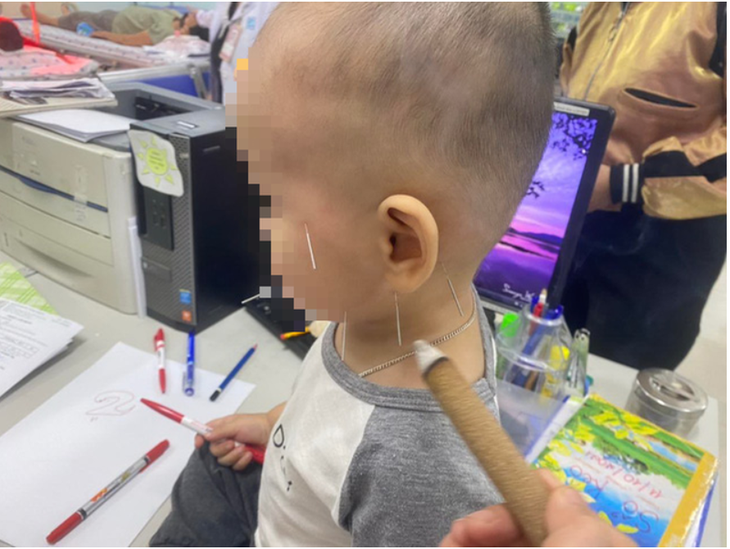 Daily habits that can easily cause facial paralysis.
Source

![[Photo] Closing Ceremony of the 10th Session of the 15th National Assembly](/_next/image?url=https%3A%2F%2Fvphoto.vietnam.vn%2Fthumb%2F1200x675%2Fvietnam%2Fresource%2FIMAGE%2F2025%2F12%2F11%2F1765448959967_image-1437-jpg.webp&w=3840&q=75)














































![[OFFICIAL] MISA GROUP ANNOUNCES ITS PIONEERING BRAND POSITIONING IN BUILDING AGENTIC AI FOR BUSINESSES, HOUSEHOLDS, AND THE GOVERNMENT](https://vphoto.vietnam.vn/thumb/402x226/vietnam/resource/IMAGE/2025/12/11/1765444754256_agentic-ai_postfb-scaled.png)













































Comment (0)