

On December 10th, the National Assembly voted to approve the Law amending and supplementing a number of articles of the Law on Education ; the Law on Vocational Education (amended); and the Law on Higher Education (amended).
Earlier, Minister of Education and Training Nguyen Kim Son reported on the feedback received, explanations made, and revisions to the draft Law amending and supplementing a number of articles of the Law on Education.
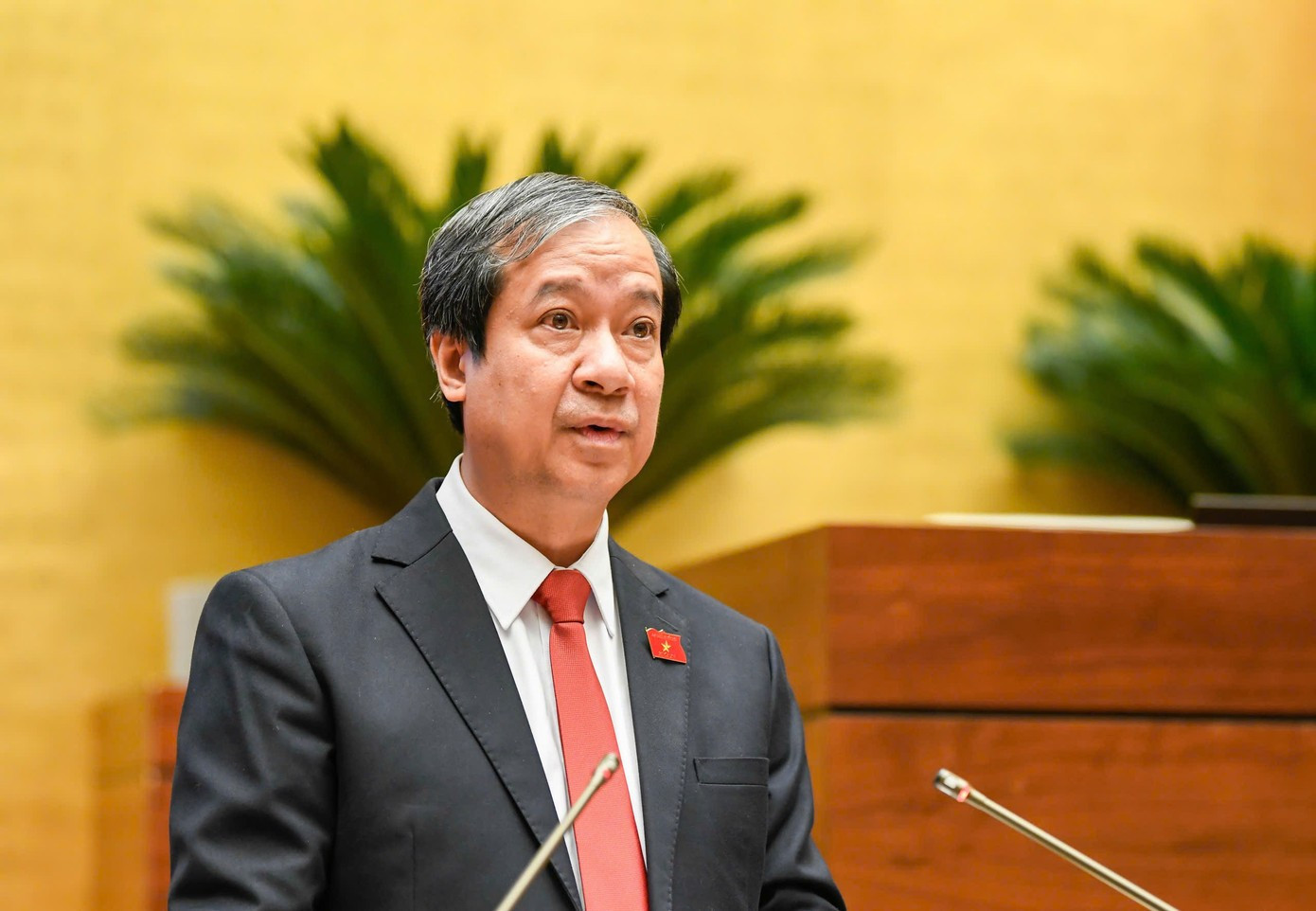
The amended law has institutionalized many key directions for educational development in the new phase. These include defining lower secondary education as compulsory; expanding universal preschool education for children aged 3-6; and stipulating that the State guarantees a unified set of textbooks for general education nationwide.
The Ministry of Education and Training is developing a plan to implement a unified set of textbooks starting from the 2026-2027 school year, aiming for transparency, cost-effectiveness, leveraging existing strengths, and minimizing disruption for teachers and students.
The law also refines scholarship policies, such as establishing a national scholarship fund; reforming the model of gifted schools, adding boarding schools as a type of high school, and restructuring budget allocation for higher education. These regulations contribute to creating a synchronized policy framework that supports the development of the national education system.
In addition, many practical shortcomings have been addressed: vocational secondary education has been added as equivalent to high school education; and the direction of streaming after lower secondary education has been clarified.
The law also stipulates that diplomas and certificates are issued in paper or digital form to increase transparency, prevent fraud, and facilitate students in verifying and authenticating them according to international standards.
Notably, instead of issuing lower secondary school diplomas, students who complete the primary and lower secondary education programs will have their academic records certified by the principal as "completed lower secondary education or equivalent," as stipulated by the Minister of Education and Training.
Compared to current regulations, the Law amending and supplementing several articles of the Education Law eliminates the issuance of junior high school graduation certificates. The new regulation helps reduce administrative procedures, lessen examination pressure, and aligns with international practices.
Another new feature is the identification of positions supporting education, such as library staff, equipment managers, psychological counselors, and social workers. This helps to clearly define job roles, standardize tasks, and create a basis for developing appropriate compensation policies. The law also allows localities to issue specific policies to attract and retain personnel in order to improve the quality of support for learners.
For postgraduate advanced training programs in the health sector leading to degrees such as residency and specialist doctor programs, the guidance on organization, implementation, and management will be carried out by the Ministry of Health in accordance with the provisions of the draft Law on Higher Education (amended).
Controlled AI applications
Regarding science, technology, and innovation, the Law for the first time fully establishes the legal validity of concepts such as innovation, controlled application of artificial intelligence, digital transformation in education, and national databases.
In addition, the regulations detail aspects of digital transformation in education, including the development and use of artificial intelligence, open data, educational technology, e-textbooks, digital learning materials, and online learning platforms.
The regulations clearly define the principles of information security and confidentiality, and require compliance with guidelines from competent authorities when applying artificial intelligence.
According to Minister Nguyen Kim Son, this approach ensures consistency with laws on science, technology, innovation, data, and digital transformation, creating a unified legal framework for educational innovation based on modern technology.
Terminate the activities of the School Board.
The National Assembly also passed the Law on Higher Education with many groundbreaking new provisions. This included ending the activities of the University Council in public higher education institutions and strengthening the leadership role of the Party organization within these institutions.
The law aims to reform higher education by promoting lifelong learning, modernizing curricula, learning materials, and technology, narrowing the gap with the labor market, and strictly controlling the fields of teaching, health, and law.
The investment policy aims to improve the standards of higher education institutions; to establish excellent universities to lead the system; to mobilize all resources and create a level playing field for competition between public and private institutions. The law opens a corridor to attract talented lecturers, support students from undergraduate to postgraduate levels; and promote training linked to scientific research and new technologies.
Before its approval, Minister of Education and Training Nguyen Kim Son reported that the draft law had received 336 direct comments, including 244 from National Assembly deputies, and had also incorporated over 3,000 comments from the Committee on Culture and Social Affairs.
One of the key focuses is expanding university autonomy. The government has incorporated feedback to institutionalize the concept of autonomy without "self-reliance," ensuring that the State and higher education institutions share responsibility for system development. The new regulations aim to build a comprehensive autonomy model while setting higher standards for transparency, accountability, and quality assurance.
The amended law introduces long-term investment policies, in which the State plays a leading role in supporting public higher education institutions to train in key disciplines that meet regional and international standards, while selectively supporting the sustainable development of private universities.
Source: https://tienphong.vn/bo-cap-bang-thcs-ket-thuc-hoat-dong-hoi-dong-truong-post1803456.tpo










































































Comment (0)