

Medical news update September 27th: A landmark organ transplant at Duc Giang Hospital.
Duc Giang General Hospital has officially made its mark on the Vietnamese organ transplant map by successfully performing its first kidney transplant on a female patient in Tuyen Quang .
A turning point in organ transplantation at a capital city hospital.
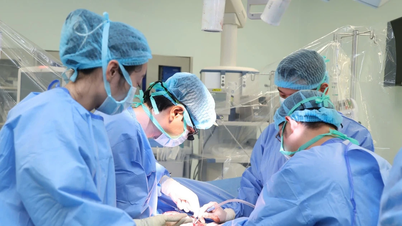
On September 8th, the hospital officially made its mark on the Vietnamese organ transplant map by successfully performing the first kidney transplant for Ms. NTBH (26 years old, Tuyen Quang) using a kidney donated from her biological mother.
 |
| Duc Giang General Hospital has officially made its mark on the Vietnamese organ transplant map by successfully performing its first kidney transplant on a female patient in Tuyen Quang. |
Dr. Nguyen Van Thuong, Director of Duc Giang General Hospital, congratulated patient H. and said that the patient's health has recovered very well and will be discharged next week.
"A new life is coming" is the sentiment of NTBH, 26, from Tuyen Quang, after successfully receiving a kidney transplant from her own mother.
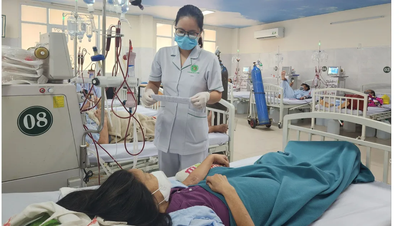
Ms. NTBH was diagnosed with end-stage chronic kidney disease in early 2022 and has been undergoing dialysis three times a week since March 2022. She hopes to receive a kidney transplant at Duc Giang General Hospital and doesn't want to have to go to the hospital for dialysis three times a week, regardless of weather, holidays, or Tet (Vietnamese New Year).
Therefore, under the direction of the hospital's leadership, all members of the kidney transplant selection, anesthesia, and transplantation team of the hospital, after a period of screening and pre-transplant treatment, successfully received kidney transplants from surgeons at Duc Giang General Hospital, under the supervision of experts from Military Hospital 103.
What's unique about this transplant is that the mother is relatively older and smaller than the recipient, so there's a risk that the transplanted kidney may not function as expected.
For a successful transplant, thorough preparation in terms of personnel and logistics is necessary, and all possible post-transplant scenarios must be anticipated, as the risk of rejection is relatively high in this patient.
With thorough preparation in terms of personnel and equipment, the patient's kidney transplant surgery proceeded as planned. After the transplant, both the donor and recipient are in stable condition, the transplanted kidney function and clinical indicators are within normal limits, and they are recovering quickly and returning to their normal lives.
The mother was discharged from the hospital one week after surgery, and her health is stable. Ms. NTBH is compatible with the new kidney, which is functioning well. The transplanted kidney's test results are within normal limits, and she continues with post-transplant maintenance treatment and regular follow-up appointments as scheduled by her doctor.
Upon discharge, Ms. NTBH shared that she was deeply moved by the affection of her family members and the dedication of the doctors, nurses, and medical staff at Duc Giang General Hospital.
I don't know what more to say than to express my sincere gratitude to my family and the doctors and nurses who have given me their complete love and care.
As for LBC, a 19-year-old from Quang Xuong district, Thanh Hoa province, in April of this year, he experienced fatigue, dizziness, frequent itching, and had to be hospitalized.
After examination, the doctor concluded that she had end-stage kidney failure. At that time, LBC was working as a shoe factory worker in the Le Mon industrial zone.
From a healthy, working young man, he rapidly lost weight and fell into a state of anxiety, fatigue, and panic because there was no greater misfortune than knowing he had an incurable disease, and that his future life would be tied to hospitals and dialysis machines. His family also took LBC to several hospitals across the country for treatment, hoping for an improvement in his health.
However, the miracle did not happen; he was diagnosed with end-stage chronic kidney disease and had to undergo dialysis three times a week.
Doctors at Duc Giang General Hospital advised him on alternative treatments for kidney failure, with kidney transplantation being the most suitable and best treatment option for him at this time.
After conducting kidney donor screening tests on family members, doctors concluded that LBC's mother's kidney was a suitable match for transplantation.
On September 11th, the kidney transplant team at Duc Giang General Hospital performed a kidney transplant surgery on a mother and daughter. After more than 6 hours of surgery, the transplant was more successful than expected. Following the transplant, both LBC and her mother are in good health.
LBC shared that he was overjoyed to have successfully received a kidney transplant. Now he no longer has to endure the fatigue of dialysis, nor the financial, mental, and physical strain. The successful surgery has given him hope for a new life.
Dr. Nguyen Van Tuyen, Head of the Department of Nephrology and Urology, said that in order to maintain life, patients have to go to the hospital for dialysis once every other day. Besides the costs covered by health insurance, patients still have to spend a considerable amount of money annually on transportation and other expenses. The more difficult issue is that neither the patients themselves nor their accompanying family members earn enough income to support them.
And even with regular dialysis, these patients' health only allows them to do light work and try to take care of themselves; participating in work, studies, or other activities is very difficult. For these patients, a kidney transplant would give them the chance to live healthy lives and work normally.
Organ transplantation is one of humanity's greatest inventions of the 20th century, the most miraculous achievement of Vietnamese medicine, and also the only way to save the lives of terminally ill patients. It is the best chance for patients with chronic, life-threatening diseases whose tissues and organs have lost function and cannot recover.
Organ and tissue donation for people with organ failure is a priceless gift, a miraculous act of life that gives patients who seemed to have lost all hope a chance to live a normal life and continue pursuing their unfinished dreams.
Currently, the Department of Nephrology and Urology at Duc Giang General Hospital has nearly 170 patients, with 80 patients undergoing hemodialysis each day, divided into 3 shifts, performing cyclical hemodialysis.
Dialysis treatment is tiring for patients and their families, involves frequent trips, and is costly. Therefore, maintaining, developing, and mastering kidney transplantation techniques at Duc Giang General Hospital will contribute to improving the quality of life for patients.
Teenage birth rates remain high.
According to the Population Department, the adolescent birth rate (aged 15-19) remains high, at 42 live births per 1,000 women nationwide, with the highest rates in the Northern Midlands and Mountains and the Central Highlands, where ethnic minorities are concentrated.
According to Mr. Le Thanh Dung, Director of the Population Department, Ministry of Health, data from the General Statistics Office shows that Vietnam's population increases by nearly 1 million people each year. The number of women of reproductive age (15-49) is approximately 25 million, and it is projected that this number will continue to increase, leading to a continued rise in demand for contraceptives.
Although the quality of family planning services has gradually improved, there is still one issue that needs attention.
The overall unmet need for family planning has not decreased but continues to increase, from 6.1% (2014) to 10.2% (2021) among married or cohabiting women, and this rate is particularly high among women who are sexually active, unmarried, or not living together as a couple, reaching 40.7%.
"The birth rate among teenagers (aged 15-19) is still high, nationwide at 42 live births/1,000 women, highest in the Northern Midlands and Mountains (115) and Central Highlands (76), where there is a large concentration of ethnic minorities," Mr. Dung said.
Therefore, in the coming period, achieving family planning goals will continue to be an important aspect of population work.
Resolution No. 21-NQ/TW, adopted at the Sixth Plenum of the 12th Central Committee of the Communist Party of Vietnam, clearly states that “Continuing to shift the focus of population policy from family planning to Population and Development” does not mean abandoning family planning, but rather continuing to implement it more effectively to achieve the goals set forth in Resolution 21: “All women of childbearing age have convenient access to modern contraceptive methods; reducing the number of unintended pregnancies among adolescents and young people by two-thirds.”
The theme for Vietnam's World Contraception Day on September 26, 2024, is "Young people should be responsible for safe sex and proactive contraception for their own happiness and the future of the country." The theme aims to raise awareness among young people about the importance of safe sex and proactive contraception for their own benefit and happiness.
According to Mr. Le Thanh Dung, it is suggested that the Departments of Health in provinces and cities coordinate with relevant departments and agencies to continue to pay attention to and advise competent authorities on the effective implementation of the Party and State's guidelines, policies, and solutions on population work in the new situation, contributing to achieving the goals of Resolution 21-NQ/TW of the Party and the Vietnam Population Strategy to 2030.
Directing the synchronized implementation of tasks and solutions to gradually overcome the issue of teenage pregnancy and childbirth; prioritizing the intensification of high-impact communication campaigns integrated with the provision of friendly population and reproductive health services for adolescents and young people.
It is necessary to ensure that all women of reproductive age in the area have access to convenient, safe, and quality family planning information and services; implement population and reproductive health education activities for adolescents and young people that are appropriate for each age group and the specific characteristics and situation of each locality.
How dangerous is May-Thurner syndrome?
Mrs. Dinh, 68 years old, suffered from pain and swelling in her left leg due to pelvic vein thrombosis. Medication was ineffective, and she required surgery to remove the thrombus and widen the narrowed area.
A month earlier, Mrs. Dinh (from Phu Yen) experienced pain and swelling in her left leg. Upon examination at the hospital, she was diagnosed with left femoral and popliteal vein thrombosis. The doctor prescribed anticoagulants, which she took for two weeks. The pain and swelling in her leg decreased, but did not completely disappear.
A week later, despite following the prescribed medication, Mrs. Dinh's left leg became more swollen, painful to the touch, and felt tight and sore, especially when sitting or lying down for extended periods. Continuing to take the prescribed medication, she felt her condition did not improve but worsened, with significant pain in her leg. She then sought treatment at Tam Anh Hospital in Ho Chi Minh City.
Dr. Tran Quoc Hoai, a specialist in Cardiovascular and Thoracic Surgery at the Cardiovascular Center of Tam Anh General Hospital in Ho Chi Minh City, stated that clinical examination revealed the patient had symptoms of pelvic venous thrombosis with swelling and edema of the left leg, extending from the foot to the thigh, tenderness on palpation, and visible collateral spider veins on the skin. Ms. Dinh underwent venous ultrasound and CT scan, which revealed severe stenosis of the left iliac vein due to May-Thurner syndrome.
May-Thurner syndrome is one of the less common causes of deep vein thrombosis in the pelvic-femoral region, accounting for 2-5% of all deep vein thrombosis cases.
This condition occurs when the right iliac artery crosses and compresses the left iliac vein, slowing blood flow from the leg back to the heart. This increases the risk of deep vein thrombosis at the site of the compressed iliac vein.
Blood clots can break off and travel to other arteries, causing life-threatening pulmonary embolism. In the long term, deep vein thrombosis can recur or cause post-thrombotic syndrome, affecting the patient's quality of life.
Dr. Pham Ngoc Minh Thuy, Department of Cardiovascular and Thoracic Surgery, Cardiovascular Center, Tam Anh General Hospital, Ho Chi Minh City, shared that previously, for patients with deep vein thrombosis, doctors usually treated them medically with anticoagulants and compression stockings.
This helps to partially improve symptoms and prevent the formation of new blood clots in the early stages. However, after some time, the disease is prone to recurrence, as in Mrs. Dinh's case, with more blood clots causing more severe symptoms.
In May-Thurner syndrome, the cause of thrombosis and recurrence is compression of the pelvic veins. Therefore, in addition to medication, a more effective method is to use thrombolytic drugs to soften the blood clot, remove some of the clot, and then place a pelvic vein stent to open the vessel. This is a minimally invasive procedure that almost completely resolves the venous stenosis and has a low recurrence rate.
Ms. Dinh underwent a two-hour procedure. First, the doctor used a small balloon to dilate the left iliac vein, then inserted a specialized instrument to remove the blood clot. Finally, the doctor placed a stent in the vein to widen the lumen, allowing blood to flow normally.
The procedure went smoothly without complications. The patient was discharged after one day, with significantly reduced swelling in her leg. She was prescribed anticoagulants for the first few months to prevent thrombosis recurrence. At a follow-up appointment two weeks later, Mrs. Dinh's left leg had returned to its original size and the pain had completely disappeared.
According to Doctor Hoai, May-Thurner syndrome is not a genetic disease and can affect anyone. The disease has three stages: Stage I is asymptomatic, Stage II involves prolonged compression of the vein causing damage to the blood vessel lining, and Stage III involves the formation of blood clots within the vessel.
Individuals at risk for blood clots include women over 50, women who have recently given birth, women with two or more children, women taking birth control pills, people who are bedridden for extended periods, and people with medical conditions that increase the risk of blood clotting, such as cancer.
To reduce the risk of developing May-Thurner syndrome, it is recommended to maintain activities that keep veins functioning normally: regular exercise, not smoking, avoiding prolonged standing or sitting, avoiding tight clothing, and maintaining a healthy weight.
When early symptoms of the disease appear (swelling, heaviness, pain in the legs, non-healing ulcers, varicose veins) or signs suggestive of deep vein thrombosis (severe leg edema, cramps, discoloration of the leg skin (red or purple), feeling warm to the touch), seek medical attention promptly.





























































































Comment (0)