

(CLO) Greenland's opposition Demokraatit party, a political force advocating independence from Denmark, won Tuesday's parliamentary elections.
After the vote count was completed, the Demokraatit party won 29.9% of the vote, a sharp increase from 9.1% in 2021, surpassing the Naleraq party – a rapidly growing pro-separatist force – which received 24.5%.
Jens-Frederik Nielsen, leader of Demokraatit and former Minister of Industry, emphasized: "The people want change... We want more businesses to fund our welfare. We don't want independence tomorrow, but we need a solid foundation." He will begin negotiations to form a governing coalition.
The ruling Inuit Ataqatigiit party and its partner Siumut, both pursuing a slow path to independence, garnered only 36% of the vote combined, a sharp drop from 66.1% in 2021. Prime Minister Mute Egede of the Inuit Ataqatigiit party acknowledged the results and stated he would listen to all proposals in coalition talks.
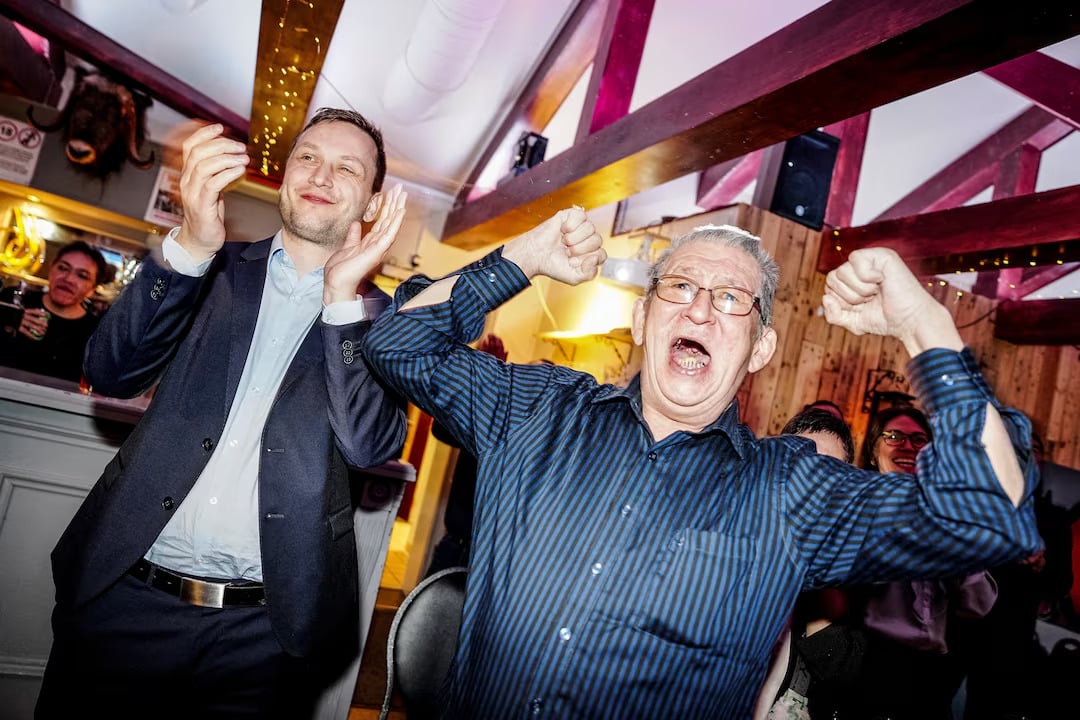
Demokraatit party leader Jens-Frederik Nielsen (left) at an election party at Killut café in Nuuk, March 12. Photo: Ritzau Scanpix/Mads Claus Rasmussen
This outcome comes amid US President Donald Trump's commitment to taking control of the island.
Since taking office in January, Trump has publicly stated his intention to bring Greenland – a semi-autonomous territory of Denmark – into the United States, citing national security interests.
However, most Greenlanders oppose this idea. With a population of only about 57,000, Greenland has become a hotbed of geopolitical competition in the Arctic, where melting ice makes resources easier to exploit and opens up new shipping routes.
Greenland was a Danish colony before becoming a territory in 1953. In 1979, it gained limited autonomy, but Denmark retains control over foreign affairs, defense, and monetary policy, and provides nearly $1 billion in financial support annually. In 2009, Greenland achieved the right to declare independence through a referendum, but has not yet implemented it due to concerns about economic impact.
Qupanuk Olsen, the candidate of the Naleraq party, asserted: "We need to live according to our own culture and language, not dependent on Denmark." Meanwhile, Inge Olsvig Brandt of the Inuit Ataqatigiit party warned: "We are not ready. There are many problems to solve before we can think about independence."
Trump's intense focus on the election has heightened tensions. During the KNR televised debate on Monday night, leaders from all five parties with seats in Congress declared their distrust of Trump. Erik Jensen, leader of the Siumut Party, criticized him, saying, "He's trying to influence us. That worries people."
Although the majority of Greenlanders support independence, they remain divided on when to implement it. Political advisor Julie Rademacher commented: "Initially, anger toward Denmark was at the heart of the debate. But concerns about American ambitions are now even greater."
The island possesses significant resource reserves, including rare earth elements used in high-tech industries. Greenland has not been heavily exploited due to environmental concerns and China's dominance in the sector.
Trump pledged to "invest billions of dollars" if Greenland joined the US. The Danish Prime Minister affirmed that Greenland is not for sale, but the decision ultimately rests with the people.
All six political parties in Greenland support independence, but they differ in their approaches. Naleraq, the leading opposition party, benefits from US attention and accusations of Danish exploitation of resources. The party wants to bring the secession issue to a vote before the next election in four years.
Ngoc Anh (according to Reuters, CNN)
Source: https://www.congluan.vn/dang-muan-doc-lap-gianh-chien-thang-trong-cuoc-bau-cu-greenland-post338171.html


![[Photo] Closing Ceremony of the 10th Session of the 15th National Assembly](/_next/image?url=https%3A%2F%2Fvphoto.vietnam.vn%2Fthumb%2F1200x675%2Fvietnam%2Fresource%2FIMAGE%2F2025%2F12%2F11%2F1765448959967_image-1437-jpg.webp&w=3840&q=75)
![[Photo] Prime Minister Pham Minh Chinh holds a phone call with the CEO of Russia's Rosatom Corporation.](/_next/image?url=https%3A%2F%2Fvphoto.vietnam.vn%2Fthumb%2F1200x675%2Fvietnam%2Fresource%2FIMAGE%2F2025%2F12%2F11%2F1765464552365_dsc-5295-jpg.webp&w=3840&q=75)



























![[OFFICIAL] MISA GROUP ANNOUNCES ITS PIONEERING BRAND POSITIONING IN BUILDING AGENTIC AI FOR BUSINESSES, HOUSEHOLDS, AND THE GOVERNMENT](https://vphoto.vietnam.vn/thumb/402x226/vietnam/resource/IMAGE/2025/12/11/1765444754256_agentic-ai_postfb-scaled.png)




































Comment (0)