

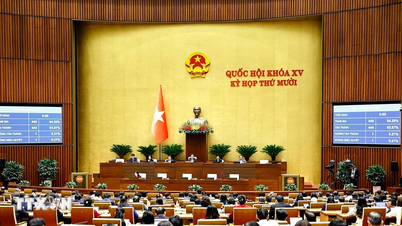
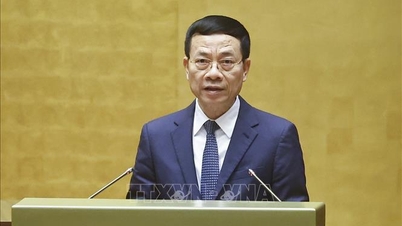
Minister of Information and Communications Nguyen Manh Hung presented a report on the responses and explanations to the discussions in the working group regarding the revised Telecommunications Law project, in preparation for the plenary session this morning, June 22nd.
Not in line with international commitments.
The report from the Minister of Information and Communications stated that some opinions suggested reviewing, clarifying, and differentiating the scope of application of the Telecommunications Law from the Electronic Transactions Law, the Information Technology Law, etc.
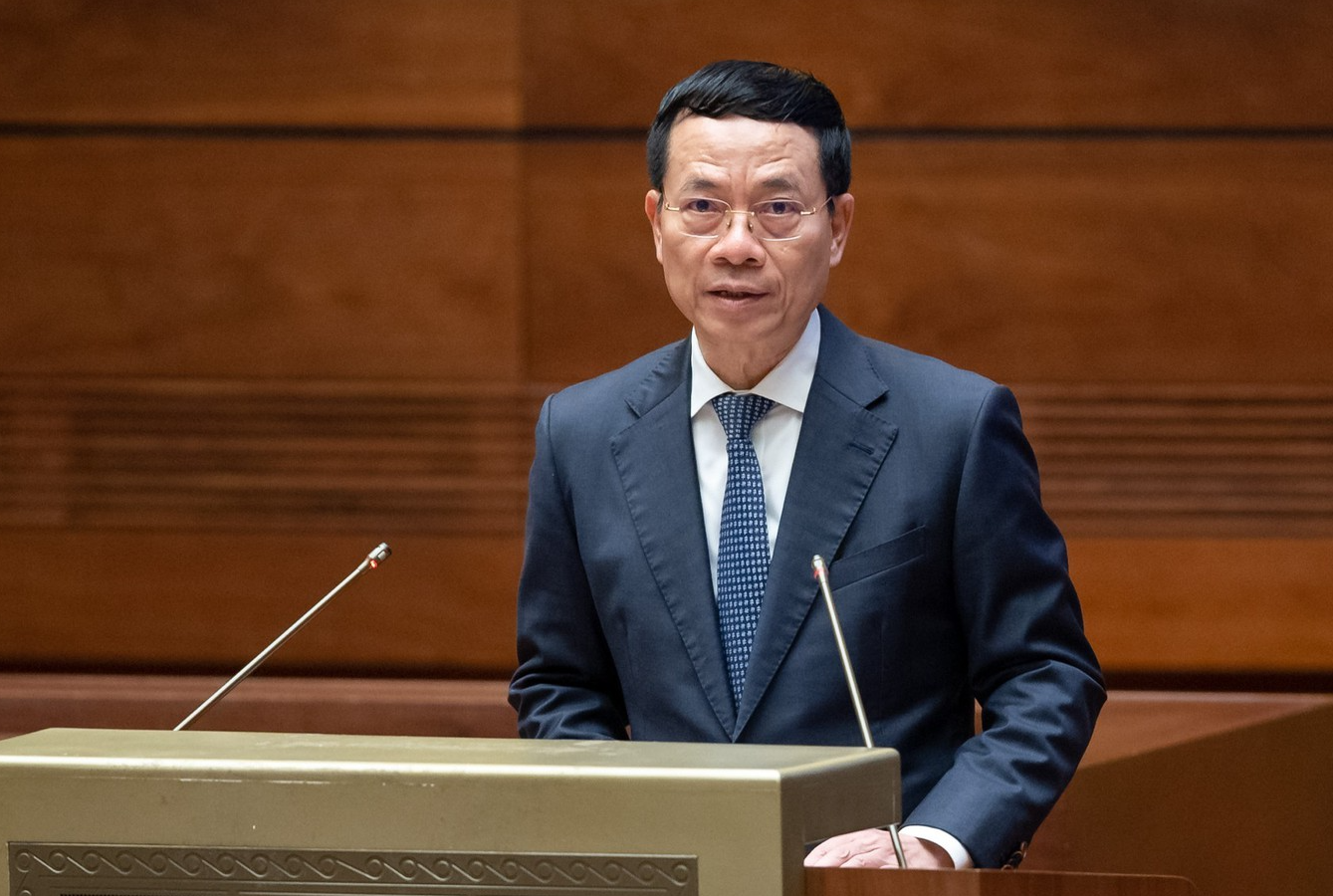
Minister of Information and Communications Nguyen Manh Hung presented the revised Telecommunications Law project to the National Assembly on June 2nd.
Some opinions suggest conducting thorough research on data center services, cloud computing, and OTT telecommunications to develop appropriate policies and management methods that ensure strict compliance, feasibility, and limit increased compliance costs for businesses, thereby mitigating the benefits offered by these emerging services and aligning with international commitments.
There have also been suggestions to consider expanding the scope of the draft law to include data center and cloud computing services.
Accordingly, National Assembly representatives argued that the provisions of the Telecommunications Law regarding the management of data center and cloud computing services are inconsistent with international commitments.
Changing the classification of these two services from information technology and information services to telecommunications services would impose market access restrictions on foreign investors (restrictions on investment capital and market access conditions). This would lead to violations of international commitments, especially the CPTPP Agreement.
Furthermore, the regulations as drafted create legal barriers and increase administrative procedures for this type of service, reducing Vietnam's competitiveness in attracting investment.
Currently, only a few countries in the world (such as China, Thailand, and Egypt) classify these services as telecommunications services. However, with the exception of China, no country imposes restrictions on investment capital.
Regulations will be implemented in a way that promotes lenient management.
Explaining this issue, Minister Nguyen Manh Hung said that the Ministry of Information and Communications will report to the Government to adjust the regulations of the law towards light-touch management of these services.
Mr. Hung explained that the telecommunications OTT service market is highly competitive and strongly self-regulating, so the level of state management should only be sufficient to avoid hindering the participation of businesses in providing services.
As for data center services and cloud computing services, these are service infrastructures that perform data storage and processing.
International experience shows that the management of these services emphasizes data protection. Therefore, in terms of managing these services within telecommunications law (market access management, business conditions, quality, etc.), a less stringent management approach could be considered to promote development.
Regarding the proposal to exclude data center and cloud computing services from the revised Telecommunications Law, Mr. Hung stated that while the Investment Law has identified data centers as a conditional business sector, there are currently no specialized regulations to clarify the business conditions and the legal framework governing the provision and use of these services.
The Telecommunications Law regulates the business activities of data center and cloud computing services to create a clear and favorable legal environment, giving businesses confidence to invest.
Data center and cloud computing infrastructure is a crucial component of the national digital infrastructure and the economy's infrastructure. Protecting user rights and ensuring cybersecurity for data center and cloud computing services is a major issue that needs to be institutionalized.
Mr. Hung affirmed that many countries around the world have regulations at various levels to manage data center and cloud computing services. Therefore, the Telecommunications Law stipulates the rights and responsibilities of data center and cloud computing service providers in ensuring the rights of users and guaranteeing security.
In addition, Mr. Hung explained that the demand for electricity for data center development is very high. Therefore, data center services fall under the scope of the Telecommunications Law and should be included in the National Telecommunications Development Plan.
The national telecommunications plan will designate areas that meet the power supply requirements for businesses investing in data centers, encouraging their development.
Source link
















































































Comment (0)