

Having been involved in the textile and garment industry since its early days, nearly 30 years ago, Mr. Nguyen Cao Phuong, production manager of Viet An Garment Company (name changed at request) , has never felt the industry is as difficult as it is now.
In 2020, when the pandemic broke out in China, the textile and garment industry suffered the consequences of an inherent weakness: over-reliance on outsourcing and dependence on foreign supply chains for raw materials. At that time, Vietnam imported 89% of its fabric for export production, with 55% coming from its populous neighbor. The previously smooth-running supply chain completely broke down due to a raw material shortage when China froze trade to combat the pandemic.
Mr. Phuong recognized this "Achilles' heel" many years ago, but he had no choice.
Export partners refuse to accept subcontracted work if the materials, including glue, lining fabric, and buttons, do not come from designated suppliers. As a result, profits are reduced because price negotiations are almost impossible. Businesses that want to make a profit have to "eat into" labor costs.
Viet An was established in 1994, seizing the opportunity when the Vietnamese economy welcomed its first wave of FDI. It was from the orders shared by these FDI "guests" that Mr. Phuong nurtured the ambition to build a large enterprise to dominate the domestic market, just as the Koreans and Chinese had successfully done.
One of Vietnam's goals in attracting FDI during that period was to create a stepping stone for domestic businesses to take off alongside the "eagles." But after three decades, despite the company's size reaching over 1,000 employees, Viet An has yet to find a way out of its last place in the textile and garment value chain.
"Golden hoop" cut and sewn
The three main production methods in the textile and garment industry, in order of increasing profitability, are: contract manufacturing (CMT), where inputs are supplied by the buyer; factory-directed production (FOB), where the factory independently purchases raw materials, manufactures, and delivers the goods; and original design (ODM), where the contract manufacturer is involved in the design process.
For the past 30 years, Mr. Phuong's company has followed the first method – always using raw materials specified by the ordering partner, including fabric, glue, and buttons, otherwise the order will be rejected. According to in-depth research on the Vietnamese textile and garment industry previously published by FPTS Securities Company, this method only yields an average profit margin of 1-3% on the processing unit price, the lowest in the entire value chain.
Mr. Phuong's company's situation is not an exception. Approximately 65% of Vietnam's textile and garment exports are made using the CMT (Cut, Make, Trim) method. FOB (Free On Board) orders – the more profitable method – account for 30%; while ODM (Original Design Manufacturer) orders – the most profitable segment – only account for 5%.
"There was a time when we found it completely unreasonable to import lining fabric from China when Vietnam could produce it at a lower price, so we decided to buy domestically," the manager of Viet An recounted about a time when he went against a partner's wishes about 10 years ago. He explained that they only specified the raw materials as suggestions, so they could be flexible with suppliers, as long as the product quality wasn't compromised.
This risky move caused Viet An to struggle. The brand found fault with everything, and the goods were returned even though, according to him, the lining fabric did not affect the product quality. After that, the company continued to depend on raw materials specified by its partners.
From the perspective of a foreign partner, Ms. Hoang Linh, a factory manager with 5 years of experience working for a Japanese fashion corporation, explains that global brands almost never allow manufacturing businesses to freely choose their input suppliers.
In addition to the two mandatory criteria of quality and price, brands must ensure that the companies supplying raw materials do not violate social and environmental responsibilities to avoid risks. For example, the US banned the import of garments using Xinjiang cotton in 2021, arguing that labor conditions there did not meet standards.
"If brands give factories the right to purchase raw materials, they also need to know who their partners are in order to hire an independent auditing firm to conduct a comprehensive assessment. That process takes at least several months, while the production schedule is already planned a year in advance," Linh explained.
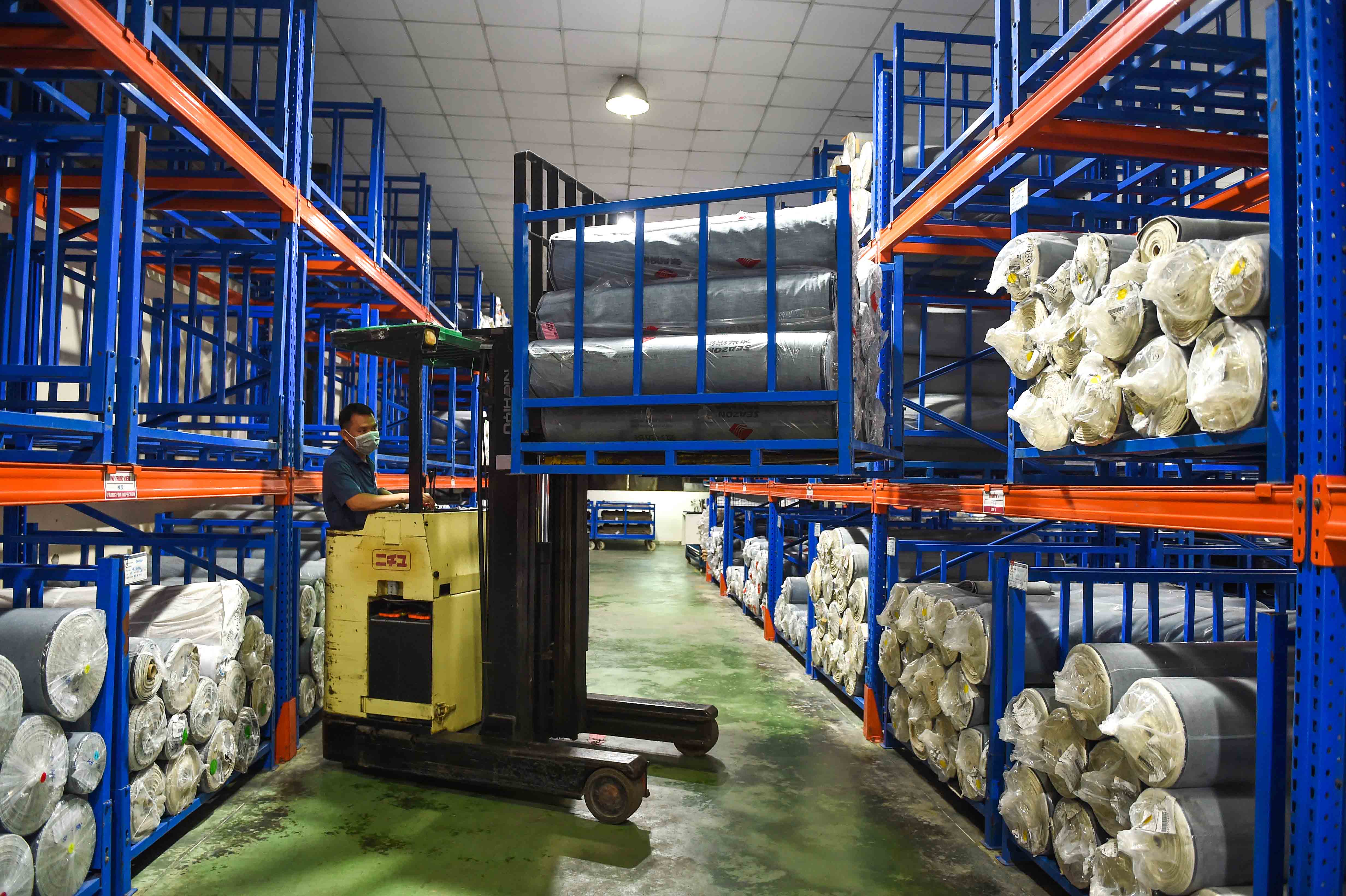
Vietnam's textile and garment industry still relies heavily on external sources for raw materials, primarily China. The photo shows the interior of the fabric warehouse at Viet Thang Jeans factory, November 2023. Photo: Thanh Tung.
Unable to break free from the traditional cut-and-sew operation, Mr. Phuong's company faced even greater difficulties when the textile and garment industry experienced a crisis of orders from the middle of last year. Factories were desperate for work, brands were driving down prices, and profits plummeted.
"The company needs orders to keep thousands of workers employed; we have to keep going even if it means losing money," he said. With no other option, he had to lower the unit price, meaning workers had to work harder for the same income.
With low profit margins, domestic companies like Viet An, which are primarily engaged in garment manufacturing, lack the cash flow to withstand market shocks or reinvest for expansion.
Textile and garment exports continue to grow steadily, but the contribution from domestic enterprises has not significantly improved over the past 10 years. More than 60% of textile and garment export value comes from FDI, even though foreign enterprises only account for 24%. In the footwear industry, FDI also holds more than 80% of export value.
The proportion of domestic and FDI enterprises' contributions to the export value of textiles, garments, and footwear.
Source: General Department of Customs.
30 years of decline
"Vietnamese businesses are losing even on their home turf," concluded Ms. Nguyen Thi Xuan Thuy, an expert with nearly 20 years of research on supporting industries, regarding the current state of the textile, garment, and footwear industries.
Ms. Thuy believes it's regrettable that Vietnam once had a complete textile and garment supply chain system, but today it's lagging behind. Previously, the textile and garment industry exported both clothing and domestically produced fabrics. However, economic integration has led the industry to a new turning point: a rush into outsourcing, relying on its biggest comparative advantage: low labor costs.
Ms. Thuy analyzed that it was the right choice at the time of opening up to attract FDI, because Vietnam was then technologically backward and naturally could not compete in terms of yarn and fabric quality with Japan and South Korea. But the problem is that this disadvantage in raw materials has lasted for the past 30 years.
"Initially, we accepted using foreign fabrics, but we should have continued to nurture the domestic textile and yarn industry, learning technology with the goal of catching up with them," Ms. Thuy said, arguing that the textile industry itself had severed links in its own supply chain.
The increase in textile and footwear exports, along with the trend of importing fabrics and accessories, shows the industry's dependence on raw materials.
According to expert Thuy, the loopholes in businesses' supply chains only truly reveal their consequences when Vietnam participates in new-generation free trade agreements such as EVFTA and CPTPP. To benefit from preferential export tariffs, garments "made in Vietnam" must ensure that their raw materials are also domestically sourced. Businesses that only do garment processing now face a "loss" because they are completely dependent on foreign fabrics.
"The ultimate beneficiaries of these agreements are FDI enterprises because they have large resources and invest in a comprehensive and complete yarn-textile-garment chain," Ms. Thuy analyzed. In the period 2015-2018, just before the EVFTA and CPTPP came into effect, Vietnam was the country receiving the most FDI from South Korean, Taiwanese, and Chinese textile and garment investors.
According to experts, this is not only the fault of the government but also of the businesses.
The world's leading industrialized nations all started with the textile industry, then sought to move up the value chain. For example, Germany continues to research new materials and textile technologies for application in the textile industry. For decades, the United States has been the world's largest supplier of cotton and cotton yarn, with the government providing subsidies to cotton farmers. Japan has for many years mastered fabric technologies such as heat retention, cooling, and wrinkle resistance, which are applied in high-end fashion.
"They preserved everything that held the highest, most essential value for their country," expert Thuy concluded.

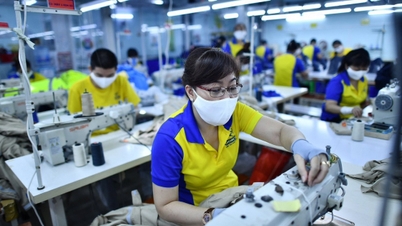
Vietnamese textile and garment workers are still primarily focused on processing and finishing work, unable to move up the value chain. Photo: Thanh Tung
Meanwhile, Vietnam has almost wasted its prime time attracting FDI for the past 35 years. In 1995, when the US and Vietnam normalized relations, the textile and garment industry boomed. However, for the past three decades, the industry has only focused on garment processing, failing to invest in research and development, fabric production, etc.
"The policies lacked foresight, and businesses were too focused on short-term gains," the expert said.
Initially, Vietnam's textile and garment industry followed a chain-based model, meaning businesses owned factories for weaving, yarn production, and garment manufacturing. However, when export orders became too large and customers only wanted garment processing, Vietnamese businesses abandoned other stages of production. Only a few state-owned corporations, with comprehensive investments made decades ago, such as Thanh Cong and member companies of the Vietnam Textile and Garment Group (Vinatex), still control the supply chain.
This situation has led to the current imbalance: the total number of businesses involved in yarn spinning, weaving, dyeing, and related supporting industries combined is only slightly more than half the number of garment companies, according to data from the Vietnam Textile and Garment Association (VITAS).
The "fish head" of the industry.
"If Ho Chi Minh City's industries were considered a fish, then the textile and garment industry would be like its head, which could be cut off at any time," lamented Mr. Pham Van Viet, General Director of Viet Thang Jean Co., Ltd. (Thu Duc City).
Labor-intensive industries such as textiles and footwear are facing pressure to relocate or innovate, according to the plan for the development of export processing zones and industrial parks for the period 2023-2030 and a vision to 2050, which Ho Chi Minh City is currently finalizing. The city's future orientation is to focus on developing eco-friendly, high-tech industrial parks.
"Nowadays, all we hear about is high technology everywhere we go. We feel very self-conscious and discriminated against because we're labeled as labor-intensive and polluting," he said.
To gradually transform, Viet Thang Jean has automated its machinery and applied technology in laser washing, bleaching, and spraying processes, reducing water and chemicals by up to 85%. However, the company is essentially left to fend for itself during this process.
According to Mr. Viet, to borrow capital for investment, companies must mortgage their assets. Typically, banks appraise 70-80% of the actual value, then lend 50-60%, while investing in technology and machinery is very expensive.
"Only business owners who truly care about the industry would dare to invest," Mr. Viet said.
With over three decades of experience in the industry, CEO Viet Thang Jean believes that for this sector to move up the value chain, the responsibility lies not only with businesses but also with policies. For example, the city needs to invest in a fashion center to train personnel, research fabrics, control the supply of raw materials, and introduce products… Associations and businesses will participate together.
When relocation is not possible, businesses must choose to leave the city or downsize. In either case, the workers are the ones who ultimately suffer.

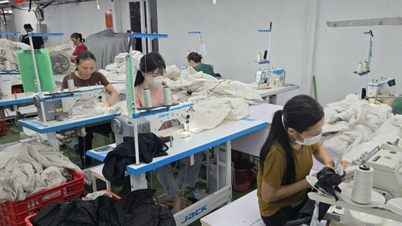
Sewing workers at the Viet Thang Jeans factory, November 2023. Photo: Thanh Tung
The policy, as stated in the document, does not overlook businesses in traditional industries. The Politburo's resolution on the orientation for national industrial policy development until 2030, with a vision to 2045, sets out the requirement to continue developing the textile, garment, and footwear industries, but prioritizes focusing on high value-added stages, linked to smart and automated production processes.
However, in reality, domestic businesses willing to invest in fabric production still face obstacles, according to Tran Nhu Tung, Vice President of the Vietnam Textile and Garment Association (VITAS).
"Many localities still think that textile dyeing is polluting and therefore refuse to grant permits, even though advanced technologies can handle it safely," Mr. Tung said.
The Vice President of VITAS emphasized that green production is now a mandatory requirement worldwide, so if businesses want to sell their products, they must be aware of sustainable development. However, if many localities still hold prejudices, Vietnam's textile and garment supply chain will continue to be deficient.
While Vietnam has yet to master the supply of raw materials, its biggest advantage over the years has been its increasingly lower labor costs compared to developing countries like Bangladesh and Cambodia.
Comparing Vietnam's textile industry with that of several other countries.
The economy cannot simply "follow trends".
Vietnam in general and Ho Chi Minh City in particular are placing high hopes on "next-generation" industries such as semiconductors, the green economy, and the circular economy, according to Associate Professor Dr. Nguyen Duc Loc, Director of the Institute for Social Life Research.
"There's nothing wrong with this because it's a global trend, but given the current circumstances, it needs careful consideration. It could be a double-edged sword. The economy can't just follow trends," he said.
For example, the semiconductor industry is expected to need 50,000 workers, but domestic labor is projected to meet only 20% of that need. Two scenarios could unfold: investors might come but Vietnam lacks the necessary workforce, forcing them to bring in personnel from abroad; or they might abandon the investment altogether.
"Either way, we'll lose out. If they invest and bring their own people over, Vietnam will just be serving up the meal for others to enjoy. But if the businesses back out, our plan will be ruined," Mr. Loc said.
In this context, he argued that we shouldn't just focus on "following trends" in the semiconductor or high-tech industries, while neglecting traditional industries that bring in export value for Vietnam. For example, the textile and garment industry brings in billions of USD annually. With three decades of development, businesses have at least some experience; the task now is to help them move up the value chain.
"Let's keep the train running according to the 30-30-30-10 principle," Mr. Loc suggested. This principle involves maintaining 30% of traditional industries, 30% of industries that need to adapt, 30% of investments in "trending" industries, and 10% for breakthrough industries.
Experts liken this approach to a flock of birds protecting each other. New-generation industries fly at the forefront, while traditional, aging industries follow behind, forming an arrowhead shape moving forward. This method not only helps the entire flock fly faster, but more importantly, it protects the workforce in traditional industries, preventing the creation of another generation left behind and becoming a burden on the social safety net.
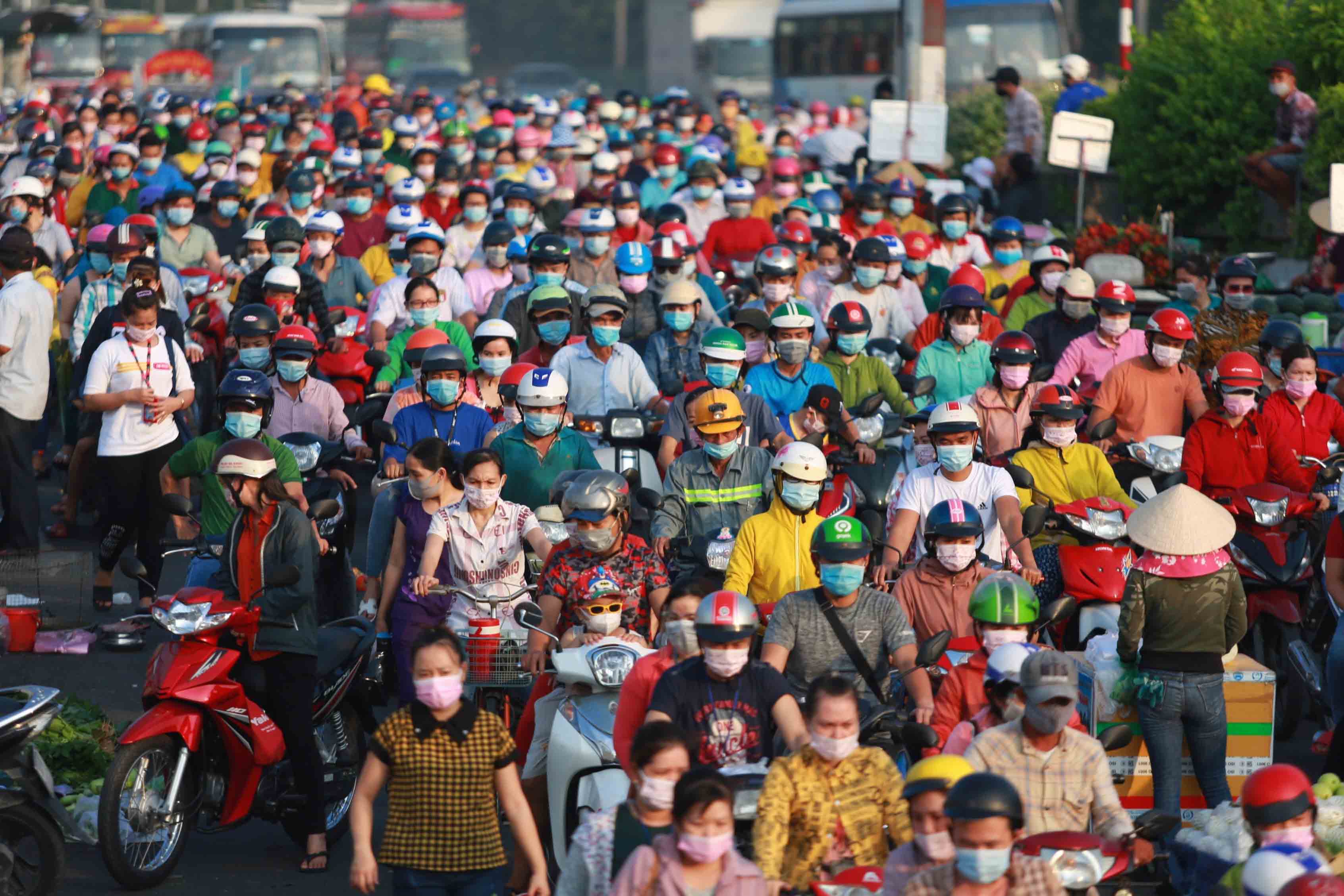
The garment industry currently employs over 2.6 million workers – the largest number among all industrial sectors. The photo shows workers at a garment factory in Binh Tan district leaving work. Photo: Quynh Tran
Along with supporting traditional industries, the state must also take responsibility for guiding and assisting the next generation of workers affected by this transition. Associate Professor Dr. Nguyen Duc Loc suggested that Vietnam learn from South Korea's approach by establishing a Labor Fund to support vocational training, healthcare, financial counseling, and other services for workers.
Expert Nguyen Thi Xuan Thuy argues that it is necessary to frankly acknowledge that Vietnam's ability to compete on labor costs will soon disappear. Therefore, policymakers need to prepare for two tasks in the near future: supporting unskilled laborers in transitioning to other industries, and repositioning Vietnam within the value chain.
In the first part, she cited Singapore's approach, where the government establishes career counseling and guidance centers in industrial zones to encourage workers to consider career changes. These centers record the thoughts and desires of workers, then provide advice and offer options for them to choose from. Depending on the needs, the government will offer training courses or subsidize the costs for workers to independently learn new skills.
Regarding the second task, experts believe that Vietnam still has many opportunities as FDI flows in thanks to three advantages: a large market size of 100 million people, favorable geopolitics; the shift of supply chains from China; and the greening trend of the European Union (EU) which forces businesses to restructure their supply chains.
"We have missed a lot of time. But with the right direction, Vietnamese businesses can still catch up with FDI corporations," Ms. Thuy said.
Content: Le Tuyet - Viet Duc
Data: Viet Duc
Graphics: Hoang Khanh - Thanh Ha
Lesson 4: "The Eagle" Stays as a Guest
Source link














































































![[Infographic] Many activities at the 96th anniversary commemoration of the death of Deputy Scholar Nguyen Sinh Sac](https://vphoto.vietnam.vn/thumb/402x226/vietnam/resource/IMAGE/2025/12/11/1765441454787_infographic-nhieu-hoat-dong-tai-le-gio-lan-thu-96-cua-cu-pho-bang-nguyen-sinh-sac20251211010322.webp)













Comment (0)