

"Eve," a robotic fish powered by hidden pumps, can swing its silicon tail from side to side to glide gracefully through the icy waters of Lake Zurich. It's being tested by SURF-eDNA, a student-led group. They've spent the last two years building a school of soft robotic fish – Eve being the latest addition.
"By making Eve look like a fish, we can minimally intrude on the ecosystem being studied," said master's student Dennis Baumann, adding that this biomimetic design would prevent other fish or marine life from being startled by its presence.
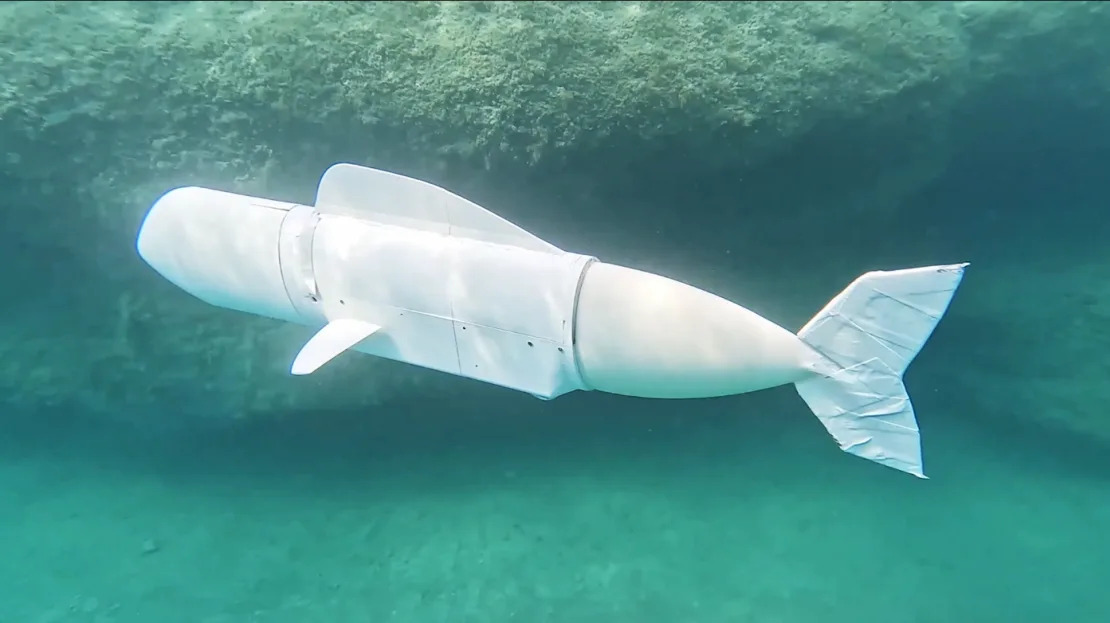
A robotic fish designed and developed by students at ETH Zurich. Photo: SURF eDNA
Besides its ability to camouflage itself as a fish, the Eve autonomous underwater vehicle (AUV) is also equipped with cameras for underwater filming, as well as sonar technology that allows it to avoid obstacles.
AUVs also have filters to collect DNA from the environment, known as "eDNA," as it swims. These eDNA particles can be sent to a laboratory for sequencing to determine which species live in the water.
"All living organisms in the environment shed their DNA, so there's DNA floating around that we can find," said postdoctoral researcher Martina Lüthi at ETH Zurich.
The students hope Eve can provide scientists with a more detailed picture of the ocean and the creatures that live in it. Although it covers more than 70% of the Earth, much of what lies beneath the ocean remains a mystery.
Tools like AUVs and remotely operated vehicles are increasingly being used to explore the ocean and learn more about underwater habitats. For example, the California-based startup Aquaai has developed a clownfish-like unmanned vehicle that can collect information such as oxygen, salinity, and pH levels in waterways. Last year, one of its autonomous vehicles recorded footage of the fish at the deepest depth ever captured on camera (8,300 meters).
The use of eDNA to monitor biodiversity is growing. More advanced tools capable of studying the environment in greater detail could play a crucial role in protecting the oceans, especially at a time when ocean habitats are facing unprecedented threats from climate change, overfishing, and other human activities.
"We want to build a reliable tool for biologists," Baumann said, adding that he hopes one day they can scale up their technology so that any scientist who wants to use it can access it.
Hoai Phuong (according to CNN)
Source: https://www.congluan.vn/gap-go-eve-chu-ca-robot-thu-thap-dna-post307367.html
![[Photo] “Red Journey” 2026: Vietnamese Youth Continue Building the Bridge of Friendship Between Vietnam and China](https://vphoto.vietnam.vn/thumb/1200x675/vietnam/resource/IMAGE/2026/04/20/1776629730866_4055880775670638308-9618-4200-jpg.webp)












































































Comment (0)