

On the morning of December 10, at the 6th session of the 10th term Ho Chi Minh City People's Council, the question-and-answer session continued with Director of Ho Chi Minh City Department of Construction Tran Quang Lam.

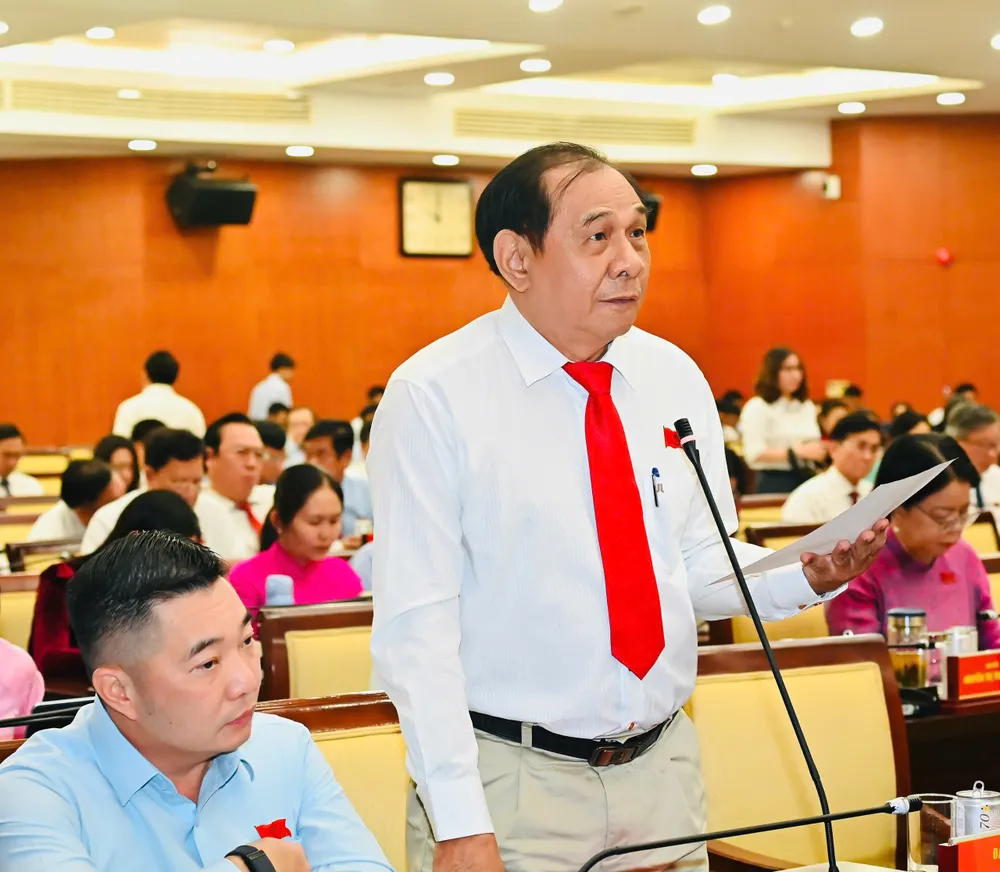
Questioning the Director of the Department of Construction of Ho Chi Minh City, delegate Tran Quang Thang stated that to develop electric vehicles, it is necessary to build charging stations first. So what is the city's policy to support land, charging station locations and charging electricity prices?
Responding to questions, the Director of the Department of Construction said that Ho Chi Minh City is a leader in green transformation. And to develop green transportation, the prerequisite is to have charging points. Currently, the city has about 1,000 electric car charging locations.
Currently, Ho Chi Minh City has 627/2,386 electric buses (accounting for 26.3%) with 5 electric bus charging stations with 56 super-fast charging posts, serving about 700 electric buses.
Ho Chi Minh City also has more than 13,000 electric taxis (accounting for 71%). By the end of June 2025, the whole city will have nearly 40,000 electric cars and nearly 87,000 electric motorbikes.
With the world 's general recommendation of about 10 cars/charging station and 50 motorbikes/charging station, the city needs about 3,960 charging stations for cars and about 1,740 charging stations for electric motorbikes. The city is reviewing public land locations such as parks, vacant land, parking lots, and sidewalks with space to install charging stations/battery exchange cabinets. In the near future, the city has 19 large bus stations, meeting nearly 2,000 charging stations.
Continuing the questioning, Deputy Nguyen Duc Hieu cited the A41 Canal renovation project and questioned the breakthrough solution to completely resolve and soon put the project into use to solve the flooding situation at Tan Son Nhat airport and surrounding areas.

Representative Nguyen Duc Hieu asks a question. Photo: VIET DUNG
Mr. Tran Quang Lam said that since the end of 2024, the investor has organized the construction of the A41 Canal Improvement Project (approved in 2016), and has so far achieved about 73% of the construction volume for installing box culverts. However, currently, only 128/142 cases have agreed and received money, and 114 cases have dismantled the project and handed over the empty site for construction.

Also related to the delay in project implementation, Deputy Chau Truong Hoang Thao requested to clarify the responsibility of the Department in ensuring the progress and quality of traffic projects. In reality, there are traffic projects that are behind schedule due to reasons related to appraisal, planning, technical document guidance and construction supervision.
Mr. Tran Quang Lam explained that planning adjustment procedures often take a long time (affecting the progress of Nguyen Khoi bridge and road, Binh Tien bridge and road...)

In addition, there are situations where, during the investment policy formulation stage, the investment scale in the final stage has not been carefully studied, and the investment phase 1 has been divided appropriately; overlapping investment policies have led to difficulties in the implementation process, such as the My Phuoc - Tan Van project...
However, he also acknowledged that the causes were due to the management capacity of the investor, the capacity of the contractor participating in the project, site clearance work, etc. Faced with the above problems, the Department has advised the Ho Chi Minh City People's Committee on many solutions to overcome them.

Before answering questions, the Director of the Department of Construction informed that the city has been investing in the beltway system and radial highways.
"Certainly by 2030, the city will have a seamless, regionally connected transport framework," Mr. Tran Quang Lam affirmed, adding that the city is continuing to invest in six urban railway lines.
According to the Director of the Department of Construction, with Resolution 188 of the National Assembly , along with the amendment and supplementation of Resolution 98/2023/QH15 with strong decentralization and delegation mechanisms for Ho Chi Minh City to be autonomous in deciding to invest in many large projects; or decentralization of planning, use of revenue from TOD... are advantages for the city to develop in the new period.
Source: https://www.sggp.org.vn/giam-director-so-xay-dung-tphcm-ra-soat-cac-vi-tri-lap-dat-tram-sac-cho-xe-dien-post827856.html


![[Photo] Explore the US Navy's USS Robert Smalls warship](/_next/image?url=https%3A%2F%2Fvphoto.vietnam.vn%2Fthumb%2F1200x675%2Fvietnam%2Fresource%2FIMAGE%2F2025%2F12%2F10%2F1765341533272_11212121-8303-jpg.webp&w=3840&q=75)

![[Photo] The captivating scenery of the fragrant maple forest in Quang Tri](/_next/image?url=https%3A%2F%2Fvphoto.vietnam.vn%2Fthumb%2F1200x675%2Fvietnam%2Fresource%2FIMAGE%2F2025%2F12%2F10%2F1765353233198_lan09046-jpg.webp&w=3840&q=75)





















![[Video] The craft of making Dong Ho folk paintings has been inscribed by UNESCO on the List of Crafts in Need of Urgent Safeguarding.](https://vphoto.vietnam.vn/thumb/402x226/vietnam/resource/IMAGE/2025/12/10/1765350246533_tranh-dong-ho-734-jpg.webp)





















































Comment (0)