

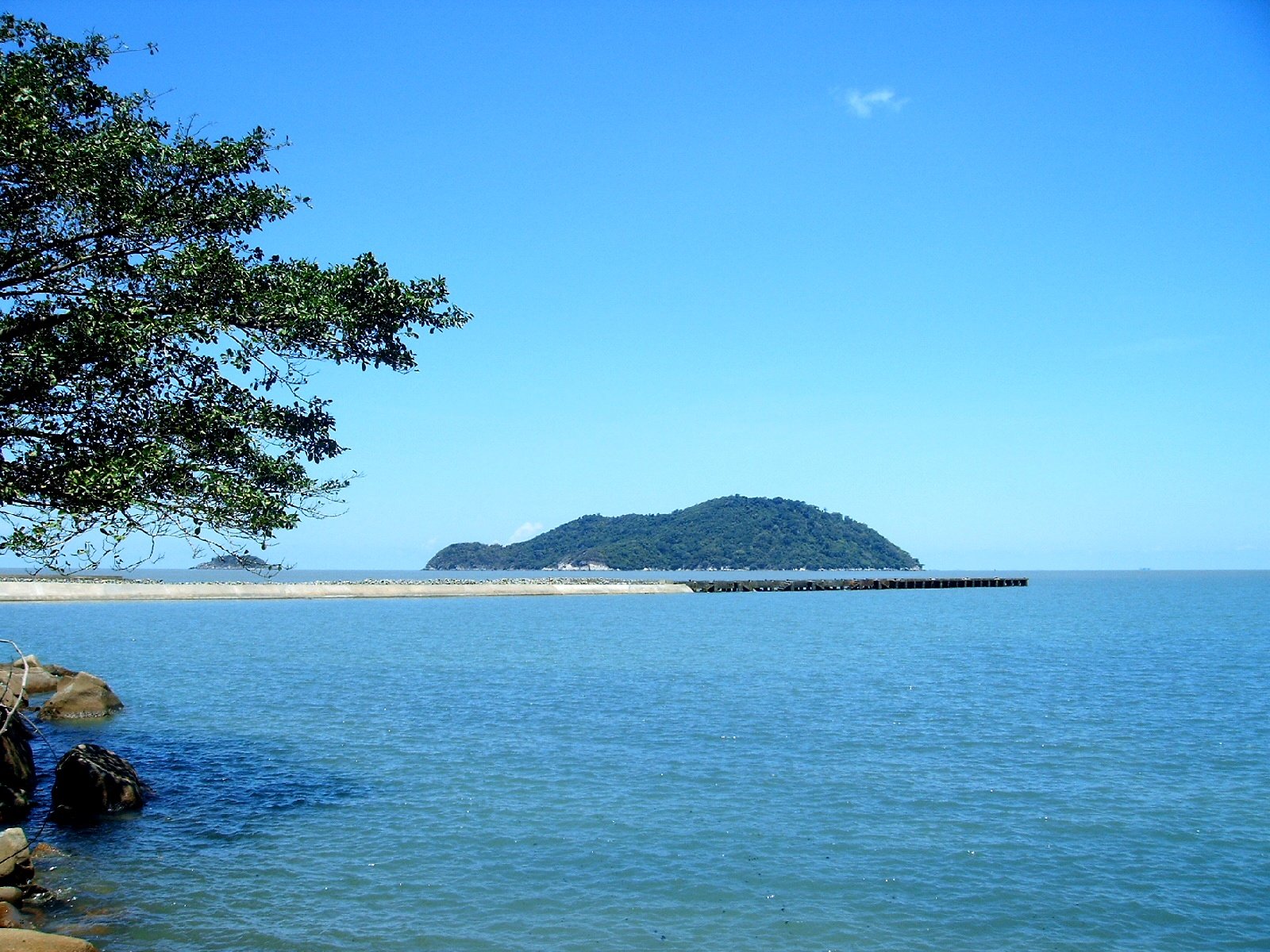
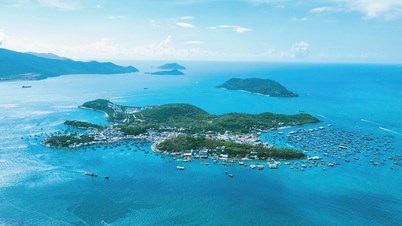
Hon Khoai Island is located about 25km from the mainland at the mouth of Rach Goc River.
The boat took us to Hon Khoai ( Ca Mau ). On both sides of the Rach Goc River, fishing villages were still asleep in the hazy mist. To the east, the sky was tinged with a soft orange hue. A new day had begun. At 6:15 a.m., the boat docked at the Rach Goc Border Guard Station. The captain, who was also the owner of the boat CM 8163 TS, presented his papers and completed the procedures. The border guards counted the people and checked the buoys. The boat retreated, then headed straight towards the sea. The sun had risen, the sea was vast and shimmering. The boat cut through the water towards Hon Khoai. On the mainland, only the towering mangrove forests were visible, like a fortress wall protecting the sea. Hon Khoai was already visible, a cluster of blue trees ahead. Hon Khoai is about 25km from the mainland at the Rach Goc estuary. The fishing boat carrying us was traveling at a speed of 6 nautical miles. "We'll reach Hon Khoai in two hours," someone on the boat said.
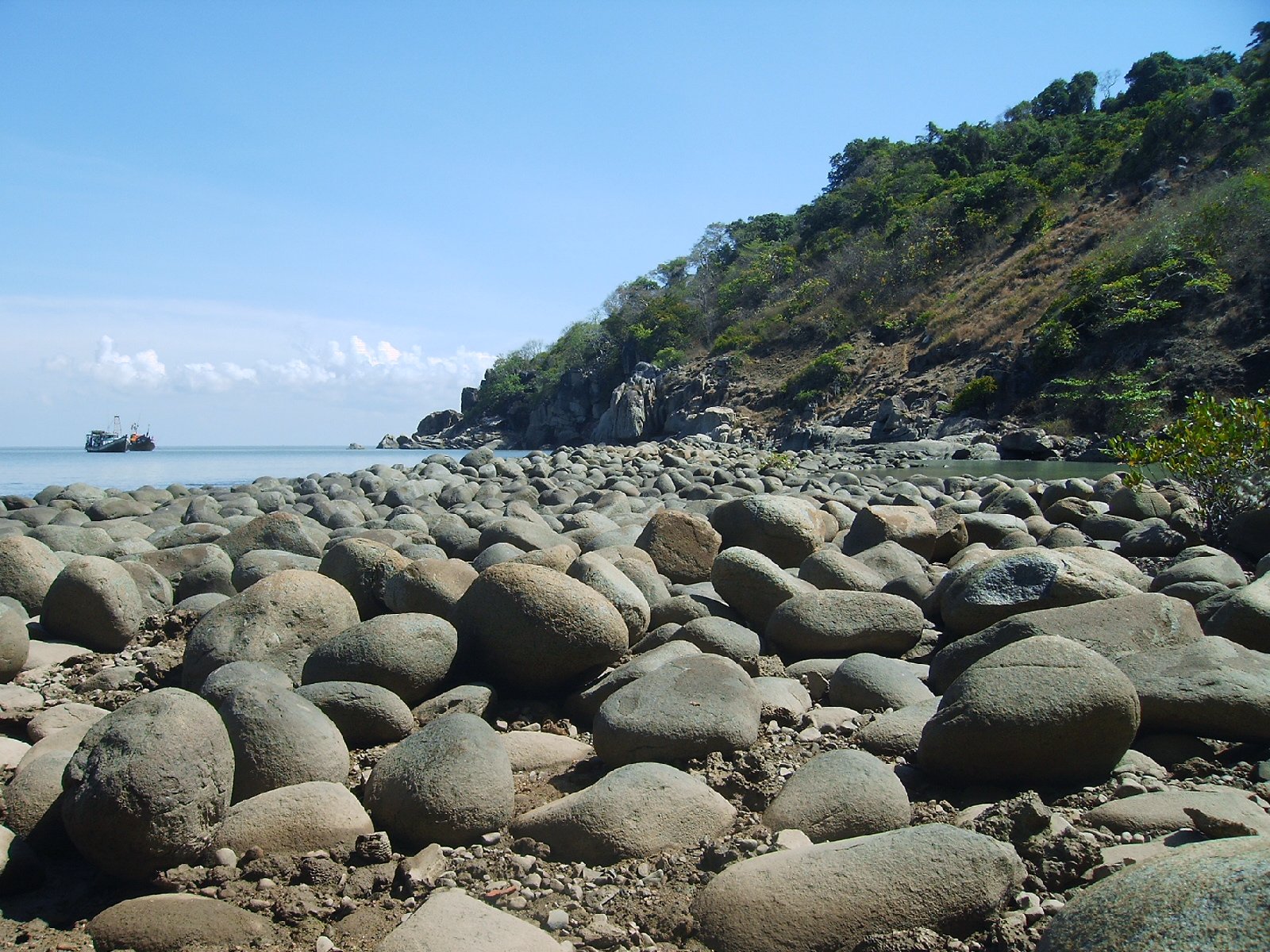
The seawater gradually turned a light blue, no longer murky like near the shore. Hon Doi Moi, Hon Tuong, Hon Sao gradually appeared,... then Hon Khoai. Millions of years of rock erosion by the waves created bizarre shapes at the base of the mountains! Hon Tuong resembled a giant elephant half-submerged in the sea. The boat docked at Bai Nho beach on the southwest side of the island. The trees on the mountain were lush, giving it a wild, romantic appearance... Bai Nho beach was shallow, so the boat couldn't dock right up to the pier. Passengers had to get off in small boats to reach the shore, about 40 meters away. To the right of the pier was a beautiful beach of egg-shaped rocks, as if arranged by some unseen hand!
Border Guard Post 700 is nestled against the mountainside. The Hon Khoai Forest Ranger Station is also located nearby. In fact, there are no inhabitants on Hon Khoai Island. The Navy is stationed at Bai Lon, on the eastern side of the island. A task force from the Maritime Safety Assurance Company oversees the lighthouse located at 8°25'36" North latitude and 104°50'06" East longitude, atop a peak 317.5 meters high.
My friends and I from Doan Tan An commune, Ngoc Hien district (formerly Ca Mau province) began climbing the mountain path to reach the lighthouse on the summit of Hon Khoai. The path through the forest was quite treacherous, with steep slopes and jagged rocks. Yet, the trees were unusually lush and strong! I stood there, admiring the large Barringtonia trees, so large that it would take seven or eight people to encircle them with their arms. Walking beneath the forest canopy, we saw many ancient Lagerstroemia trees. Dipterocarpus, Dipterocarpus, and other species of trees were scattered along the mountain slopes. Birds chirped in the forest trees with their clusters of ripe, dark fruit. A faint, silvery fragrance of magnolia wafted through the mountains. Occasionally, we crossed small streams and creeks, their clear water reflecting our faces. The winding path to the lighthouse, about 3km long, took almost two hours to reach. The Hon Khoai lighthouse has a diesel-powered generator. In addition, there are solar panels that absorb energy and convert it into electricity for lighting, watching TV, etc.
The Hon Khoai lighthouse is part of the Can Gio - Con Dao - Phu Quoc lighthouse system, built by the French in 1939 and subsequently upgraded and repaired. The lighthouse is 15.7 meters high, with each side measuring 4 meters, constructed of rubble stone, and features a spiral staircase inside. Its searchlight illuminates up to 35 nautical miles.
On the summit of Hon Khoai, next to the lighthouse, there is a stele briefly recording the Hon Khoai uprising led by teacher Phan Ngoc Hien. Several rows of stone houses built during the French colonial period stand desolate and dilapidated, as a testament to time. We descended the mountain, circling around the eastern side of Hon Khoai along a gently sloping asphalt road, amidst the intertwining canopy of forest trees (*). There were a few sharp and steep bends. Bai Lon beach appeared like a miniature Nha Trang. The sea was clear blue, with distant, gently rippling waves, sparkling. Fishing boats bobbed on the waves, and the wind rustled through the bay. The sea, forest, and rocky mountains intertwined, creating a poetic and pristine natural landscape.
We took a shortcut up the mountain to get back to Bai Nho, exhausted from the steep mountain road. Hon Khoai Island is only 561 hectares, with freshwater available year-round. During the dry season, coastal residents of Ca Mau and fishing boats often stop at Hon Khoai to get water. Scientists , environmental activists, and those concerned about Hon Khoai have legitimate concerns for this small island. If not strictly protected, the island's flora and fauna risk becoming depleted because the forest area is small and far from the mainland, lacking interaction and replenishment between species. Human impact is also a noteworthy consideration when considering tourism on the island. Exploitation and conservation must be two parallel and closely intertwined criteria for the natural environment. We arrived at the forest ranger station on the mountainside just before noon. The meal consisted of braised pomfret, sour soup with sea bass head and sliced wild banana, boiled crab with chili salt dip, stingray stew, boiled mantis shrimp, and steamed tiger prawns with beer... Hon Khoai seemed to have everything, except perhaps the presence of people! We boarded the boat back to the mainland. The commander, deputy commander, and soldiers stood on the pier waving goodbye. The green sign with the words "Border Guard Post 700" faded into the distance and then disappeared into the twilight over the sea.../.
(*) "Giao đu" (local term): Trees and foliage on both sides spread out, covering roads, rivers, streams, and paths like a canopy.
Hoang Tham
Source: https://baolongan.vn/hon-khoai-hoang-so-hon-ngoc-tho-a198111.html
















![[Photo] Reception to welcome General Secretary and President To Lam and his wife on their State visit to the Philippines](https://vphoto.vietnam.vn/thumb/1200x675/vietnam/resource/IMAGE/2026/06/01/1780295488620_vna-potal-chieu-dai-chao-mung-tong-bi-thu-chu-tich-nuoc-to-lam-va-phu-nhan-tham-cap-nha-nuoc-toi-philippines-8798060-7855-jpg.webp)
















































Comment (0)