

DNVN - The Hong Kong (China) government has just announced a plan to spend approximately US$77 million to convert public transport to electric vehicles, aiming to reduce emissions and achieve carbon neutrality by 2050.
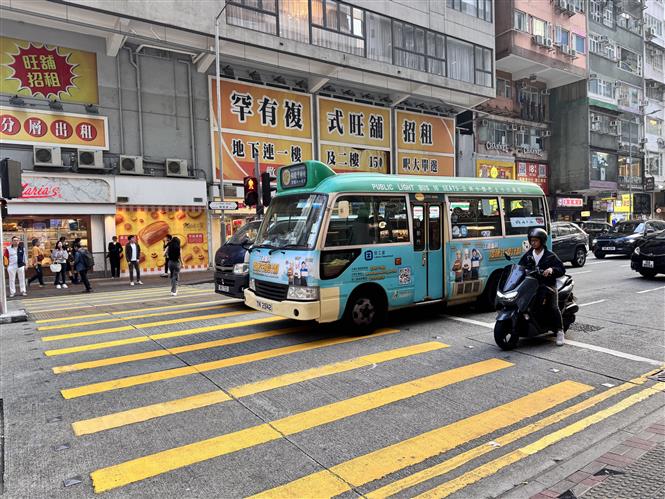
In the announcement, Tse Chin-wan, head of Hong Kong's Environment and Ecology Department, outlined a roadmap for replacing diesel buses and taxis with electric vehicles, including a subsidy package and an enhanced charging station network across the city.
Initially, this roadmap was planned to be announced by the government in the first half of 2023 as part of a policy speech. However, Mr. Tse explained that the plan was delayed because the market at that time did not offer a sufficient variety of electric vehicle models.
Mr. Tse shared: “To encourage taxi owners to switch to electric vehicles, we need to ensure there is enough choice in the market, so we have spent time talking with suppliers and introducing new models to Hong Kong, some of which are custom-designed for us.”
He continued: “Over the past year, we’ve also seen a rapid drop in electric vehicle prices, so we believe this is a good time to accelerate the green transition for buses and taxis.”
According to the plan, the subsidy program, which will be implemented this month, will support the purchase of 600 electric buses and 3,000 electric taxis in Hong Kong.
The total amount of subsidies allocated is HK$470 million for buses and HK$135 million for taxis, with notification of participation in the subsidy program to be sent to operators and vehicle owners later this month.
Currently, only 1.4% of the 6,000 franchised buses and 0.5% of the 18,000 taxis in Hong Kong are electric.
Mr. Tse emphasized that the government would adopt a "carrot without a stick" approach by using incentives instead of forcing the switch. He argued that with the current downward trend in electric vehicle prices, the government did not need to increase subsidies further, and the switch would not significantly increase costs for customers.
Regarding the recycling of electric vehicle batteries, he stated that a dedicated battery recycling plant is being built in Tuen Mun and will be operational in 2026.
Senior environmental official Ron Yang Rong from Hong Kong stated that subsidies are necessary because electric buses are still about 50% more expensive than diesel buses.
Accordingly, single-decker and double-decker buses will receive subsidies of HK$400,000 and HK$800,000 respectively, or 25% of the cost of capital, whichever is lower.
Each taxi owner will receive a subsidy of HK$45,000, equivalent to 10-25% of the current value of their electric vehicle. The government prioritizes replacing approximately 3,000 of the oldest taxis, those that have been in use for over 12 years.
Hong Kong aims to have 700 electric buses and 3,000 electric taxis in operation by the end of 2027.
When asked why hydrogen-powered vehicles were not included in the roadmap, Mr. Tse explained that the technology is still in its early stages of development, and the government will continue to monitor its progress in the market.
To support the transition, the government will increase the number of fast-charging stations, including installations at gas stations and taxi stands, and expand the use of existing charging stations at bus stops for taxis. At least 500 additional charging stations are expected by the end of 2027 and 3,000 by 2030, with franchised bus operators responsible for installing their own stations.
Mr. Chau Kwok-keung, Chairman of the Hong Kong Taxi and Public Bus Association, welcomed the subsidies but argued that the support for taxis was "unfair and disproportionate" compared to buses. He suggested that the government should promptly consider feedback from the taxi industry to better understand the problems they are facing.
Mr. Chau said: “Many taxi owners are concerned about the burden of replacing batteries, and the battery packs on electric vehicles only last about four to five years but cost between HK$60,000 and HK$100,000. We also find it difficult to find replacement parts for electric vehicles.”
He also questioned whether the additional 500 fast-charging stations would be enough to meet the needs of 3,000 new electric taxis by 2027, given the rapidly increasing number of private cars.
Citybus announced plans to purchase 200 electric buses and committed to converting its entire fleet to zero-emission vehicles by 2045. Meanwhile, KMB also expressed support for the subsidy and said it would “actively consider” purchasing electric buses.
Cao Thong (compiled)
Source: https://doanhnghiepvn.vn/cong-nghe/hong-kong-dau-tu-hang-chuc-trieu-usd-thuc-day-chuyen-doi-sang-xe-dien-cong-cong/20241212103317536
![[Photo] Prime Minister Pham Minh Chinh holds a phone call with the CEO of Russia's Rosatom Corporation.](/_next/image?url=https%3A%2F%2Fvphoto.vietnam.vn%2Fthumb%2F1200x675%2Fvietnam%2Fresource%2FIMAGE%2F2025%2F12%2F11%2F1765464552365_dsc-5295-jpg.webp&w=3840&q=75)















































































Comment (0)