

Patients with severe gallstone complications and complex deformities.
A male patient (63 years old, in Hanoi ) was recently admitted to E Hospital for treatment due to gallstones. Through examination and imaging results, doctors discovered that the patient had a congenital defect of complete situs inversus, with all organs in the abdomen and chest being arranged in the opposite position compared to normal people. The heart is on the right side, instead of the left side of the chest.
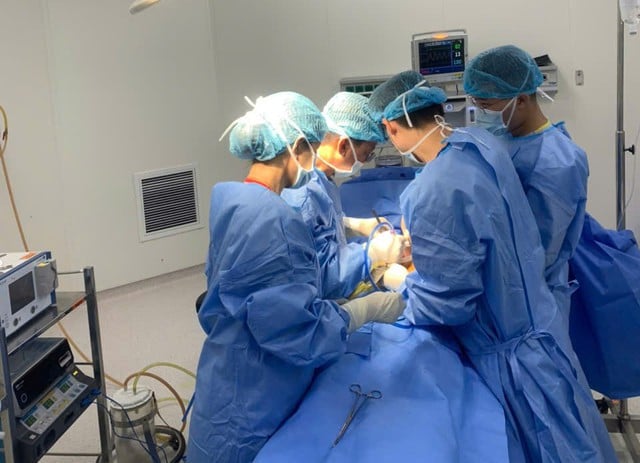
A patient with gallstones and a congenital defect of complete situs inversus (reversal of the internal organs), with the heart located right in the chest cavity, underwent successful surgery.
PHOTO: XUAN THANH
According to Dr. Nguyen Khac Diep, Department of Gastrointestinal Surgery, E Hospital, situs inversus is a rare congenital defect, inherited through an autosomal recessive gene, with an incidence rate of only about 1 in 5,000 to 1 in 20,000 people depending on the region.
In people with this condition, the internal organs in the chest and abdomen are arranged in a "mirror image" compared to their normal structure.
Situs inversus does not increase the risk of gallstones, but it creates many difficulties in diagnosis and treatment because the clinical signs and anatomical images are reversed.
In this patient's case, doctors assessed it as complex due to the extremely large size of the stones, which caused complications such as biliary tract infection, bile duct obstruction, and acute pancreatitis due to stones in the common bile duct, all on a background of complete situs inversus (reversal of internal organs).
In situs inversus, the entire stomach, duodenum, liver, bile ducts, and gallbladder undergo anatomical changes, posing significant challenges during surgery and the localization of these structures. Doctors must conduct interdisciplinary consultations to develop the optimal and safe treatment plan.
Because the patient had complete situs inversus (reversal of internal organs), the surgical team had to perform the opposite procedures compared to normal surgeries, requiring considerable experience to ensure safe and successful treatment.
The patient has now recovered and been discharged from the hospital.
Doctors in the Department of Gastrointestinal Surgery advise that gallstones are a fairly common disease and can cause many dangerous complications if not detected and treated promptly, especially in complex cases like this patient's.
Therefore, when experiencing symptoms such as lower abdominal pain, high fever, jaundice, and yellowing of the eyes, it is necessary to immediately go to a reputable medical facility with full specialized care for examination and treatment to avoid life-threatening dangers.
Source: https://thanhnien.vn/kham-soi-mat-bat-ngo-phat-hien-tim-ben-phai-phu-tang-dao-nguoc-18525090812092119.htm


![[Photo] Closing Ceremony of the 10th Session of the 15th National Assembly](/_next/image?url=https%3A%2F%2Fvphoto.vietnam.vn%2Fthumb%2F1200x675%2Fvietnam%2Fresource%2FIMAGE%2F2025%2F12%2F11%2F1765448959967_image-1437-jpg.webp&w=3840&q=75)

![[Photo] Prime Minister Pham Minh Chinh holds a phone call with the CEO of Russia's Rosatom Corporation.](/_next/image?url=https%3A%2F%2Fvphoto.vietnam.vn%2Fthumb%2F1200x675%2Fvietnam%2Fresource%2FIMAGE%2F2025%2F12%2F11%2F1765464552365_dsc-5295-jpg.webp&w=3840&q=75)






































![[OFFICIAL] MISA GROUP ANNOUNCES ITS PIONEERING BRAND POSITIONING IN BUILDING AGENTIC AI FOR BUSINESSES, HOUSEHOLDS, AND THE GOVERNMENT](https://vphoto.vietnam.vn/thumb/402x226/vietnam/resource/IMAGE/2025/12/11/1765444754256_agentic-ai_postfb-scaled.png)












































Comment (0)