

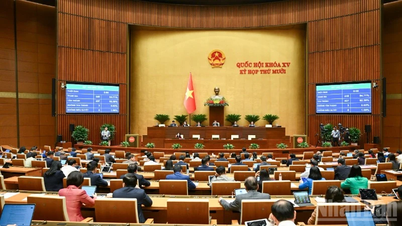
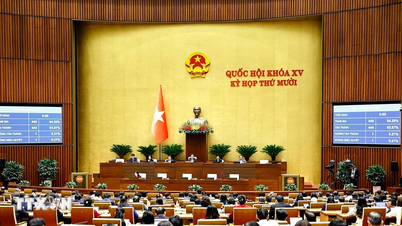
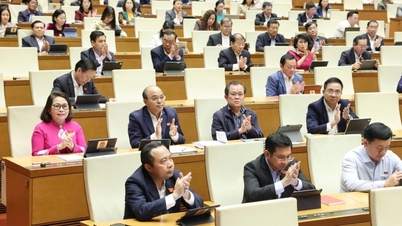
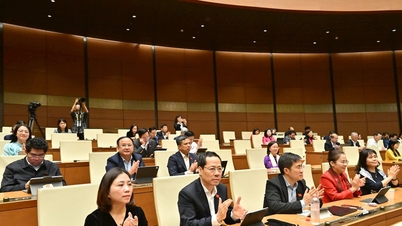
On the morning of December 10th, the National Assembly passed the amended Press Law, in which the chapter on journalist cards was revised to be stricter, clearly defining the subjects eligible for cards, mandatory conditions, cases of refusal, and revocation of cards.
Cards will only be issued to officials holding positions within media organizations.
According to the new law, journalist cards are issued to leaders of media agencies, heads of specialized departments, reporters, editors, cameramen, and directors of radio and television programs. Those working in state management of the press and those teaching journalism at higher education institutions are also eligible for consideration for cards if they meet the requirements.
A significant change is that those working at scientific journals are not eligible to be issued press cards. Accordingly, scientific journals are defined as operating with the function of research and academic exchange, not aiming for journalistic work, and therefore are not subject to the provisions of this clause.
For first-time card issuance, the law requires applicants to have worked continuously for two years or more at a media agency and possess a university degree; however, for cameramen working for television media agencies and ethnic minorities producing content in their ethnic minority languages, a college degree may suffice.
From January 1, 2027, first-time applicants for journalistic credentials must complete a professional and ethical training course organized by the competent authority.

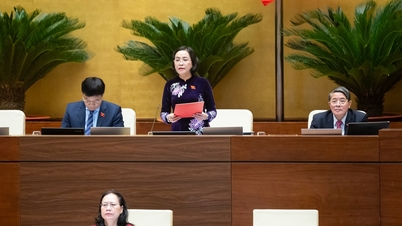
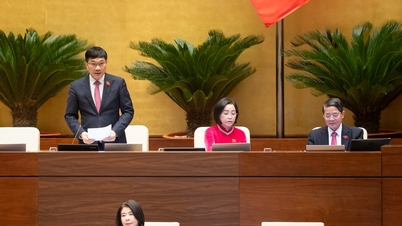
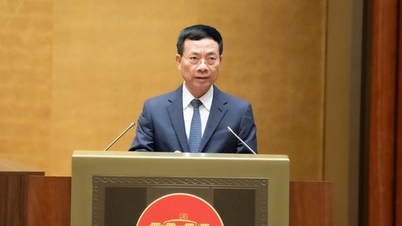
People working at scientific journals are not eligible to be issued press cards (Illustrative image: Hoang Trieu).
Strengthening ethics and accountability.
The law stipulates a number of cases in which a journalist's card will not be granted. Individuals currently under investigation in a criminal case or who have been convicted and whose criminal record has not yet been expunged will not be considered. Similarly, individuals whose journalist's card has been revoked by law must wait at least 12 months from the date of revocation before applying for re-issuance.
Cases involving disciplinary action or cases where the Journalists' Association concludes a violation of professional ethics, and where less than one year has passed since the decision took effect, will also disqualify individuals.
Furthermore, individuals who do not hold one of the prescribed positions within a press agency will not be considered for a press card, ensuring that the use of the press card is strictly in line with professional duties.
The regulations clearly define the circumstances under which cards may be revoked.
The amended Press Law also specifically lists the cases in which journalist cards are revoked, aiming to increase deterrence and transparency. Those who violate professional ethics, violate regulations on journalistic activities, misuse their cards, or publish false information causing serious consequences will have their cards revoked.
The card is also revoked if the holder commits disciplinary violations at the level of a warning or higher, or receives disciplinary action at the level of a reprimand or higher twice in two consecutive years. If prosecuted as a suspect, the card is also revoked; if the investigation is subsequently suspended or the individual is found not guilty, the management agency will consider returning the card.
Individuals who are no longer employed by a media organization or who have changed to positions no longer eligible for the card must return it within the specified timeframe. Failure to return it by the deadline will result in the revocation by the managing authority.
Source: https://dantri.com.vn/thoi-su/khong-cap-the-nha-bao-cho-nguoi-lam-viec-tai-tap-chi-khoa-hoc-20251210185218402.htm






























![[Video] The craft of making Dong Ho folk paintings has been inscribed by UNESCO on the List of Crafts in Need of Urgent Safeguarding.](https://vphoto.vietnam.vn/thumb/402x226/vietnam/resource/IMAGE/2025/12/10/1765350246533_tranh-dong-ho-734-jpg.webp)






















































Comment (0)