

As Lizbeth Hernandez, 35, a marketing executive and content creator, sat eating lunch at a counter in Los Angeles, a waitress complimented her engagement ring: a striking, three-carat, East-meets-West step-cut diamond set in a gold band.
Hernandez had just managed to say thank you when the woman sitting next to her interjected: "Is that a lab-grown diamond?"
Hernandez turned around and replied that it was completely natural - but the woman was skeptical and said there was nothing wrong with admitting she owned a man-made diamond.
Hernandez was shocked and ended the conversation. She later told the Washington Post: “People often wonder why a young woman would own such a large diamond. But it’s rude to ask if it’s ‘real’ or not.”
In the US, synthetic diamonds are increasingly appearing at low prices and in abundant quantities.
In 2015, lab-grown diamonds were a less than $1 billion industry; today, diamond industry analyst Paul Zimnisky estimates it to be around $40 billion globally.
Signet Jewelers, the parent company of popular retailers like Kay, Jared, Zales, Blue Nile and James Allen, estimated earlier this year that lab-grown diamonds will account for more than a third of its total wedding revenue by 2025—all while they continue to get cheaper.
The size is getting bigger and bigger
As the size of diamonds in engagement rings continues to balloon, a tricky etiquette dilemma is emerging: Is it okay to ask if a diamond is lab-grown? And if so, what are you really asking?
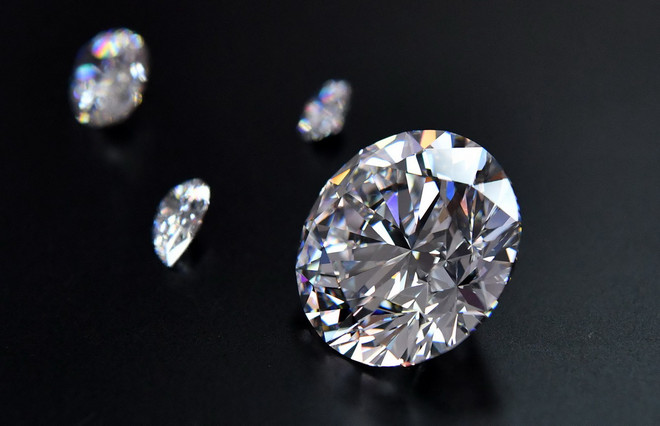
For decades, a solid carat has been the standard size for a diamond on an engagement ring in America. But in Manhattan’s Flatiron District, inside the airy, sun-filled second-floor showroom of Brilliant Earth—a company specializing in jewelry—the default size for a diamond, whether lab-grown or natural, has doubled.
“I think two carats is the baseline size for most shapes,” says Michelle Walker, a customer experience manager, as she leans over a jewelry cabinet. But across the U.S., the popular size of lab-grown diamonds has increased to three, four, and even five carats.
Price is the deciding factor
Couples often come in to buy rings after deciding between lab-grown or natural diamonds, Walker said.
Both have their own appeal. Natural diamonds are objects of eternity, formed in the earth long ago and destined to outlive us. The value of this romance hardly needs to be proven.
Similar man-made diamonds can be plucked from a lab in just a few weeks. But what man-made diamonds lack in that romantic eternity, they make up for in affordability.
When Brilliant Earth began selling lab-grown diamonds in 2012, they were priced just slightly lower than natural diamonds. But today, as diamond-culturing technology—first developed in the early 20th century—has advanced, lab-grown diamonds are flooding the market and driving prices down.
For two 2-carat diamonds, nearly flawless, round brilliant, nearly identical in color, the lab-grown one sold for $2,380, while the other, a natural diamond, sold for $22,000. The average person would be almost unable to tell the difference between the two.
Tom Moses, executive vice president and director of research and laboratories at the Gemological Institute of America (GIA), said about 90 percent of the lab-grown diamonds graded by GIA have the same color and clarity as the highest-graded natural diamonds.
In the early 1940s, GIA introduced the concept of the “four Cs” of diamond grading: cut, color, clarity, and carat. Carat measures the weight of the diamond, while GIA gemologists rate the grade of each of the remaining Cs.
Just this fall, the 94-year-old gem-grade body established an additional grading system for lab-grown diamonds, dividing them into “Standard” (for diamonds that typically have lower C grades) and “Premium” (for higher-quality diamonds). Because the range of quality in lab-grown diamond grading is narrower, the structure attempts to highlight the differences.
Some lab-grown advocates worry that the move will also protect the supposed premium status of natural diamonds, but many younger consumers, faced with an expensive proposal and suddenly the chance to save tens of thousands of dollars, are not concerned.
Difficult to answer social questions
“What you can get for a two-carat lab-grown diamond is comparable to a one-carat natural diamond for the same budget,” says Beth Gerstein, co-founder and CEO of Brilliant Earth. “One thing we hear all the time is customers say, ‘There’s almost no difference to the naked eye, so why wouldn’t I just buy the bigger diamond?’”
But that also leads to a stereotype that a large diamond can only be a lab-grown one. Caroline Sacks, a 29-year-old content creator living in Brooklyn, got engaged last year and started wearing an oval diamond that weighs just over four carats.
She has not hesitated to answer questions from friends and fans about the origin of the diamond. However, she said that although she answered that it was a man-made diamond, she still sometimes received questions implying “did you buy it or rent it” as a way to verify her status.
The debate between natural and lab-grown diamonds, however, is about more than just class. Critics of natural diamonds often cite the ethical aspects of diamond mining, while critics of lab-grown diamonds cite the enormous amount of energy required to create the gems.
Back to the question: Should you ask if it's a real or lab-grown diamond, Lizzie Post, co-president of the Emily Post Institute, USA, gave the following verdict: "Our general advice to the public is please don't ask this question. It's none of your business, and whether it's a real or lab-grown diamond doesn't affect the beauty of the ring," she said./.
Source: https://www.vietnamplus.vn/kich-thuoc-cua-kim-cuong-nhan-tao-va-dinh-kien-xa-giao-kho-tra-loi-post1080361.vnp

































![[Photo] Parade to celebrate the 50th anniversary of Laos' National Day](/_next/image?url=https%3A%2F%2Fvphoto.vietnam.vn%2Fthumb%2F1200x675%2Fvietnam%2Fresource%2FIMAGE%2F2025%2F12%2F02%2F1764691918289_ndo_br_0-jpg.webp&w=3840&q=75)

































































Comment (0)