

That historic river is not only a place name but also a place where the sacred energy of mountains and rivers converge, where brilliant pages of history were written with the blood and wisdom of our ancestors. It reminds us of Truong Han Sieu's poem as an echo from thousands of years ago: "The Dang River is a long and terrifying stretch / Its huge currents and waves rush to the East Sea / The unjust people perish / For thousands of years, how many heroes will remain famous?"
Right from the entrance to the relic site, groups of students from secondary and high schools in Hai Phong, Hanoi , Quang Ninh, and Bac Ninh followed each other to visit and experience. Their bright faces and eager steps showed their desire to learn about history and to experience the thousand-year mark with their own eyes.
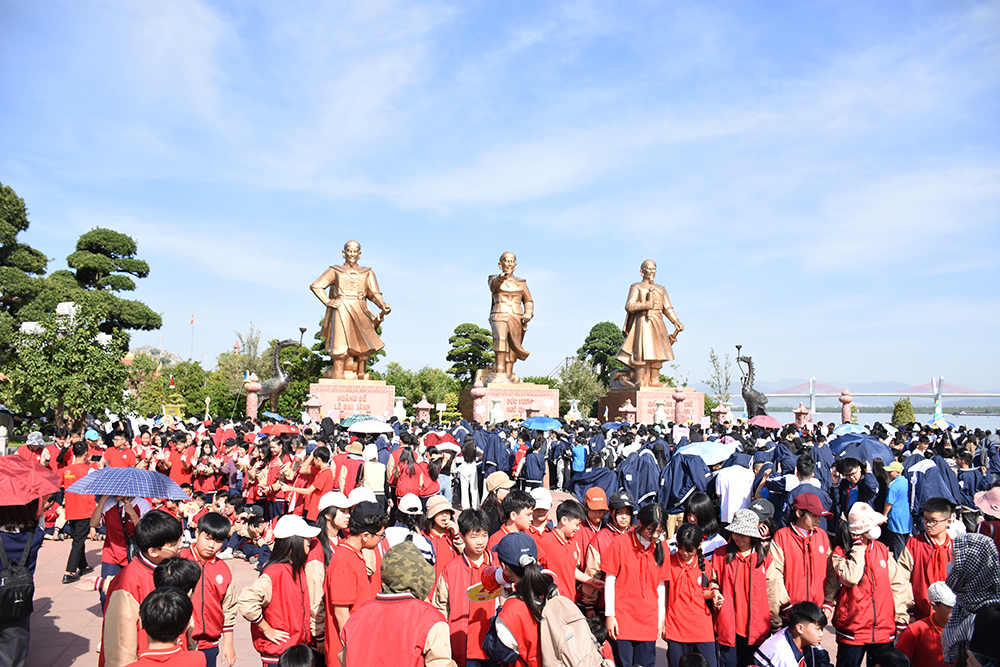 |
| Many students visited Victory Square at Bach Dang Giang Relic Site. |
If in the past, the vestiges of the Bach Dang River's feats were mainly shown through textbooks or stories, then at the Bach Dang Giang Relic Site, the wooden stakes lying deep in the ground were restored and preserved, helping history come alive right before the eyes of today's generation. From the naval battle in 938 of Ngo Quyen, the victory in 981 of Le Dai Hanh to the great victory over the Yuan-Mongol army in 1288 led by Hung Dao Dai Vuong Tran Quoc Tuan. 3 great wars, a river... forged the indomitable spirit of the Vietnamese people.
Ms. Tran Thi Mai, an officer of Hai Phong City Museum, accompanied us and introduced to us each sightseeing spot in the relic. Stopping next to the stele engraved with the poem "Giang san vuong khi Bach Dang thu", she said proudly: "Bach Dang Giang is one of the few cultural tourist areas that successfully implemented the 3 no principles: No commerce - no fees - no waste. This place always maintains its solemnity, true to the spirit of commemoration and traditional education ".
The space seems to become more sacred in the middle of the Trang Kenh scenic complex, which is likened to “Ha Long on land” with its overlapping mountains and rivers. This is a land with traces of ancient Vietnamese people, a place where Au Viet and Lac Viet cultures intersect; and at the same time, it is a strategic defense line. From that, we can understand why Bach Dang has become a lasting spiritual support in the history of building and defending the country.
In Victory Square, the three bronze statues of King Ngo Quyen, Emperor Le Dai Hanh and Hung Dao Dai Vuong Tran Quoc Tuan stand majestically amidst the vast sky and water. Although they belong to three different dynasties, they all look towards the river of history. King Ngo Quyen has a brave posture; Emperor Le Dai Hanh is majestic, his robe fluttering; and Tran Quoc Tuan is dignified, holding the Military Strategy Essentials in one hand and the sword in the other, exuding the spirit of "this year fighting the enemy is easy".
The sound of Bach Dang waves crashing against the shore is like a wordless epic. Under the layer of alluvium, there used to be a battle of stakes that terrified the enemy. Nowadays, rows of simulated concrete stakes are erected for sightseeing and historical education, helping viewers visualize more clearly the strategies of our ancestors.
Continuing the journey up the left bank of the river about 10 kilometers, we arrived at the Cao Quy stake site (Luu Kiem ward). Five years ago, the wooden stake site of the Bach Dang battlefield in 1288 was discovered, causing a great stir in the archaeological community. Together with the Dam Thuong stake site (Viet Khe commune), this discovery added important scientific basis, proving the great role of the Thuy Nguyen army and people in the great victory over the Yuan-Mongol. The stakes are simple but contain master military intelligence. When touching the dark wood, it is like hearing the breath of time echoing from the old battle, when the tide receded, the Bach Dang waves rose, the enemy panicked in the "heavenly net" of the Dai Viet army and people.
Immediately after discovering the stake field, the Hai Phong City Party Committee, People's Council and People's Committee directed the protection, research and restoration. Leading scientists joined in, making this place an important historical destination of the city. The thousand-year-old vestiges were awakened, becoming a valuable source of documents to foster patriotism and national pride.
Late afternoon, the early winter sunlight spread thinly on the Bach Dang River, the water waves glittered like bright spears in an endless triumphal march. Standing before that scene, one could clearly feel the Bach Dang spirit in every gust of wind, the rhythm of life of Hai Phong people today. Groups of people continued to flock to the Bach Dang Giang relic site, Cao Quy stake field, Dam Thuong stake field. Classes of students listened attentively to the explanations, so that history could be told with heart and emotion. The Bach Dang spirit continued to spread, persistently cultivating patriotism, arousing the responsibility to preserve the sacred values of the nation.
According to Mr. Vu Dinh Tien, Deputy Director of the Department of Culture, Sports and Tourism of Hai Phong City: Hai Phong is actively preserving and promoting the value of Bach Dang Giang relics, Cao Quy stakes and many other heritages associated with the heroic spirit of Bach Dang. This is not only the pride of the city's people but also a destination to introduce the depth of Vietnamese history and culture to international friends.
Source: https://www.qdnd.vn/van-hoa/doi-song/hai-phong-phat-huy-hao-khi-bach-dang-1015128


![[Photo] Cat Ba - Green island paradise](/_next/image?url=https%3A%2F%2Fvphoto.vietnam.vn%2Fthumb%2F1200x675%2Fvietnam%2Fresource%2FIMAGE%2F2025%2F12%2F04%2F1764821844074_ndo_br_1-dcbthienduongxanh638-jpg.webp&w=3840&q=75)










![[Video] 800m2 museum preserves the "memory bank" of the Vietnamese National Assembly](https://vphoto.vietnam.vn/thumb/402x226/vietnam/resource/IMAGE/2025/12/04/1764808349841_bao-tang-qh-1101-jpg.webp)




















![[VIMC 40 days of lightning speed] Da Nang Port: Unity - Lightning speed - Breakthrough to the finish line](https://vphoto.vietnam.vn/thumb/402x226/vietnam/resource/IMAGE/2025/12/04/1764833540882_cdn_4-12-25.jpeg)































Comment (0)