

According to data from the Vietnam Trade Office in Singapore, in the first nine months of 2024, Singapore imported seafood from nearly 100 countries and territories with a total import value of approximately SGD 839.1 million (USD 635.24 million), a decrease of 4.51% compared to the same period in 2023. However, Vietnam remains among the countries with the largest market share of seafood in Singapore, and for the first time, Vietnamese seafood has maintained its position as number 5 for three consecutive quarters.
Statistics from the Singapore Enterprise Agency show that the seafood product group with the largest market share in Singapore includes: Shrimp, crab, and crustaceans (HS0306), accounting for 24.24% of total market consumption; followed by fresh and chilled fish (HS0302), accounting for 18.71%; frozen fish (HS0303), accounting for 18.55%; chilled or frozen fish fillets and meat (HS0304), accounting for 16.94%; and molluscs (HS0307), accounting for 10.46%... Product groups such as fresh fish, processed fish, and aquatic products account for relatively low shares, at 3.55%, 4.81%, and 2.73% respectively.
Among the top 15 seafood exporting countries to the Singapore market, Malaysia continues to lead, followed by Indonesia, Norway, China, and Vietnam, which for the first time has maintained its 5th position for three consecutive quarters.
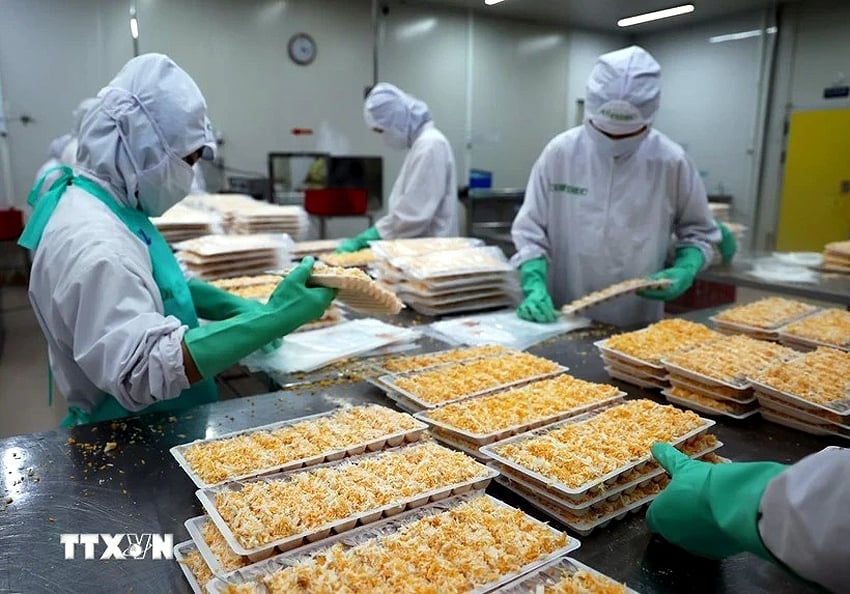
The seafood market share in Singapore is generally evenly distributed among partners, as each country has its own export strengths. The top six countries hold the largest market shares, ranging from 9-13%, specifically Malaysia (13.42%), Indonesia (10.98%), Norway (10.34%), China (9.81%), Vietnam (9.22%), and Japan (8.42%).
Malaysia has a strong advantage in fresh fish and shrimp, crab, and crustaceans, with market shares in these segments of 31.35% and 20.24% respectively. Norway and Spain have strengths in chilled fresh fish and frozen fish products.
Vietnam dominates the Singapore seafood market with frozen fish fillets (accounting for 29.57%) and processed fish (accounting for 19.57%). China has an advantage in mollusk products (accounting for 29.34% of the market share) and Japan has an advantage in aquatic products (accounting for 40.16% of the market share). The remaining market share is divided among more than 90 other partners, including Chile, India, Australia, Thailand, the United States, etc.
In its policy of diversifying its supply sources, Singapore continuously seeks and expands its import markets through various policies. This has led to increasing competition among seafood exporting countries to Singapore.
In the first nine months of 2024, Vietnam's seafood exports to the Singapore market decreased by 2.51% (export value reached nearly 77.36 million SGD), accounting for a market share of 9.22%. Although there was good growth in the Fresh Fish - HS0301 group (up 19.33%), there was a sharp decline in three product groups: Fresh and chilled fish (down 46.56%), frozen fish (down 35.42%), and aquatic products - HS0308 (down 35.9%).
According to Mr. Cao Xuan Thang, Commercial Counselor and Head of the Vietnamese Trade Office in Singapore, the above statistics demonstrate the important position and role of Vietnamese seafood in the Singaporean market. However, in order to sustainably increase market share, improve ranking, and enhance the value of seafood exports to Singapore, Vietnam needs to further improve the quality of its seafood products.
On the other hand, rising inflation and the trend of tightening spending also pose a significant challenge for the seafood industry of countries exporting to Singapore, including Vietnam. Countries that can leverage their logistics advantages and minimize costs will gain a greater competitive advantage in exporting goods to Singapore.
Source: https://vov.vn/kinh-te/xuat-khau-thuy-san-cua-viet-nam-duy-tri-tot-thi-phan-tai-singapore-post1131242.vov











![Major policy decisions for agricultural development in Thanh Hoa: [Part 2] Building water reservoirs for the future](https://vphoto.vietnam.vn/thumb/402x226/vietnam/resource/IMAGE/2025/12/14/1765679409826_z7282518628489_e53ef9fd8c182096bda23471d91bbdf1-nongnghiep-172014.jpeg)






















































Comment (0)