

All kinds of online scams
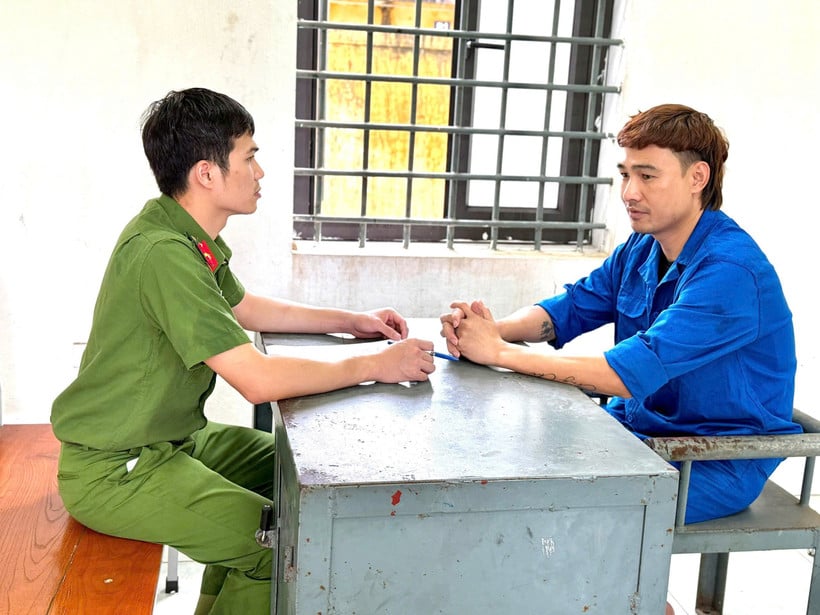
Recently, officers of the Criminal Police Department, Phu Tho Provincial Police discovered a criminal gang of about 30 Vietnamese people in the Phnom Penh area, Cambodia. These subjects specialize in fraud and appropriation of money through APPs such as "Love 2.1" and APP "Love Connection". To successfully commit crimes, the subjects often collude closely, assigning clear roles and responsibilities such as: "Scratch customers", "Sale", "Dieu Don", "Kiet Khach". The criminal group is led by Do Dong Hung, born in 1986, residing in Phu Xuyen, Thai Nguyen (residence: Yen Phong commune, Bac Ninh ).
Through professional measures, the police officers identified the assistant and general manager for Hung as Tran Minh Tai (born in 1986, residing in Phu Xuyen, Thai Nguyen province). Under Tai is Dinh Tran Tung (born in 1990, also residing in Phu Xuyen, Thai Nguyen province), whose task is to manage the amount of money that the scammers have collected (called Backstage). In addition, under Tung, the subjects continue to be divided into two groups: The first group led by Phan Ba Huynh (born in 1993, residing in Phu Thinh, Thai Nguyen province, with the Telegram nickname BIN) is in charge of fraud and appropriation of property through the APP "love 2.1". The second group led by Nguyen Hai Long (born in 2001, residing in Phu Xuyen, Thai Nguyen province) is in charge of fraud and appropriation of property through the APP "Connection of Love"...
Based on the collected documents, it was determined that the above group of subjects had defrauded and appropriated the property of five victims, with a total amount of 393 million VND. Given the seriousness of the case, the Investigation Police Agency of Phu Tho Province Police decided to prosecute the case and prosecute seven defendants for the crime of Fraudulent Appropriation of Property under Article 174 of the Penal Code as prescribed.
Previously, the HLĐ4 Project was implemented to fight against a group of subjects who violated regulations on multi-level marketing led by Tat Van Hao (born in 1977, residing in District 5 (formerly), Ho Chi Minh City) and Lim Choon Foong (aka Nicklim) (born in 1982, Malaysian nationality).
Initial verification results show that in 2019, Tat Van Hao established Bitney Vietnam Investment Trading Company Limited at 109, Street 22, Ward 11, District 6, Ho Chi Minh City to sell mixed fruit juice Multi Juice, Lucenta deer placenta, Bitney Multi Cream. Hao and Nick Lim then organized multi-level marketing of the products according to the "binary model". At the time of being "taken down", the company had sold millions of products but had not been fully licensed as required. All products sold by the company were priced dozens of times higher than the import price.
Notably, in 2022 and 2023, the Ho Chi Minh City Food Safety Management Board tested Bitney Multi Juice products at the National Institute for Food Safety and Hygiene Control and the Nha Trang Pasteur Institute - Ministry of Health. The test results showed that Bitney Multi Juice products contain "Tadalafil". This is a banned substance in food production and can only be used when prescribed by a doctor. Determining the seriousness of the case, the Investigation Police Agency of Phu Tho Provincial Police prosecuted five defendants for "Violating regulations on multi-level marketing" including: Lim Choong Foong, born on September 16, 1982, Malaysian nationality, temporarily residing in District 6, Ho Chi Minh City; Tat Van Hao, born on May 13, 1977, residing in District 5, Ho Chi Minh City; Voong Tu Thanh, born on June 16, 1978, residing in Tan Phu district, Ho Chi Minh City; Le Ngoc My, born on April 14, 1987, residing in Phu Nhuan district, Ho Chi Minh City.
The investigation agency has temporarily seized VND 1,990,000,000; 3 cars, 15 mobile phones; 07 laptops; 41,800 boxes of Multi Juice tea; 3 round seals and other related documents.
Through investigation, along with the fraudulent tricks of love apps, multi-level marketing, virtual currency..., the subjects also take advantage of discount programs during golden hours, stimulating shopping activities on e-commerce platforms. From there, they carry out acts of using computer networks and electronic devices to appropriate discount codes. Specifically, the group of subjects opened shops on Shopee, then recruited people to place virtual orders, taking advantage of the time when Shopee offered large discount codes to require people to place orders selected by the subjects themselves, and at the same time choosing virtual locations to receive the placed orders. After receiving the virtual orders, the subjects will package and deliver them to the shipping unit as real goods, but in fact there is no delivery or sale of goods. When delivering the goods, even though the person placing the order does not receive the goods and transfer payment, the goods are still notified as successfully delivered.
In addition, to deal with the authorities, the subjects also rent or borrow bank accounts, use fake ID cards, use "junk" SIM cards to register accounts, and transfer money around to different accounts. Most of the bank accounts are used by the subjects for a short period of time, and after withdrawing all the money, they will be destroyed to erase the traces of the money flow. All information exchange activities are mainly carried out by the subjects via Zalo, Viber, Telegram...
Need many synchronous and effective solutions
According to Lieutenant Colonel Nguyen Quang Hoa, Deputy Head of the Cyber Security and High-Tech Crime Prevention Department, Phu Tho Provincial Police, the police force has also encountered a number of difficulties and challenges in the fight against high-tech crimes. Specifically, the propaganda and warning work to the people has not been implemented synchronously and is not very effective, especially at the grassroots level. The coordination with the professional units of the Ministry of Public Security in technical reconnaissance and electronic tracing has had certain positive results.
However, the conversion into procedural evidence is difficult, such as: Mobile subscriber numbers cannot be received from BTS stations, so their geographical location cannot be determined because they are used for international roaming calls; accounts used to commit crimes are all registered on Internet service application platforms, IP addresses are converted into IP addresses in foreign countries by subjects using specialized software. Furthermore, the server is located abroad, so the crime is committed outside of Vietnam.
To help people proactively prevent fraud and property appropriation in cyberspace, officers of the Department of Cyber Security and High-Tech Crime Prevention, Phu Tho Provincial Police recommend: People need to regularly update the tricks of cybercriminals on mass media, official news sites, Zalo security groups, fanpages of the Police force.... Raise vigilance, absolutely do not trust strange calls and messages, do not trust acquaintances in cyberspace that you have never met in person. Regularly educate and remind relatives, especially minors, not to buy, sell, give, or donate bank accounts for any reason. Carefully check information before making financial transactions, always verify the recipient's identity through known information channels such as the owner's phone number. Use official banking applications, do not make transactions via links received via text messages. In case of discovering articles, websites, subjects, behaviors... with signs of suspicion of fraud or property appropriation, people should immediately report to the police, local authorities, neighborhood leaders, village chiefs... for verification and clarification.
Source: https://nhandan.vn/lua-dao-tren-khong-gian-mang-va-nhung-he-luy-tiem-an-post928693.html

![[Photo] General Secretary To Lam receives the Director of the Academy of Public Administration and National Economy under the President of the Russian Federation](/_next/image?url=https%3A%2F%2Fvphoto.vietnam.vn%2Fthumb%2F1200x675%2Fvietnam%2Fresource%2FIMAGE%2F2025%2F12%2F08%2F1765200203892_a1-bnd-0933-4198-jpg.webp&w=3840&q=75)





























































































Comment (0)