

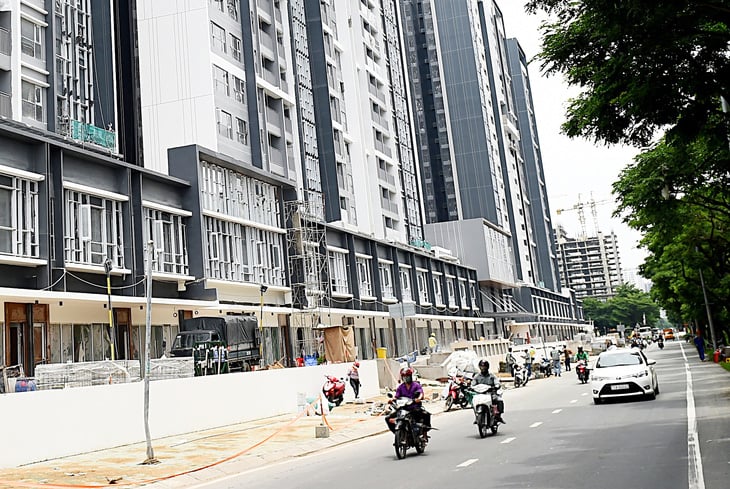
A commercial high-rise complex is nearing completion on Nguyen Huu Tho Street, Nha Be District, Ho Chi Minh City – Photo: TU TRUNG
The Land Law and the Housing Law stipulate that Vietnamese citizens residing abroad (overseas Vietnamese) must be able to enter Vietnam to receive, be gifted, or acquire land and houses. To carry out these procedures, overseas Vietnamese must possess all relevant personal documents, such as proof of Vietnamese citizenship and Vietnamese ancestry.
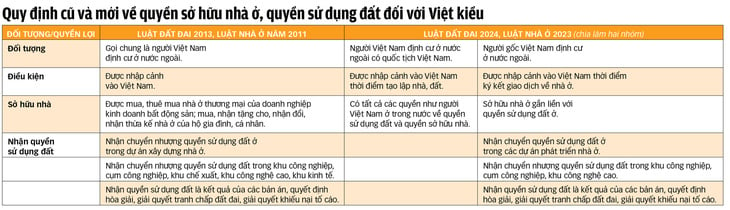
Land Law: Overseas Vietnamese have the same rights as domestic citizens
The 2024 Land Law stipulates that land users include Vietnamese citizens residing abroad and people of Vietnamese origin residing abroad. These two groups have different rights regarding land use and house ownership in Vietnam.
Accordingly, Vietnamese people residing abroad are Vietnamese citizens (i.e., those who still hold Vietnamese nationality) and are entitled to fully exercise all rights and obligations related to land as individuals in Vietnam (Clause 3, Article 4 of the 2024 Land Law). These rights include the right to be allocated land by the State, leased land, recognized land use rights, granted land use certificates, receive land use rights, sublease land, convert, transfer, lease, sublease, inherit, donate, mortgage, and contribute capital using land use rights.
Thus, Vietnamese people residing abroad who hold Vietnamese citizenship can directly purchase houses and land like Vietnamese citizens in the country, instead of being restricted in certain rights as stipulated in the 2013 Land Law. The law also unifies the term "individual" for both individuals in the country and Vietnamese people residing abroad who are Vietnamese citizens. Therefore, the rights and obligations of individuals using land, including individuals in the country and Vietnamese people residing abroad who are Vietnamese citizens, are equal.
Article 3 of Decree 95 of 2024 guiding the Housing Law stipulates the types of documents proving that an individual is eligible to own a house in Vietnam. It states that Vietnamese citizens must possess a Vietnamese identity card, passport, or other documents proving Vietnamese nationality. To own a house, Vietnamese citizens residing abroad must have a valid Vietnamese passport with an entry stamp into Vietnam at the time of acquiring the house.
When notarizing house purchase and sale contracts, land use right transfer contracts at notary offices, and registering ownership transfer at land registration office branches, overseas Vietnamese who are Vietnamese citizens must have documents proving their Vietnamese nationality and eligibility to own housing as described above.
Expanding rights for Vietnamese people residing abroad
Clause 1, Article 44 of the 2024 Land Law stipulates: "People of Vietnamese origin residing abroad who are permitted to enter Vietnam are entitled to own houses attached to land use rights in Vietnam, and have the right to use residential land acquired through the transfer of land use rights in housing development projects."
When applying for home ownership in Vietnam, Vietnamese citizens residing abroad must possess a foreign passport or other valid international travel document as stipulated by immigration laws, and a document confirming their Vietnamese origin as prescribed by nationality laws. The issuing authority for this document is the Department of Justice or a Vietnamese diplomatic mission in the country where the applicant resides at the time of application, or the State Committee for Overseas Vietnamese Affairs under the Ministry of Foreign Affairs.
To prove eligibility for home ownership, Vietnamese citizens residing abroad must possess a valid passport with an entry stamp into Vietnam, or other valid international travel document with an entry stamp into Vietnam at the time of signing the housing transaction. Only when these conditions are met can Vietnamese citizens residing abroad enjoy the rights to housing and land as stipulated by law.

A real estate project under construction in District 7, Ho Chi Minh City – Photo: Q. Dinh
What is the procedure?
According to Major Tran Duy Hien - Deputy Director of the National Population Data Center (Department of Administrative Police for Social Order - C06, Ministry of Public Security ), in principle, overseas Vietnamese who want to get an ID card must still have or still have Vietnamese nationality and must determine their place of residence.
The Ministry of Public Security is currently proposing amendments to Decree 62 regarding the confirmation of citizens' residence (to distinguish between permanent residence, temporary residence, and current address). This will allow authorities to establish procedures for registering current addresses to obtain information for printing on identity cards and issuing identity cards to overseas Vietnamese.
Lawyer Tran Thi Thanh Lam, from the Hanoi Bar Association, stated that regarding Vietnamese people living abroad, or overseas Vietnamese in general, there are two groups of people recognized by the 2024 Land Law as eligible for land use right certificates: "Vietnamese people residing abroad who are Vietnamese citizens" and "people of Vietnamese origin residing abroad." However, proving one's Vietnamese origin requires personal identification documents, which may include a citizen identification card. The Vietnamese Nationality Law also stipulates that those with Vietnamese nationality are Vietnamese citizens.
According to Article 19 of the 2023 Identity Card Law, effective from July 1, 2024, the person eligible for an identity card is a Vietnamese citizen. Therefore, overseas Vietnamese who still retain Vietnamese citizenship and are 14 years of age or older are eligible for an identity card. Overseas Vietnamese who still hold Vietnamese citizenship and are under 14 years of age can still be issued an identity card if they so desire.
Procedures for granting citizen identification cards are stipulated in Article 21 of Decree 70 guiding the Law on Identification Cards as follows:
Citizens can go to the identity card management agency (the identity card management agency of the district, town, city police... where the citizen resides or the identity card management agency of the Ministry of Public Security) to request the issuance, renewal, or replacement of an identity card, providing information including: surname, middle name and given name, personal identification number, and place of residence so that the receiving officer can verify the information against the National Population Database.
– If a citizen's information in the National Population Database is missing or contains errors, the receiving officer shall correct the information according to regulations before requesting the issuance, replacement, or re-issuance of the identity card.
– If the citizen's information is accurate, the person receiving the request for issuance, renewal, or re-issuance of the identity card will extract the citizen's information from the National Population Database. After verifying that the information of the person requesting the issuance, renewal, or re-issuance of the identity card is accurate, they will proceed with the procedures for issuing the identity card as stipulated in Article 23 of the Law on Identity Cards.
Procedures for issuing ID cards through the National Public Service Portal, the Ministry of Public Security Public Service Portal, and the national identification application: Citizens select the procedure and check their information exploited in the National Population Database. If the information is correct, register the time and the ID management agency to carry out the procedure. The system will confirm and automatically transfer the citizen's request to the ID management agency where the citizen requests to issue, exchange, or reissue the ID card.
Citizens should go to the identity card management agency at the registered time and location to carry out the procedures for issuing, renewing, or reissuing identity cards according to the prescribed procedures, similar to the procedures for issuing identity cards at the identity card management agency.
Documents required to obtain a certificate of Vietnamese origin
According to Clause 1, Article 33 of Decree 16/2020/ND-CP, the application for a certificate of Vietnamese origin includes: an application form according to the prescribed form, accompanied by two 4×6 photos taken within the last six months and copies of the following documents:
– Personal documents (identity card, citizen identification card, residence papers, temporary residence card, passport, international travel documents or identity documents with photo issued by a competent authority).
– Documents previously issued to prove that the person once held Vietnamese citizenship, or documents proving that at birth, the person's parents or paternal or maternal grandparents once held Vietnamese citizenship.
– In case of not having any of the above documents , depending on the specific circumstances, one can submit copies of documents on personal identity, nationality, and household registration issued by the old regime in the South before April 30, 1975; documents issued by the old government in Hanoi from 1911 to 1956; a guarantee letter from the Overseas Vietnamese Association where the person is residing, confirming that the person is of Vietnamese origin; a guarantee letter from a person with Vietnamese nationality, confirming that the person is of Vietnamese origin; documents issued by a competent authority of a foreign country stating Vietnamese nationality or nationality of Vietnamese origin.
– Issuance time: Within five working days from the date of receiving the application, the receiving agency is responsible for reviewing and verifying the information in the application, comparing it with the database and documents related to nationality to decide whether or not to issue the certificate of Vietnamese origin. If there is no basis for issuing the certificate, the applicant will be notified.
There have been problems proving identity.
Mr. NTH is a Vietnamese expatriate who moved to the US as a child and holds US citizenship. Recently, Mr. H. returned to his hometown in Tan Uyen (Binh Duong) to receive a gift of land and house from his parents. Mr. H. still possesses his birth certificate, proving that he retains Vietnamese citizenship.
However, when he went to notarize the gift contract, there was a discrepancy between his name in the passport and his birth certificate. The reason was that his American name was different from the name on the birth certificate. Mr. H. was instructed by the notary to carry out the procedure to prove and confirm that Mr. H. in the birth certificate and passport was the same person, otherwise, the related procedures could not be carried out.
Mr. H. went to the local civil status management agency to carry out the procedure of confirming personal information, but the authorities also seemed confused. A knowledgeable acquaintance instructed Mr. H. to contact the consulate or civil status management agency in the US to carry out the above confirmation.
The case of Ms. LTT, a Vietnamese expatriate, also involves issues related to personal identification documents. Ms. T. initially had her household registration in District 1 (Ho Chi Minh City), but transferred it to District 3 after marriage. Later, she and her husband emigrated to the United States and obtained US citizenship. During their time in the US, they divorced. Recently, Ms. T. returned to Vietnam and wants to sell a portion of land she previously purchased to buy land elsewhere.
Upon contacting a notary office to inquire about the procedure, Ms. T. was informed that, because the civil registry in Vietnam still recognizes her as being married, she must obtain confirmation of her marital status if she wants to sell the land alone. Specifically, Ms. T. must bring the divorce decree from a competent authority in the US to have it legalized by the consular office.
“In addition, if I want to own a house in Vietnam, I must have an ID card, passport or other documents that can prove my Vietnamese nationality. While I only have an old ID card, I was instructed to change it to an ID card…”, Ms. T. said.
Tuoitre.vn
Source: https://tuoitre.vn/luat-da-mo-kieu-bao-muon-mua-nha-dat-o-viet-nam-can-chuan-bi-gi-20240825085231873.htm






















![[Photo] Prime Minister Pham Minh Chinh holds a phone call with the CEO of Russia's Rosatom Corporation.](/_next/image?url=https%3A%2F%2Fvphoto.vietnam.vn%2Fthumb%2F1200x675%2Fvietnam%2Fresource%2FIMAGE%2F2025%2F12%2F11%2F1765464552365_dsc-5295-jpg.webp&w=3840&q=75)
















































Comment (0)