

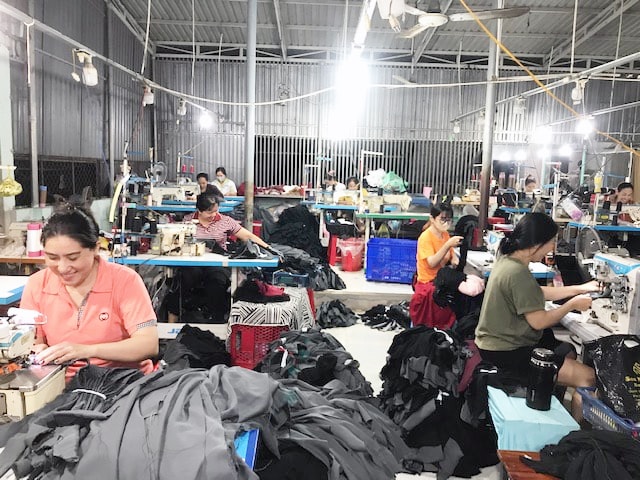
In recent months, the Nguyen Thi Le garment processing facility, located along National Highway 55 in Thang Hai village, Son My commune, has been illuminated at night to serve its workers who are working overtime. The owner stated: “In the last months of the year, several businesses and establishments in Ho Chi Minh City have placed more orders for garment processing; we have increased our working hours to meet demand and boost the income of the 30 local women who work as seamstresses.” One worker shared: “My house is only about 1 km from the factory, so working overtime is convenient. My colleagues and I work overtime from 6 PM to 9 PM, earning between 10 and 15 million VND per month depending on the products we produce. During the day, I take advantage of my lunch and afternoon breaks to ride my motorbike home to prepare meals for my family before returning to work at the factory. The income from these past few months has ensured we can cover our family's living expenses, while the cost of living in my hometown isn't too expensive.”
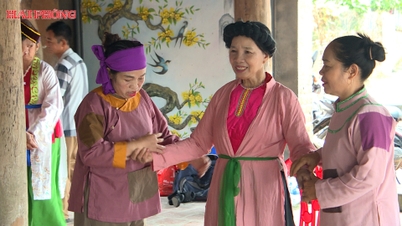
Ms. Truong Thi Hien, formerly a garment worker for a company in the city, has been working at a garment factory along National Highway 55 in Thang Hai village since having a young child, earning 10 million VND per month. Ms. Hien shared: “Not only me, but other women with young children in the area find this job stable. When doing garment work near home, my younger siblings and I can manage our work independently, ensuring we can take care of our families and have a stable source of income.” Nearby, another garment factory displays a sign that reads “Recruiting garment workers,” indicating the current demand for this type of work in rural areas. The Nguyen Thi Le garment factory received a certificate of merit last year from the Women's Union of the former Thang Hai commune (now Son My commune) for “Outstanding achievements in implementing the emulation movement and tasks of the union in 2024,” and a certificate of merit for “Winning third prize in the 2024 Elegant Ao Dai Contest.”
Meanwhile, Mr. Tran Van Chinh, the owner of Thuy Duong garment factory in Hamlet 2, Son My Commune, understands the employment needs of many housewives in rural areas quite well. Recognizing the potential for garment manufacturing in his hometown, he and his wife invested in machinery and opened a garment factory to supply businesses in Ho Chi Minh City, thus developing their family economy while creating jobs for local women. His factory has been operating for nearly 10 years, providing employment for nearly 100 female workers, with an income of 8-10 million VND per person per month (paid based on output).
Mr. Tran Van Chinh shared that garment manufacturing is easy to learn and do, with the advantage of conveniently arranging time to pick up and drop off children and take care of the family. Making a garment requires many steps, such as cutting fabric, assembling the yoke and pockets, hemming, overlocking, and sewing. Even someone who doesn't know how to sew can learn in just over half a month, or at most a month, to be able to sit at the sewing machine and earn a stable monthly income. Although it doesn't require high technical skills, the worker must be skillful and meticulous to create quality and aesthetically pleasing products; building a reputation for the business and ensuring income for rural workers.
Currently, Son My commune has more than 20 large and small garment processing facilities, creating jobs for many female workers in the area. In other communes and wards such as Phuoc Hoi, La Gi, Tan Hai, Ham Tan, Tan Minh, etc., there are also garment processing facilities that supply companies in the city. It can be seen that garment processing in rural areas provides both employment and stable income for many hardworking and diligent women in some localities in the southeastern part of Lam Dong province.
Source: https://baolamdong.vn/may-gia-cong-nong-thon-loi-ca-doi-be-392853.html


























































































Comment (0)