

 |
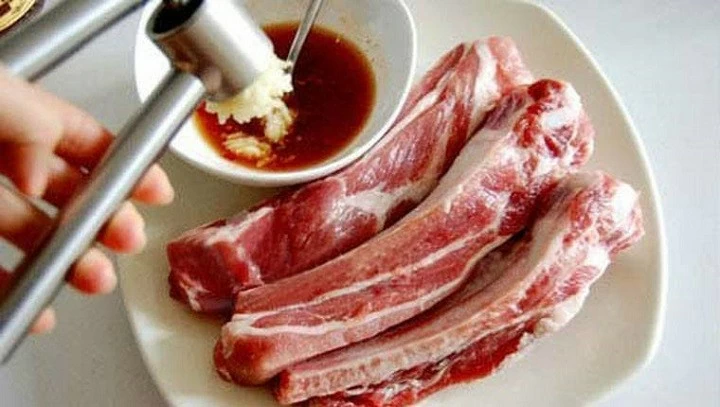
| Pork prices today, November 13th: Slight decrease in two southern provinces. (Source: Gia Chanh Cam Tuyet) |
Pork price today, November 13th
*Pork prices in Northern Vietnam:
A survey of the northern market on the morning of November 13th showed that live pig prices in the region remained stable at around 62,000 – 64,000 VND/kg.
Accordingly, the highest transaction price nationwide, 64,000 VND/kg, was recorded in Hanoi, Bac Giang, Hung Yen, Hai Duong, Thai Binh , Thai Nguyen, Phu Tho, and Vinh Phuc. Meanwhile, Lao Cai and Ninh Binh are currently selling live pigs at 62,000 VND/kg, the lowest in the region.
In the Central Highlands region
In the Central and Central Highlands regions, the live pig market has also remained relatively calm.
Specifically, the highest price in the region is 63,000 VND/kg, continued to be recorded in Thanh Hoa and Nghe An. Besides Ha Tinh, Lam Dong, and Quang Binh , which remain at 62,000 VND/kg, other localities are trading at prices ranging from 60,000 to 61,000 VND/kg.
In the Southern region
Prices in the southern region fluctuated slightly today, decreasing in Kien Giang and An Giang, to 60,000 – 61,000 VND/kg respectively.
Southern traders are currently buying live pigs at around 60,000 – 63,000 VND/kg, with Can Tho being the only locality where the price of live pigs reaches 63,000 VND/kg, the highest in the region.
Pork supply needs to increase by 10-15% to meet market demand during the Lunar New Year holiday.
The Import-Export Department (Ministry of Industry and Trade) assesses that Vietnam's pork supply in the last months of the year and during the Lunar New Year 2025 will basically meet domestic consumption needs, so it is predicted that imports of meat and meat products in general, and pork in particular, will not increase dramatically.
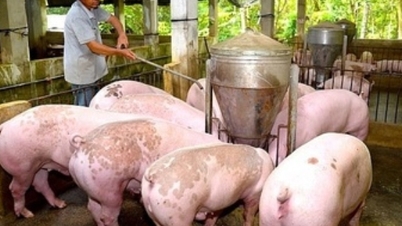
Currently, pig production in small-scale households has decreased to 35-40%, while production in professional households and farms has reached 60-65%. According to recommendations from the Ministry of Agriculture and Rural Development, small-scale farmers in affected areas should not restock their herds at all costs, as the disease remains latent and the risk of losses is high.
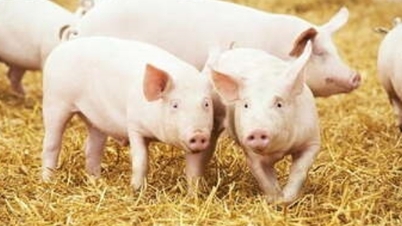
To ensure a balance between supply and demand, especially during the upcoming Lunar New Year (Tet) in 2025, the supply of pork will need to increase by 10-15%. Therefore, this is the time for livestock farms to focus on restocking. However, for sustainable restocking and guaranteed supply, disease prevention is a crucial factor.
According to Nguyen Kim Doan, Vice Chairman of the Dong Nai Provincial Livestock Association, the restocking of pigs to supply the market for the 2025 Lunar New Year has begun in September, but currently only about 50% of households in Dong Nai have restocked. The remaining households chose to restock in mid-October, when the price of piglets tends to decrease slightly. This delay of more than a month compared to the planned schedule could lead to a shortage of pork supply during the upcoming Lunar New Year, driving up pork prices.
In addition to forecasting a shortage during the upcoming Tet holiday, the Dong Nai Livestock Association stated that the locality has also reduced its pig supply to Ho Chi Minh City by approximately 20%, to less than 4,000 pigs per day.
According to Nguyen Xuan Duong, Chairman of the Vietnam Livestock Association, the erratic fluctuations in live pig prices are also one of the reasons why farmers are hesitant. Specifically, in October, live pig prices ranged from 66,000 to 67,000 VND/kg, but in the last half month, the price has dropped to 60,000 to 64,000 VND/kg.
Meanwhile, feed prices show no sign of decreasing, resulting in each pig sold only breaking even or yielding a profit of 100,000-200,000 VND per animal. Although farmers can still make a profit at prices above 60,000 VND/kg, the complex disease situation leaves many households worried about the risk of losing everything when investing in restocking.
Regarding solutions to ensure supply, Deputy Minister of Agriculture and Rural Development Phung Duc Tien stated that the demand for pork will be very high during the end of the year and leading up to the Lunar New Year of the Year of the Snake 2025. Therefore, from the beginning of the third quarter of 2024, the Ministry directed the Department of Animal Husbandry, the Department of Veterinary Medicine, and localities to proactively prepare from the outset, focusing on promoting livestock farming in a biosecure manner and effectively controlling diseases; and building the pork industry in a linked chain, harmonizing the interests of all participating components.

![[Photo] Prime Minister Pham Minh Chinh holds a phone call with the CEO of Russia's Rosatom Corporation.](/_next/image?url=https%3A%2F%2Fvphoto.vietnam.vn%2Fthumb%2F1200x675%2Fvietnam%2Fresource%2FIMAGE%2F2025%2F12%2F11%2F1765464552365_dsc-5295-jpg.webp&w=3840&q=75)
![[Photo] Closing Ceremony of the 10th Session of the 15th National Assembly](/_next/image?url=https%3A%2F%2Fvphoto.vietnam.vn%2Fthumb%2F1200x675%2Fvietnam%2Fresource%2FIMAGE%2F2025%2F12%2F11%2F1765448959967_image-1437-jpg.webp&w=3840&q=75)


































![[OFFICIAL] MISA GROUP ANNOUNCES ITS PIONEERING BRAND POSITIONING IN BUILDING AGENTIC AI FOR BUSINESSES, HOUSEHOLDS, AND THE GOVERNMENT](https://vphoto.vietnam.vn/thumb/402x226/vietnam/resource/IMAGE/2025/12/11/1765444754256_agentic-ai_postfb-scaled.png)














































Comment (0)