

On November 6, the U.S. State Department approved a $320 million sale to Israel of equipment for manufacturing precision GPS-guided bombs, according to a document the Department sent to Congress and obtained by the New York Times.
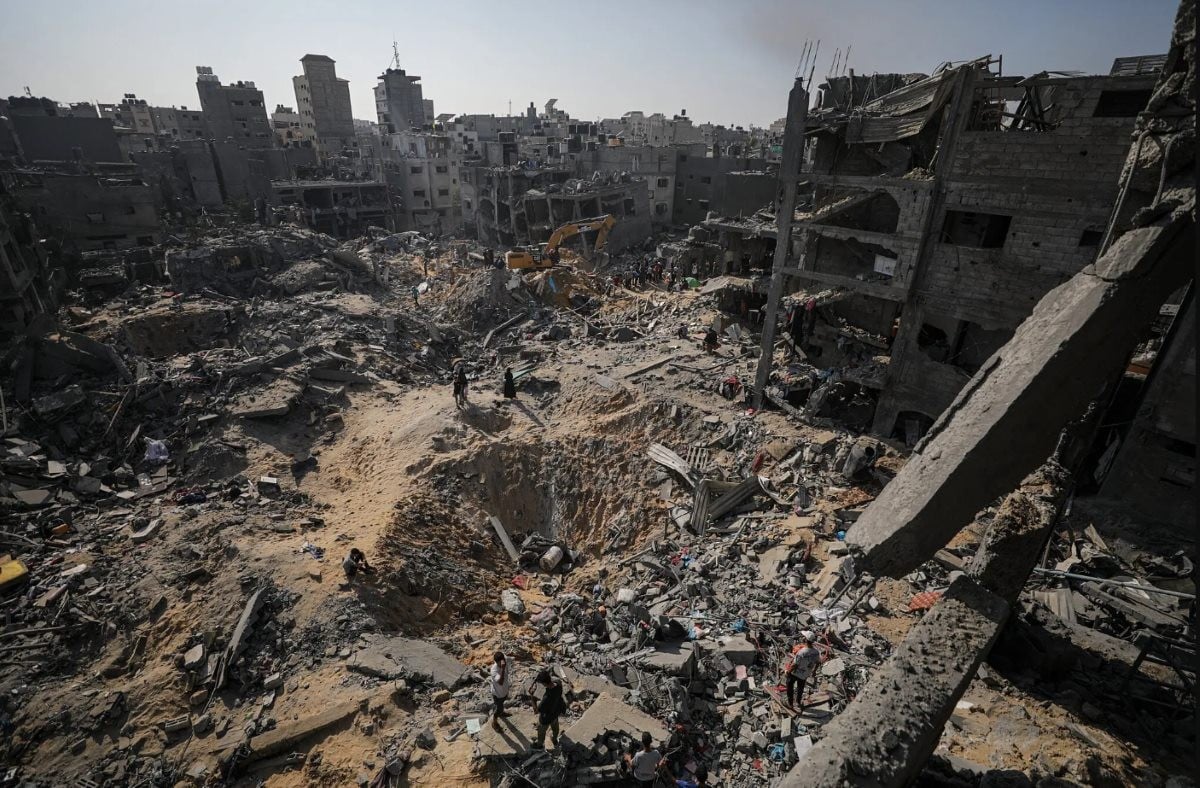 |
| Palestinians search for survivors at the Jabaliya refugee camp, a day after an Israeli airstrike on October 31 in northern Gaza. (Source: Shutterstock) |
Israel used this kit in its bombing campaign in Gaza. This order follows a previous order for the device worth nearly $403 million.
Israel has ordered additional ammunition from the United States along with equipment for manufacturing guided bombs. Modern armies often add guidance systems to their bombs with the goal of minimizing civilian casualties, although damage can still be very severe, especially in urban areas.
Israel's anti-aircraft arsenal primarily consists of 1,000- and 2,000-pound bombs, among the largest bombs used by any military force. Israel dropped at least two 2,000-pound bombs in an airstrike on October 31st on the densely populated Jabaliya district of Gaza. According to Gaza authorities and hospitals, that attack killed dozens of people and injured many others.
Israel says it successfully targeted a senior Hamas commander who helped plan the October 7 attacks, which killed more than 1,400 people, mostly Israeli civilians, and abducted over 240 others. Hamas denies that any of its commanders were present in the Jabaliya area at the time of the October 31 attack.
The State Department coincidentally sent documents regarding the sale of new bomb-making equipment to congressional offices on the day of the attack on Jabaliya. The documents stated that Rafael Advanced Defense Systems, a weapons manufacturer owned by the Israeli Defense Ministry , was paying $320 million for equipment and services for the “Spice Family Glide Bomb Assembly Kit,” referring to a precision bomb manufactured by Rafael. The seller of the equipment was Rafael USA, an American company based in Bethesda, Md., with ties to the Israeli business.
This is a transaction in which a foreign entity purchases weapons directly from a U.S. company rather than through the U.S. government. Therefore, the State Department is only required to disclose its approval through restricted channels. The Congressional Registry notes that the State Department filed this document on October 31, but the document is not available on any public congressional websites or the State Department website.
The document was sent from Naz Durakoglu, Assistant Secretary for Legislative Affairs, to House Speaker Mike Johnson, as well as to the House Foreign Affairs Committee and the Senate Foreign Relations Committee, both of which oversee the State Department's approval of arms sales.
Josh Paul, a State Department official working in the political-military office that oversees arms sales, said Israel's request for authorization to purchase $320 million worth of bomb-making equipment was made earlier this year and underwent informal review by congressional committees but had not received final State Department approval before the October 7 attack.
According to the document, a previous order placed by Rafael Advanced Defense Systems for the same type of equipment, worth nearly $403 million, was approved by the Department on February 5th.
According to the Hamas-run health agency in Gaza, Israeli attacks have killed approximately 10,000 Palestinians, 40% of whom were children and teenagers.
Source
![[Photo] Closing Ceremony of the 10th Session of the 15th National Assembly](/_next/image?url=https%3A%2F%2Fvphoto.vietnam.vn%2Fthumb%2F1200x675%2Fvietnam%2Fresource%2FIMAGE%2F2025%2F12%2F11%2F1765448959967_image-1437-jpg.webp&w=3840&q=75)

![[Photo] Prime Minister Pham Minh Chinh holds a phone call with the CEO of Russia's Rosatom Corporation.](/_next/image?url=https%3A%2F%2Fvphoto.vietnam.vn%2Fthumb%2F1200x675%2Fvietnam%2Fresource%2FIMAGE%2F2025%2F12%2F11%2F1765464552365_dsc-5295-jpg.webp&w=3840&q=75)









































![[OFFICIAL] MISA GROUP ANNOUNCES ITS PIONEERING BRAND POSITIONING IN BUILDING AGENTIC AI FOR BUSINESSES, HOUSEHOLDS, AND THE GOVERNMENT](https://vphoto.vietnam.vn/thumb/402x226/vietnam/resource/IMAGE/2025/12/11/1765444754256_agentic-ai_postfb-scaled.png)











































Comment (0)