

The Kremlin claims Ukraine deliberately sabotaged the Kakhovka dam in Kherson to divert attention, rejecting accusations that Russia was behind the incident.
"We can confirm that this was a deliberate act of sabotage on the part of Ukraine," Kremlin spokesman Dmitry Peskov said at a press briefing today, referring to the collapse of the Kakhovka dam in Kherson province. "And one of their aims was to cut off the water supply to the Crimean Peninsula."
According to Peskov, Ukraine also wants to divert attention from the large-scale counteroffensive that Kyiv claims to be preparing, but which is currently stalled.
When asked about accusations from Ukraine that Russia had destroyed the Kakhovka dam, Peskov replied that Moscow "resolutely rejects this." He warned that "the deliberate sabotage by the Ukrainian side has extremely serious consequences for tens of thousands of people in the region."

Kremlin spokesman Dmitry Peskov in Moscow in December 2021. Photo: AFP
The Kakhovka Dam on the Dnieper River, in the Russian-controlled area of Kherson province, was partially destroyed after an explosion on June 6. Both Russia and Ukraine consider it a deliberate attack and blame each other.
Ukrainian President Volodymyr Zelensky has convened an emergency meeting of the National Security Council. Ukrainian officials accuse Russia of blowing up the Kakhovka dam to prevent Ukrainian forces from crossing the Dnieper River ahead of a counter-offensive.
The European Union, NATO, and the UK have all criticized Russia, stating that Moscow is responsible for the incident.
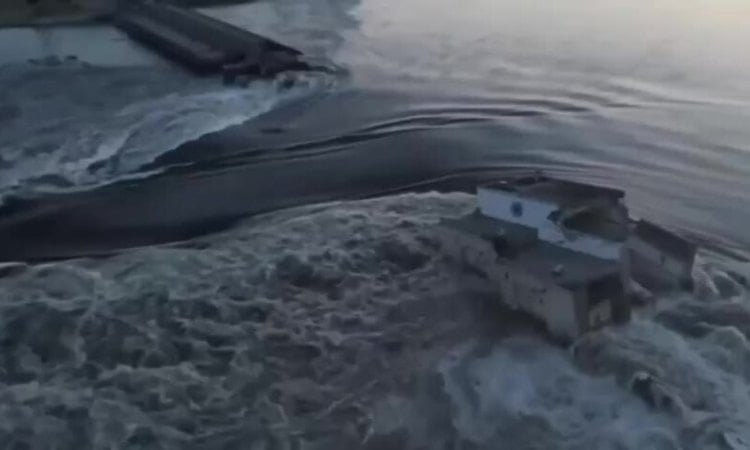
Images allegedly showing the Kakhovka hydroelectric dam breaking on the morning of June 6th. Video : Telegram/RVvoenkor
The Kakhovka Dam, located approximately 70 km northeast of the Ukrainian-controlled city of Kherson, serves to store water from the Dnieper River, supplying the hydroelectric power plant of the same name, as well as supporting agricultural irrigation and river transport in the Kherson province.
Since the outbreak of hostilities, Russia and Ukraine have repeatedly accused each other of plotting to destroy this Soviet-era dam.
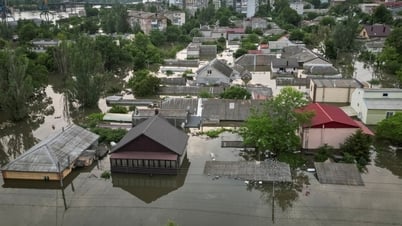
The Kakhovka reservoir, with a capacity of approximately 18 billion cubic meters, provides cooling water for the Zaporizhzhia nuclear power plant and the Crimean Canal. Officials appointed by both Ukraine and Russia in Kherson have reported rising water levels downstream, causing flooding in several areas.
The International Atomic Energy Agency (IAEA) has confirmed that there is "no immediate safety risk" to the Zaporizhzhia nuclear power plant and that its experts "are closely monitoring the situation".
Crimean Governor Sergei Aksyonov said the peninsula currently faces no risk of water supply disruption or flooding following the dam collapse, adding that reservoirs are 80% full and the North Crimean Canal currently holds approximately 40 million cubic meters of water. Authorities on the peninsula are implementing efforts to minimize the amount of water escaping from the canal.
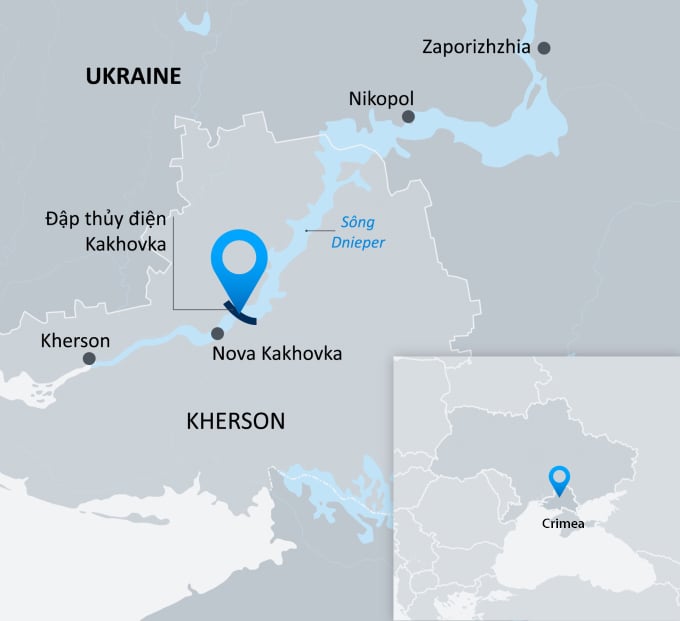
Location of the Kakhovka hydroelectric dam. Graphic: DW
By Như Tâm (According to Reuters, AFP )
Source link













































































Comment (0)