

Recently, many real estate businesses have expressed concerns about regulations related to home loan terms.
Specifically, Mr. Le Hoang Chau, Chairman of the Ho Chi Minh City Real Estate Association, stated that he and other real estate businesses are very concerned about the regulation in point a, clause 11, article 2 of Circular 41/2016/TT-NHNN (amended and supplemented by Circular 22/2023/TT-NHNN).
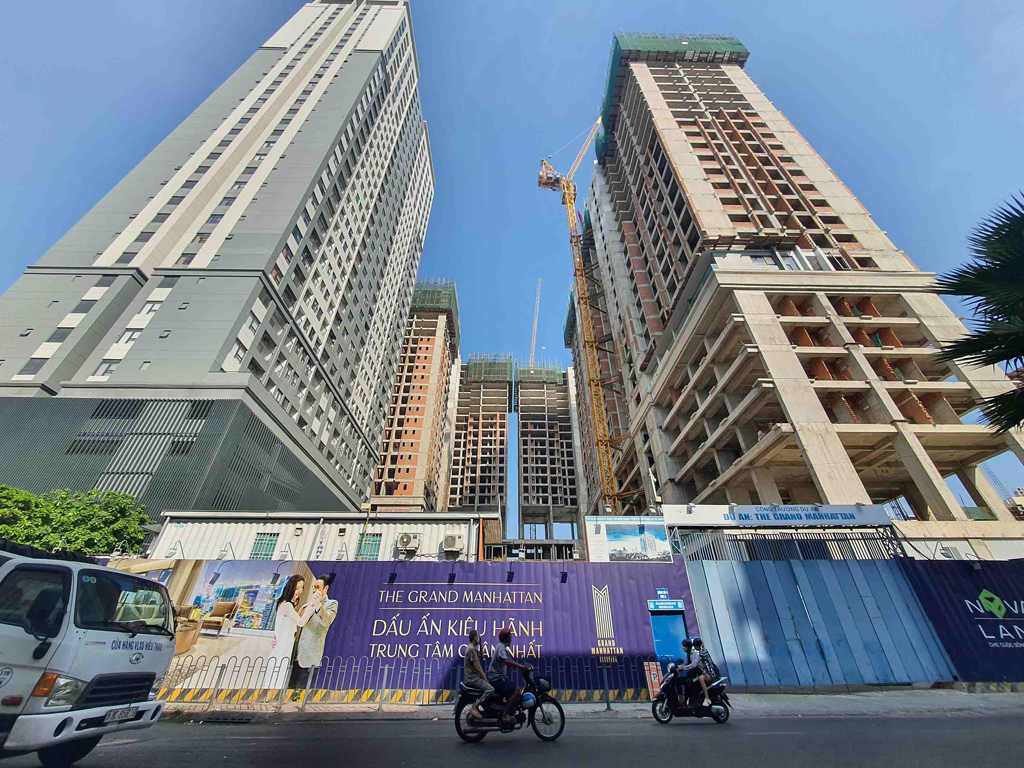
Real estate businesses have just gone through a turbulent and challenging year.
According to this regulation, for real estate-secured loans to individuals to purchase homes, including commercial housing, banks are only allowed to lend to individuals to purchase completed and ready-to-move-in homes, i.e., ready-to-move-in housing.
Therefore, Circular 22/2023/TT-NHNN does not allow banks to lend to individuals to purchase unfinished commercial housing (i.e., commercial housing under construction) secured (mortgaged) by the house itself. Thus, individuals wishing to obtain credit to purchase commercial housing under construction must implement other security measures or provide collateral in the form of other assets.
Regarding this matter, the State Bank of Vietnam issued a response on January 31st.
According to the State Bank of Vietnam, Circular 41/2016/TT-NHNN (amended and supplemented by Circular 22/2023/TT-NHNN) regulating the capital adequacy ratio of commercial banks and branches of foreign banks is not a document guiding the credit granting operations of credit institutions.
Clause 10, Article 2 of Circular 41/2016/TT-NHNN stipulates: "Loans secured by real estate are loans to individuals and legal entities to purchase real estate or implement real estate projects, and are secured by the real estate or real estate project formed from the loan, in accordance with the provisions of the law on secured transactions."
The State Bank of Vietnam affirms that Circular 22/2023/TT-NHNN does not amend or supplement this content. Organizations and individuals wishing to purchase a house and secure (mortgage) this future-built house will apply a risk weighting of 30-120% depending on the loan-to-value ratio (LTV), calculated as the ratio of the loan balance to the value of the collateral; in cases where the LTV ratio is unavailable, the risk weighting will be 150%.
Borrowing to buy social housing does not require meeting the condition that the house has been completed and handed over.
According to the State Bank of Vietnam, Clause 11, Article 2 of Circular 41/2016/TT-NHNN stipulates: "A mortgage loan is a loan secured by real estate to an individual for the purpose of purchasing a house." The following conditions must be met: the source of repayment funds must not be rental income generated from the loan; and the house must be completed according to the house purchase contract.
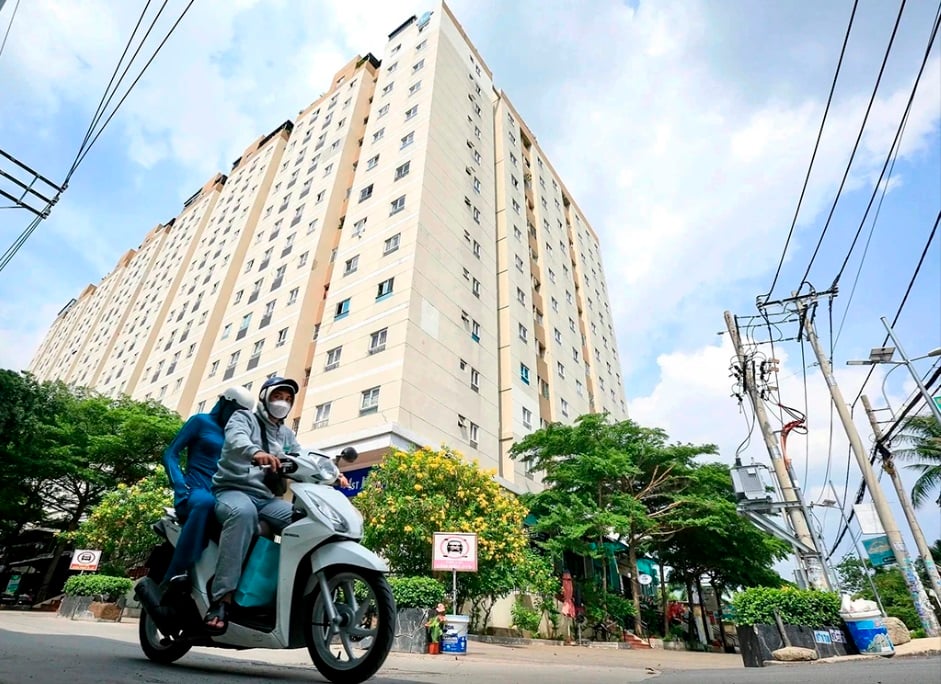
A social housing complex in District 12 (Ho Chi Minh City)
Banks and branches of foreign banks have full legal rights to seize mortgaged properties when customers fail to repay their debts, in accordance with the law on secured transactions.
The property acquired through this mortgage loan must be independently appraised (either by a third party or by a department independent of the credit approval department of the bank or foreign bank branch) with a prudential valuation (the price must not exceed the market price at the time of loan approval) as stipulated by the bank or foreign bank branch.
Meanwhile, Clause 1, Article 1 of Circular 22/2023/TT-NHNN stipulates: "1. Amend and supplement Clause 11, Article 2 as follows: "11. Mortgage loans are loans secured by real estate to individuals to purchase houses, including loans secured by real estate to individuals to purchase houses that meet the following conditions: the source of repayment is not from rental income generated from the loan; the house has been completed and is ready for handover according to the house purchase contract.
Banks and branches of foreign banks have full legal authority to seize mortgaged properties when customers fail to repay their debts, in accordance with the laws on secured transactions and housing laws.
The property acquired through this mortgage loan must be independently appraised (either by a third party or by a department independent of the credit approval department of the bank or foreign bank branch) with a prudential principle (the value must not exceed the market price at the time of loan approval) as stipulated by the bank or foreign bank branch...
State Bank of Vietnam
Home mortgage loans will include: home mortgage loans for purchasing eligible housing, including the condition of completion and handover; and loans for purchasing social housing or housing under government support programs and projects.
The risk weighting applied to home mortgage loans varies depending on the type, ranging from 20% to 100%, depending on the loan-to-value ratio (LTV) and the distributional risk weighting (DSC). For loans to purchase social housing or housing under government support programs and projects, which do not require the house to be completed and ready for handover, the risk weighting is lower than other home mortgage loans, ranging from 20% to 50%, in line with the government's policy of encouraging social housing.
According to the State Bank of Vietnam, the condition that the house must be completed as per the house purchase contract only applies to mortgage loans secured by real estate (which are subject to a lower risk weighting compared to other receivables secured by real estate).
In cases where organizations or individuals need to build or purchase housing under construction and mortgage this housing under construction, it will fall under the category of loans secured by real estate as stipulated in Clause 10, Article 2 of Circular 41/2016/TT-NHNN and the corresponding risk coefficient will be applied as stipulated in Clause 10, Article 9 of Circular 41/2016/TT-NHNN.
"Therefore, this regulation does not restrict the rights of organizations and individuals to purchase housing under construction, and does not contradict current regulations (Civil Law, Housing Law, Real Estate Business Law, Investment Law 2020, Law on Credit Institutions 2024)," the State Bank of Vietnam stated.
Source link
















![[Photo] Prime Minister Pham Minh Chinh holds a phone call with the CEO of Russia's Rosatom Corporation.](/_next/image?url=https%3A%2F%2Fvphoto.vietnam.vn%2Fthumb%2F1200x675%2Fvietnam%2Fresource%2FIMAGE%2F2025%2F12%2F11%2F1765464552365_dsc-5295-jpg.webp&w=3840&q=75)














































Comment (0)