

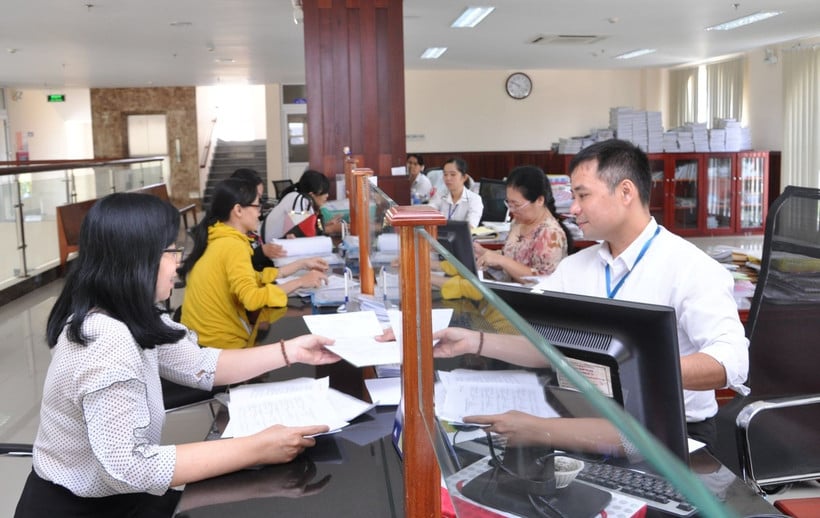
Up to now, thanks to strict implementation of discipline in directing, operating and managing budget collection; focusing on fully implementing the tasks and solutions of the Government and the Ministry of Finance on implementing the State budget collection estimate for 2025, the tax sector has completed the State budget collection target for 2025, and is on the final stretch of the journey to strive to complete the task of increasing revenue under the direction of the Prime Minister.
Total State budget revenue in November 2025 managed by the Tax authority is estimated at 170,200 billion VND, reaching 9.9% of the estimate, equal to 124% of the same period in 2024. Accumulated in the first 11 months of 2025, total State budget revenue managed by the Tax authority is estimated at 2,094,277 billion VND, reaching 121.8% of the estimate, equal to 134.5% of the same period in 2024.
Of which, revenue from crude oil is estimated at VND 44,351 billion, equal to 83.4% of the estimate, equal to 84.5% of the same period in 2024. Domestic revenue is estimated at VND 2,049,926 billion, equal to 123% of the estimate, equal to 136.2% of the same period in 2024. Domestic tax and fee revenue is estimated at VND 1,416,382 billion, equal to 113.3% of the estimate, equal to 122% of the same period in 2024. Central budget revenue in the first 11 months of 2025 is estimated at VND 826,264 billion, equal to 106.9% of the estimate, equal to 117.7% of the same period. Local budget revenue is estimated at VND 1,268,013 billion, equal to 133.9% of the estimate, equal to 146.7% of the same period.
Compared to the estimate, 17/19 revenue items and taxes achieved quite well (over 95%), in which some large revenue items such as: the foreign-invested enterprise sector is estimated at 105.3%; revenue from the non-state economic sector is estimated at 123.3%; personal income tax is estimated at 119.2%; land use fee is estimated at 173%; land and water surface rental fee is estimated at 173.9%; mineral and water resource exploitation right fee is estimated at 120.8%;... Compared to the same period, 15/19 revenue items and taxes have growth.
The above results reflect the correct management of the state budget collection task. Accordingly, in the field of domestic revenue, the tax sector has closely monitored the collection progress, evaluated and analyzed the collection situation in each locality, each collection area, revenue item and tax. Forecasting monthly and quarterly revenue closely matches the actual situation to advise on timely collection solutions. Strengthening the management of revenue sources, preventing revenue loss, exploiting revenue increase through tightening the management of revenue sources, especially potential revenue sources such as: e-commerce business activities, on digital platforms, cross-border, individual households doing business in the fields of food and beverage, accommodation, chain business, house rental, exploitation of resources, minerals and land revenues,... both affirming Vietnam's tax sovereignty over corporations and transnational companies in the digital economy, while contributing to increasing state budget revenue and consolidating a solid financial foundation in the long term.
Right from the beginning of the year, the Tax Department has drastically implemented tax management solutions according to the new organizational model, assigning tax management tasks by subject to each local tax agency, by province/city under its management, to each tax team, and to each management officer.
In particular, the tax sector will well implement the 2025 tax inspection plan on the basis of applying risk management, ensuring the completion of both quantity and quality targets, improving the efficiency of tax inspection work; effectively implementing revenue management for business households and individuals, in accordance with the direction of Resolution No. 68 of the Politburo; strengthening the application of big data, connecting with ministries and branches (Ministry of Public Security, State Bank...) in cash flow management, invoice control, non-cash payments... contributing to gradually changing the method of revenue management, aiming at the goal of 100% of business households using Etax Mobile to declare and pay taxes; organizing the review and accurately determining the tax debt of each taxpayer, classifying tax debts according to each group of tax debtors to have appropriate management and collection solutions; Assign responsibility for managing and urging tax debt collection of each taxpayer to each tax collection manager, closely monitor and supervise the progress of debt collection and limit the occurrence of new debts.
In addition, the tax sector effectively implemented specialized inspection work according to topics focusing on industries and fields with high tax risks such as: personal income tax of taxpayers with high income; enterprises with sudden revenue growth; large-scale enterprises but have not been inspected or examined for many years; enterprises with many years of losses; enterprises with low profit margins compared to the industry average for many years; large business households but not established enterprises; business households and individuals doing retail business of goods, food services, restaurants and hotels; preventing loss of revenue from e-commerce, business on digital platforms; affiliated transactions; insurance business activities; gold, jewelry, handicrafts; production, business, export and import of iron and steel, scrap; mining and trading of mineral resources; golf service business; origin fraud.
In addition, the industry continues to review and resolutely implement solutions to prevent invoice fraud such as: Building a set of criteria and applying risk analysis according to the set of criteria to identify taxpayers with high risk signs in invoice management and use; building a database to manage electronic invoices of taxpayers who have abandoned their business addresses and a list of taxpayers transferred by the police; upgrading and effectively operating the application to compare value-added tax declarations and invoices; building and deploying an industry-wide application to identify chains of businesses using invoices of businesses that have abandoned their business addresses; applying AI intelligence to analyze data along the chain of goods trading based on electronic invoice data to identify chains with high risks in tax refunds, in sales without invoices, and in buying and selling invoices.
At the same time, the tax sector continues to promote reform and comprehensive digital transformation in tax management towards modernization, synchronous and effective investment. In particular, it continues to promote data sharing connections with ministries and branches (population data, journey monitoring data, etc.) and collect information from data sources outside the sector (banks, securities, insurance, land management, etc.), tax management information to build and build large databases on e-commerce, tax refunds, invoices, real estate transactions, etc. Accelerate the application of AI in big data processing, deploy tax statistics projects to effectively exploit the sector's data sources, providing necessary information for direction and operation.
It is noteworthy that the Tax Department will more vigorously implement the application of electronic invoices generated from cash registers; closely inspect and supervise the issuance of electronic invoices for each sale of gasoline retail, gold, silver, precious stones, food and beverage services, and retail. Strengthen discipline, discipline, correct working style, attitude, and behavior of tax officials and civil servants in performing public duties throughout the industry. Timely handle violations in performing public duties. Effectively prevent corruption and negativity; practice thrift and combat waste.
The entire industry focuses on resolving and handling work, especially backlogs, slow-progress work, and arising work and situations, so as not to affect the lives and production and business activities of people and enterprises.
Source: https://nhandan.vn/nganh-thue-tiep-tuc-day-manh-cai-cach-chuyen-doi-so-triet-de-toan-dien-trong-cong-tac-quan-ly-thue-post928768.html


![[Photo] General Secretary To Lam receives the Director of the Academy of Public Administration and National Economy under the President of the Russian Federation](/_next/image?url=https%3A%2F%2Fvphoto.vietnam.vn%2Fthumb%2F1200x675%2Fvietnam%2Fresource%2FIMAGE%2F2025%2F12%2F08%2F1765200203892_a1-bnd-0933-4198-jpg.webp&w=3840&q=75)































































































Comment (0)