

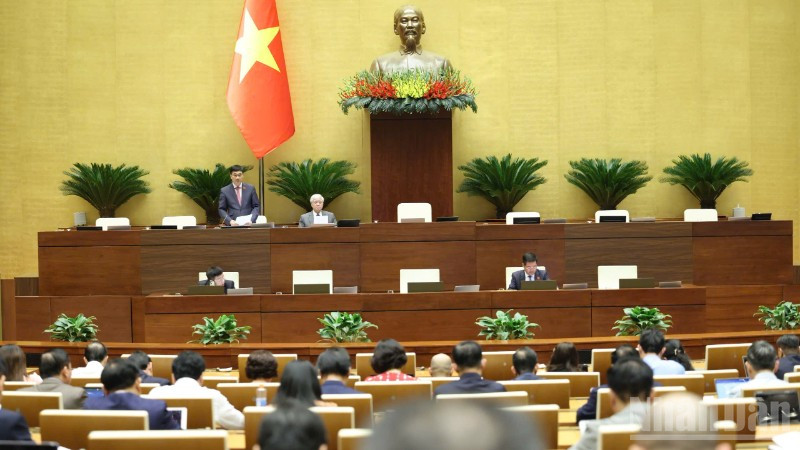
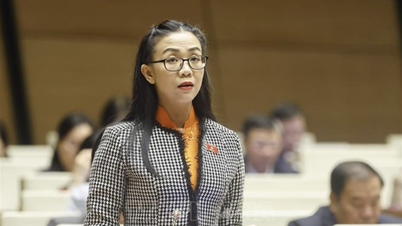
Scene of the National Assembly session on the afternoon of December 8. (Photo: DUY LINH)
Mechanism breakthrough for offshore wind power development and transmission infrastructure
On the afternoon of December 8, discussing at the meeting hall the draft Resolution of the National Assembly on mechanisms and policies for national energy development in the 2026-2030 period, many National Assembly deputies emphasized the need for new, breakthrough mechanisms to remove long-standing obstacles in the energy sector, especially offshore wind power, power transmission and ensuring hydropower safety.
Opinions focused on proposing solutions to ensure energy security , meet high growth requirements, implement NetZero commitments and increase economic competitiveness.
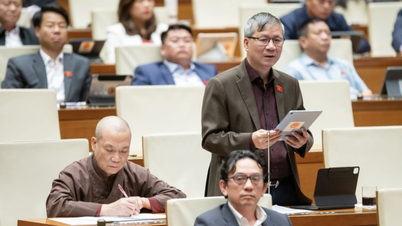
Delegate Nguyen Hai Nam ( Hue ) said that in order to strive for economic growth of more than 10% from 2026, the need for energy development, especially electricity, is very large. In particular, offshore wind power is an important pillar, but there are still many legal problems that need to be resolved.
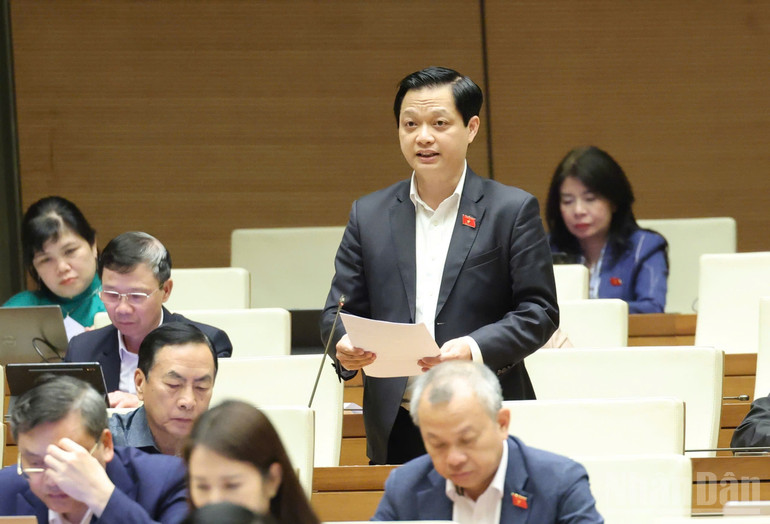
Delegate Nguyen Hai Nam (Hue) speaks. (Photo: DUY LINH)
According to delegates, this sector is facing five major legal difficulties and problems, including: First, the planning is not synchronized. The spatial planning has not been approved, causing offshore wind power projects to not have a solid legal basis for implementation, although there are goals in the power sector planning.
Second, the pricing mechanism is not suitable. There is a lack of clear, attractive and long-term policies and pricing mechanisms for offshore wind power projects to attract international and domestic investors.
Third, regarding regulations on sea area allocation: There are no clear instructions on the order and procedures for leasing and allocating sea areas for surveying, researching, constructing and operating offshore renewable energy projects.
Fourth, regarding the procedures and criteria for selecting investors: There is a lack of specific regulations on procedures and criteria for selecting investors for large-scale offshore wind power projects with high investment capital. In particular, survey costs are very high.
Fifth, decentralization of investment appraisal/approval: There are still difficulties in the authority to approve investment policies for offshore wind power projects.
Faced with the above difficulties and obstacles, delegate Nguyen Hai Nam proposed solutions to promote development to create a breakthrough for the offshore wind power industry. Accordingly, Vietnam needs to implement synchronous solutions in terms of law, mechanism and infrastructure.
First, perfect the legal framework: Create a strong legal corridor, covering issues from surveying, assigning sea areas, to investment and operation.
Second, approve synchronous planning: Urgently complete and approve planning to serve as a basis for clearly identifying priority areas for offshore wind power development.
Third, regulations on sea allocation/lease, speeding up survey activities: Issue clear regulations on procedures for sea surface lease and granting survey and research licenses for wind power projects.
Fourth, develop a suitable pricing mechanism and model contract: Soon issue an offshore wind power pricing mechanism, competitive bidding, reasonable, ensuring competitiveness and attractiveness, which can be flexibly adjusted according to technology and project scale. Develop a Power Purchase Agreement (PPA) with risk assurance provisions such as stoppage/deflation clauses, helping investors easily mobilize capital from international financial institutions.
Fifth, transparent investor selection process. Establish a public and transparent bidding/auction process to select capable investors to implement projects allocated in the Power Sector Plan.
Sixth, promote the implementation process and supply chain. Develop support for the supply chain and human resources. Have support and incentive mechanisms (such as green credit) to promote the localization of the equipment supply chain (foundation, specialized ports, installation vessels) and the training of high-tech human resources.
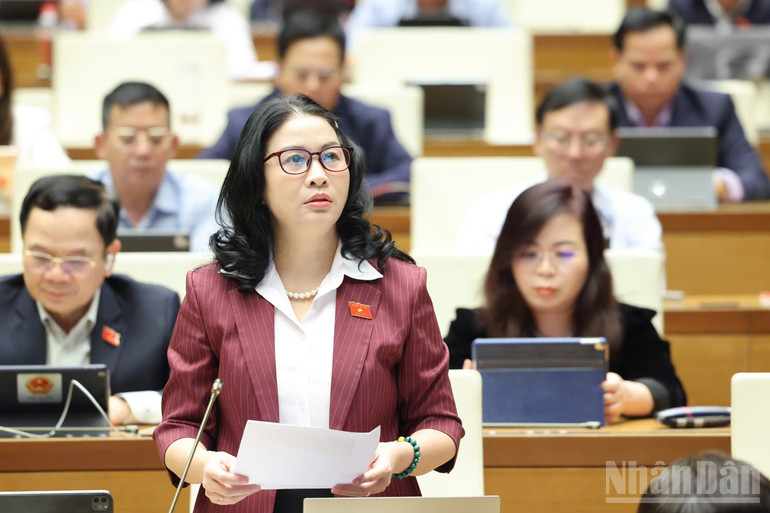
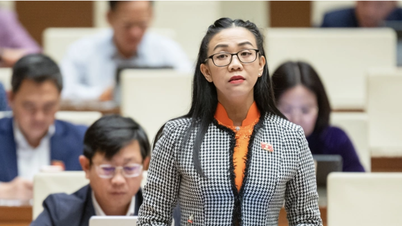
Delegate Nguyen Thi Lan (Hanoi) speaks. (Photo: DUY LINH)
Delegate Nguyen Thi Lan (Hanoi) emphasized that the draft resolution is “very urgent” for three reasons: The electricity system is a bottleneck for high-tech agriculture, logistics and research; pressure from the EU’s NetZero commitments and CBAM mechanism; many transmission projects, renewable energy, LNG and offshore wind power are “waiting for mechanisms”.
To complete the draft, Ms. Lan proposed 4 groups of contents: First, add the concept of biomass energy to Article 3, considering this an advantage of Vietnam and suitable for the circular economy.
Second, in Articles 6 and 7, priority should be given to local adjustments to transmission planning for key agricultural regions such as the Mekong Delta, Central Highlands, and Red River Delta - where there is a large demand for electricity for preservation, processing, and logistics.
Third, in Article 22 on petroleum reserves, it is necessary to add directions to increase the proportion of biofuels such as E5, E10, SAF; at the same time, mobilize universities and research institutes to participate in research and testing.
Fourth, regarding the development of small-scale nuclear power (Article 12), delegates believe that this is a suitable choice for the initial stage, mainly for research, training, and mastering technology. The initial stage requires the leading role of the State due to the large investment, long recovery period, and high risk. After accumulating sufficient capacity, Vietnam can expand the scale and attract the private sector; the roadmap from small-scale to large-scale is in line with international practice.
Ensuring absolute safety of hydropower: "If it is not safe, it should definitely not be done"
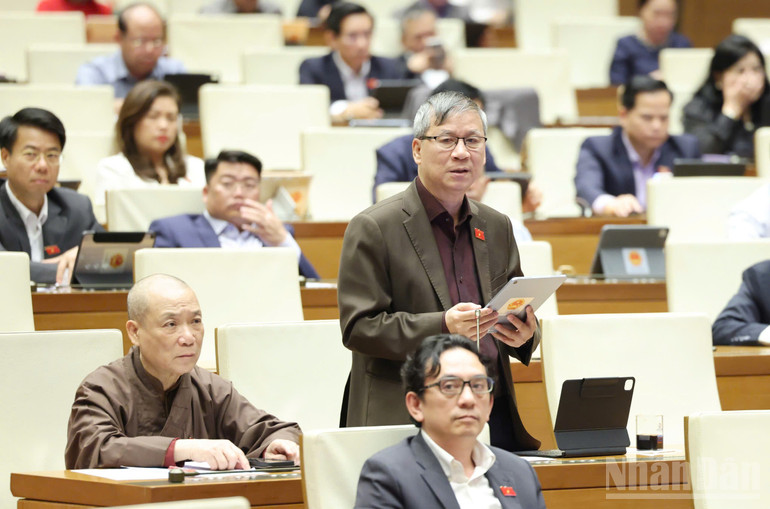
Delegate Nguyen Anh Tri (Hanoi) speaks. (Photo: DUY LINH)
Delegate Nguyen Anh Tri (Hanoi) focused on giving comments on hydropower - a field that he said was "very important but not mentioned" in the draft Resolution, even though flood discharges causing damage have occurred in many localities.
He stated that hydroelectric reservoirs must ensure functions such as storing water for electricity, serving irrigation, aquaculture, tourism, and environmental regulation; but most importantly, they must not harm people or affect human life.
According to delegates, to ensure the safety of hydroelectric reservoirs, it is necessary to: have a large enough capacity based on safe rainfall of 200 years or more; during the rainy season, only store a maximum of 50% of capacity; operate the bottom spillway properly; forecast weather accurately; absolutely do not discharge floodwaters when the water level is high downstream.
He said that nearly 20 small hydropower plants had discharged floodwaters causing damage downstream, pointing out three main groups of causes: The location of the plant on steep terrain; small reservoirs with insufficient storage capacity; and untimely operation procedures and flood discharge notifications.
Although this issue was mentioned in Report 921 to the Government, the draft Resolution has not yet mentioned it. Delegates suggested that the National Assembly and the Government consider 3 groups of recommendations: Review all small and medium-sized hydropower plants in operation, fix the causes of flood discharge; if not, close them. If damage is caused, compensation must be paid, if death is caused, criminal prosecution must be carried out.
At the same time, it is necessary to review all approved small and medium hydropower projects, in which small hydropower should not be built in steep mountainous areas, with many streams, or places without safe operating procedures.
In addition, priority should be given to investing in large hydropower plants, ensuring high safety, while developing wind and solar power to replace small hydropower plants in accordance with Vietnam's technological advantages and conditions.
Delegates proposed to include the above contents in the Resolution, clearly expressing the viewpoint: "If we build hydropower plants, we must do it safely. If it is not safe, we should definitely not do it."
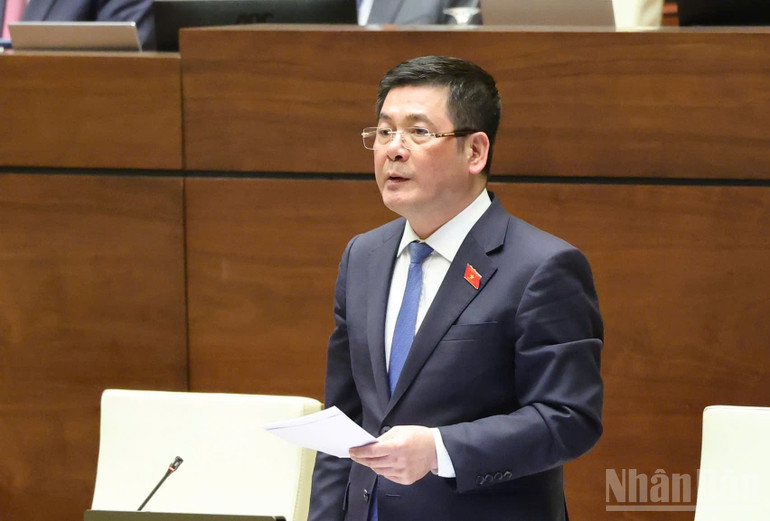
Minister of Industry and Trade Nguyen Hong Dien spoke to explain and clarify the opinions of National Assembly deputies at the meeting. (Photo: DUY LINH)
Further explaining the opinion of delegate Tri at the meeting, Minister of Industry and Trade Nguyen Hong Dien said that current legal regulations related to small hydropower are still relatively appropriate.
He said that small hydropower is a long-term project, not too urgent, so the drafting agency respectfully accepts the opinions of delegates and will consider them in the process of reviewing and amending the Electricity Law, expected to be implemented in 2026.
Regarding offshore wind power, the Minister stated that current legal policies are relatively complete; the price framework has been issued since June 2025, with specific regulations for each region. Vietnam has great potential with more than 3,000km of coastline, but this is a completely new type of energy, and is associated with national security factors at sea.
The Minister noted that the country is long and has only one exit to the sea. If offshore wind power is developed simultaneously, it is necessary to calculate and handle complex situations that may arise, especially in the future when external factors will be very large.
The Government's viewpoint is to act step by step, cautiously, exploiting potential while learning from experience to ensure safety and sustainability, Minister Nguyen Hong Dien emphasized.
Source: https://nhandan.vn/thao-diem-nghen-giai-phong-nguon-luc-cho-nang-luong-quoc-gia-post928816.html


![[Photo] General Secretary To Lam receives the Director of the Academy of Public Administration and National Economy under the President of the Russian Federation](/_next/image?url=https%3A%2F%2Fvphoto.vietnam.vn%2Fthumb%2F1200x675%2Fvietnam%2Fresource%2FIMAGE%2F2025%2F12%2F08%2F1765200203892_a1-bnd-0933-4198-jpg.webp&w=3840&q=75)












































































Comment (0)