

Issued together with this Decree are the model working regulations of the People's Committees of provinces and centrally run cities.
Decree 314/2025/ND-CP takes effect from December 8, 2025.
Decision No. 53/2006/QD-TTg dated March 8, 2006 of the Prime Minister stipulating the model working regulations of the People's Committees of provinces and centrally run cities ceases to be effective from the effective date of this Decree.
Abolish regulations related to meetings of the People's Committees of provinces and centrally run cities, and specialized agencies under the People's Committees of provinces and centrally run cities in Decision No. 45/2018/QD-TTg dated November 9, 2018 of the Prime Minister stipulating the meeting regime in the management and operation activities of agencies under the state administrative system.
Regarding implementation responsibilities: The People's Committees of provinces and centrally run cities shall promulgate Working Regulations in accordance with the Model Working Regulations of the People's Committees of provinces and centrally run cities attached to this Decree.
For the People's Committees of provinces and centrally run cities that have issued Working Regulations to ensure compliance with the provisions of the Law on Organization of Local Government No. 72/2025/QH15, they shall continue to implement them. In case of necessity, based on the characteristics and practical situation of the locality, the provisions of the law and to ensure better management and operation of the government apparatus, the People's Committees of provinces and centrally run cities shall base on the provisions of this Decree to adjust and supplement accordingly.
The Chairman of the People's Committee of the province or centrally-run city and relevant agencies, organizations and individuals are responsible for implementing this Decree.
The model working regulations attached to Decree 314/2025/ND-CP include 9 Chapters and 48 Articles, comprehensively regulating the working regime, responsibilities, working relationships and work handling procedures of the Provincial People's Committee.
The model regulations set out specific working principles and responsibilities, emphasizing collectivity while promoting the leadership role and personal responsibility of the Chairman of the Provincial People's Committee.
Specifically, regarding working principles and responsibilities: All activities of the provincial People's Committee must comply with the Constitution and laws, and handle work in accordance with legal regulations, the direction and administration of the Government and the Prime Minister. In particular, the activities of the provincial People's Committee must ensure publicity, transparency, smoothness and continuity; focusing on fighting corruption, negativity and waste.
The Chairman of the Provincial People's Committee is the person who leads and manages the work of the Provincial People's Committee; is personally responsible for the assigned work and, together with the members of the Provincial People's Committee, is collectively responsible for the activities of the Provincial People's Committee. The Vice Chairman of the Provincial People's Committee performs the assigned tasks and powers; is personally responsible to the Chairman of the Provincial People's Committee and before the law for decisions within the assigned fields, areas, scopes, and powers.
Members of the Provincial People's Committee perform duties and powers according to the provisions of law and as assigned by the Chairman of the Provincial People's Committee; are responsible for proactively and actively participating in resolving common work of the People's Committee.
Work handling methods and Digital transformation: The regulations strongly encourage the application of information technology and digital transformation in work handling. In the process of handling work, each task is only assigned to one agency, unit, or one responsible individual.
For voting: Can be done through a centralized meeting or in the form of a voting ballot, electronic voting ballot on the Document Management and Operation Information System.
The process of handling records and work (Chapter III) is standardized, requiring records and work to be processed in an electronic environment (except for cases in the list of state secrets). The Office of the Provincial People's Committee is responsible for receiving, processing, creating a list to monitor the process of handling records and work, and archiving according to regulations.
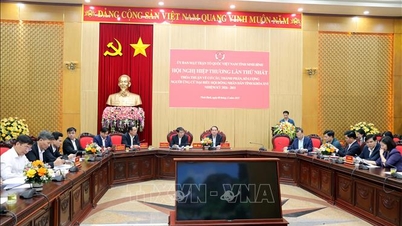
Organizing meetings and sessions: The Provincial People's Committee holds regular meetings once a month to resolve arising and unexpected matters as decided by the Chairman of the Provincial People's Committee. Meetings can be held in person or online. The Provincial People's Committee Office is responsible for checking and synthesizing project documents, proposals, and draft documents to be submitted to the meeting.
The Regulations also stipulate the Working Meetings of the Chairman and Vice Chairman of the Provincial People's Committee to handle regular work and complex, urgent work.
Monitoring, urging and inspection work is carried out regularly and according to a plan. Inspection and urging work is carried out in accordance with authority, order, procedures and on the basis of legal regulations. This work must ensure effectiveness and efficiency and enhance the application of information technology and digital transformation.
The Provincial People's Committee and the Chairman of the Provincial People's Committee have full responsibility for implementing Party, State, and legal documents, and at the same time perform other tasks assigned by superiors.
The work of receiving citizens and handling complaints and denunciations (Chapter VIII) clearly stipulates the responsibility of the Chairman of the Provincial People's Committee in directing inspection activities, receiving citizens, handling complaints and denunciations, and handling violations of authority. The Chairman of the People's Committee must schedule a meeting with citizens, and in urgent cases, must directly receive citizens within 01 day.
Information and Information Disclosure: The Chairman of the Provincial People's Committee and Vice Chairman of the Provincial People's Committee periodically report on the socio -economic situation, security and national defense of the locality. In particular, the Regulation emphasizes the requirement to publicize and widely disseminate documents, regulations and policies issued by the Provincial People's Committee and Chairman of the Provincial People's Committee related to the rights and obligations of local citizens.
Legal documents, reports and other relevant information serving the direction and administration of the Provincial People's Committee must be posted on the Provincial People's Committee's electronic information system. This is to promote the application of information technology, digital transformation...
Source: https://baotintuc.vn/thoi-su/quy-che-lam-viec-mau-cua-uy-ban-nhan-dan-tinh-thanh-pho-truc-thuoc-trung-uong-20251208230043180.htm

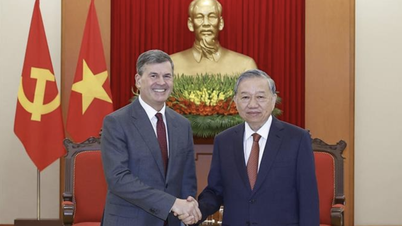
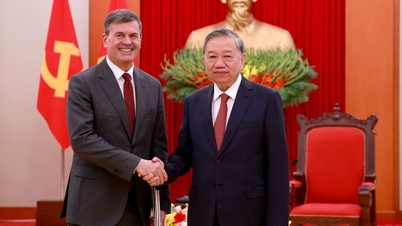
![[Photo] General Secretary To Lam receives the Director of the Academy of Public Administration and National Economy under the President of the Russian Federation](/_next/image?url=https%3A%2F%2Fvphoto.vietnam.vn%2Fthumb%2F1200x675%2Fvietnam%2Fresource%2FIMAGE%2F2025%2F12%2F08%2F1765200203892_a1-bnd-0933-4198-jpg.webp&w=3840&q=75)




































































Comment (0)