

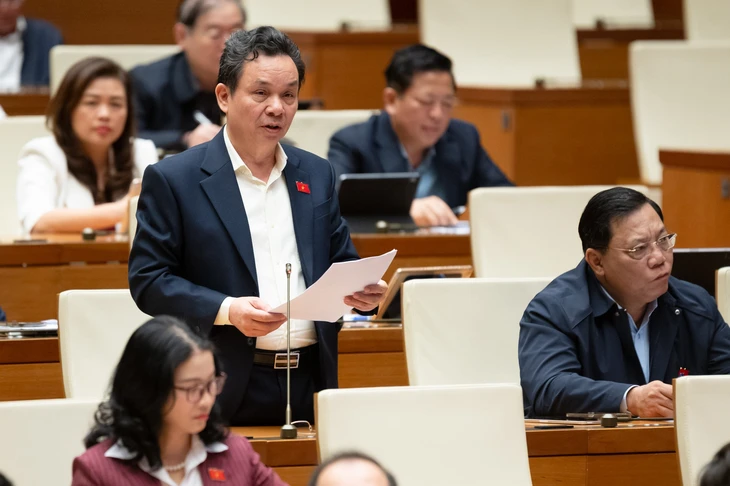
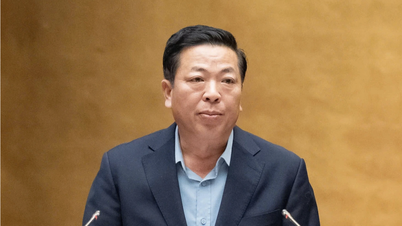
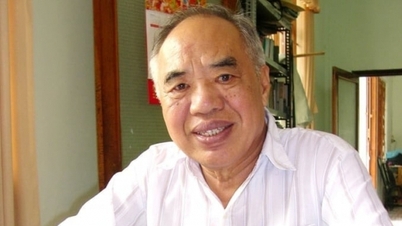
Delegate Hoang Van Cuong - Photo: GIA HAN
On the morning of December 8, the National Assembly discussed in the hall the draft Resolution of the National Assembly amending and supplementing a number of articles of Resolution 98 on piloting a number of special mechanisms and policies for the development of Ho Chi Minh City.
With such a large entity, Ho Chi Minh City cannot wear the same institutional coat as other localities.
Delegate Hoang Van Cuong (Hanoi) said that Ho Chi Minh City was originally the largest economic center of the country, a dynamic and creative area, a place where new management institutions were created to be replicated throughout the country.
After merging Binh Duong and Vung Tau, the position and potential of Ho Chi Minh City has grown stronger both domestically and internationally, which no other locality can compare to.
"With such a large entity, Ho Chi Minh City does not wear the same institutional coat as other localities in the country, but needs to have a different and more open legal framework, creating a separate space for Ho Chi Minh City to freely create and develop under control. That is the goal and mission that this resolution must achieve," Mr. Cuong emphasized.
Delegates from Hanoi expressed their agreement with all mechanisms and policies on developing TOD urban models, on urban planning and management; on attracting strategic investors, and on the proposal to establish a free trade zone.
However, according to him: "I think all of these proposals are still somewhat modest and not strong enough to truly create a strong enough mechanism to help Ho Chi Minh City freely innovate and develop in line with its potential and current position."
From there, he proposed to review and remove all regulations that make it impossible to implement specific mechanisms.
Mr. Cuong gave an example in the first paragraph of the draft resolution, which is to amend points a and c, clause 2, Article 4 as: "The City People's Council decides to use the local budget to... do a series of things... according to the provisions of law".
According to him, "if we follow the law, then we should just do it, why do we need to issue this resolution? There are many provisions in this draft resolution." He suggested that we should review and remove such provisions "so that we can implement specific regulations without having to ask anyone else."
On the other hand, the delegate said that the draft resolution is listing all the tasks that need to be requested for special methods, listing and describing in detail the types of projects that need to be given incentives as strategic investors.
If this resolution approves the above tasks and the above list of projects, and after a while another task appears or another strategic investment request appears, then the resolution must be revised to do it.
"I suggest that this resolution should not list like that, but should provide general principles and criteria on which to base the City People's Council to decide on specific matters, similar to the way resolutions of the capital are drafted," Mr. Cuong said.
Create a truly attractive mechanism to attract strategic investors

Delegate Tran Khanh Thu (Hung Yen) - Photo: GIA HAN
Delegate Tran Khanh Thu (Hung Yen) acknowledged that although Ho Chi Minh City is a provincial-level administrative unit, its population and economic scale are very large, requiring a strong enough mechanism to meet the practical needs of proactive and effective management.
After the merger, Ho Chi Minh City is the largest urban area in the country with a population of 13.6 million people, contributing more than 23% of GDP and about 1/3 of the total national budget revenue.
Therefore, the National Assembly's consideration of a resolution with unprecedented mechanisms and policies for Ho Chi Minh City is not just the story of one locality.
"This is a strong political commitment of the National Assembly and the Government in giving Ho Chi Minh City the conditions to lead, pave the way and test development models of national influence," Ms. Thu emphasized.
This resolution, therefore, not only creates more room for development for a locality, but also creates a national policy laboratory where new, breakthrough models will be tested before being replicated.
DELEGATE TRAN KHANH THU
The female delegate supported the addition of 11 project groups, of which she was interested in three particularly important groups: projects on specialized healthcare, sports complexes, cultural parks - thematic parks; projects on renovating and relocating houses on canals and riverside; and projects on green parks, public parking lots, clean energy, and public toilets.
According to Ms. Thu, the above project groups all have one thing in common: the intertwined public-private nature, large investment volume, requiring very high management and coordination capacity.
Without a specific mechanism, it will be difficult to attract truly strategic investors, it will be impossible to solve the urban problems that have persisted for many years, and Ho Chi Minh City will not be able to enter a new development phase with a leading role in the country.
"In amending Resolution 98, the most important thing is to create a truly attractive mechanism to attract strategic investors, while also properly handling the issue of land management and use. It is recommended that the drafting agency continue to review the list of projects that need to be summarized according to the objectives, nature and issues to be solved, avoiding describing each item in too much detail because that can easily become outdated, limit flexibility and lose the opportunity to attract new models and technologies," Ms. Thu suggested.
Back to topic
TIEN LONG - THANH CHUNG
Source: https://tuoitre.vn/ung-ho-khung-phap-luat-khac-biet-cho-tp-hcm-dai-bieu-noi-phai-tao-co-che-hap-dan-nha-dau-tu-20251208105319973.htm


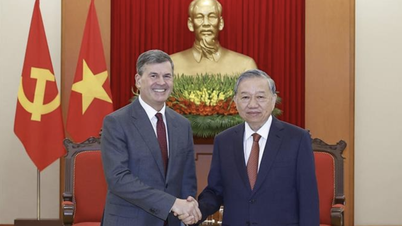
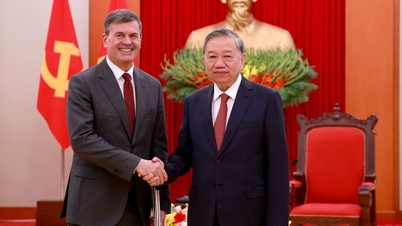
![[Photo] General Secretary To Lam receives the Director of the Academy of Public Administration and National Economy under the President of the Russian Federation](/_next/image?url=https%3A%2F%2Fvphoto.vietnam.vn%2Fthumb%2F1200x675%2Fvietnam%2Fresource%2FIMAGE%2F2025%2F12%2F08%2F1765200203892_a1-bnd-0933-4198-jpg.webp&w=3840&q=75)











































































Comment (0)