

On September 27th, Associate Professor, Doctor Pham Van Quang, Head of the Intensive Care and Toxicology Department at Children's Hospital 1 (Ho Chi Minh City), stated that after a few weeks of relative stability, the hand, foot, and mouth disease situation is now flaring up in the Mekong Delta provinces as children begin returning to school, especially in Can Tho . Currently, the Intensive Care Unit at Children's Hospital 1 is treating 10 severe cases of hand, foot, and mouth disease, including 8 children on ventilators and 2 undergoing dialysis. All cases are from other provinces, mostly in the Mekong Delta.
The hospital recently recorded a case of a child dying from hand, foot, and mouth disease. The 3-year-old child, residing in Ca Mau, had previously shown symptoms of fever and fatigue and was transferred to a local hospital for treatment. The child was diagnosed with hand, foot, and mouth disease. After two days on a ventilator, the child's condition worsened significantly with a poor prognosis. At the family's request, the child was transferred to Children's Hospital 1 for emergency treatment.
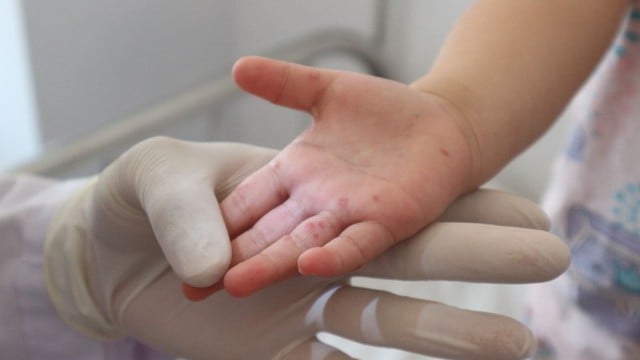
Hand, foot, and mouth disease commonly occurs in children under 5 years old.
According to Dr. Pham Van Quang, the child was in critical condition upon admission. Doctors made every effort to save the child, but just 15 minutes after admission, the child suffered cardiac arrest and died with a diagnosis of stage 4 hand, foot, and mouth disease.
According to Dr. Nguyen Minh Tien, Deputy Director of the City Children's Hospital, the hospital is currently treating 7 severe cases of hand, foot, and mouth disease, including 5 cases requiring mechanical ventilation and 2 cases requiring hemodialysis.
The symptoms of hand, foot, and mouth disease are worsening.
Dr. Quang advises parents that if they notice signs of hand, foot, and mouth disease such as rashes, blisters on the palms, soles, knees, buttocks, and throat ulcers, they should take their children to see a doctor. Children should be taken to a medical facility quickly if they show severe symptoms of hand, foot, and mouth disease.
- High fever that is persistent and difficult to bring down, fever lasting more than 2 days.
- Frequent vomiting
- Startled and bewildered.
- Runny nose, unsteady gait.
- Shortness of breath
- Cold extremities, mottled skin.
- Seizures, altered consciousness...
According to the Ministry of Health, from the beginning of the year to September 20th, the whole country has recorded more than 80,700 cases of hand, foot, and mouth disease, with 21 deaths. Compared to the same period in 2022 (47,896 cases/3 deaths), the number of hand, foot, and mouth disease cases increased by 68.6%, and the number of deaths increased by 18 cases. Since the beginning of 2023, there has been an increase in the rate of cases testing positive for the EV71 virus. This strain often causes severe illness, easily leads to complications, and can be fatal.
How should we care for a child with hand, foot, and mouth disease?
According to the Ho Chi Minh City Center for Disease Control (HCDC), hand, foot, and mouth disease is most contagious when caused by Enterovirus 71 (EV71). Most children with the disease will recover on their own. However, in some cases, children may develop severe complications affecting the brain and heart.
Caring for children with hand, foot, and mouth disease primarily involves their diet, as eating can be difficult when they have the illness. It's important to feed them easily digestible, liquid foods. If they experience significant mouth pain, they should see a doctor for pain relief medication. With proper care, children should recover within 5-7 days.
However, the most important thing is to detect complications early, with signs such as startling or changes in sleep patterns. If left untreated, the child may experience labored breathing, seizures, and then a rapid or undetectable pulse.
There is no vaccine to prevent hand, foot, and mouth disease. Since it is a gastrointestinal disease, maintaining good hygiene is paramount. The virus is abundant in saliva, sores, and blister fluid. The virus can also survive on surfaces around infected children. Children's hands or the hands of caregivers who touch contaminated objects will carry the virus. If these hands are then touched to the eyes, nose, or mouth, the virus will enter the body.
Therefore, the most important preventive measure is to thoroughly wash the hands of both children and caregivers, and to disinfect surfaces and objects that are frequently touched. Caregivers need to ensure good hand hygiene and wash their hands frequently to avoid transmitting viruses to children.
Source link








































































Comment (0)