

C. THE GAP BETWEEN PUBLIC AND INDEPENDENT/PRIVATE SCHOOLS
At a workshop held yesterday morning, January 12th, by the Ho Chi Minh City Department of Education and Training to evaluate the results of introducing English to preschool children according to Circular 50/2020/TT-BGDĐT, data showed that in the 2023-2024 school year, Ho Chi Minh City had 449 public preschools out of a total of 474 schools introducing English to preschool children, a rate of 94.72%. This rate was 50.9% in non-public schools. The rate was even lower in independent private preschools, at only 20.7%.
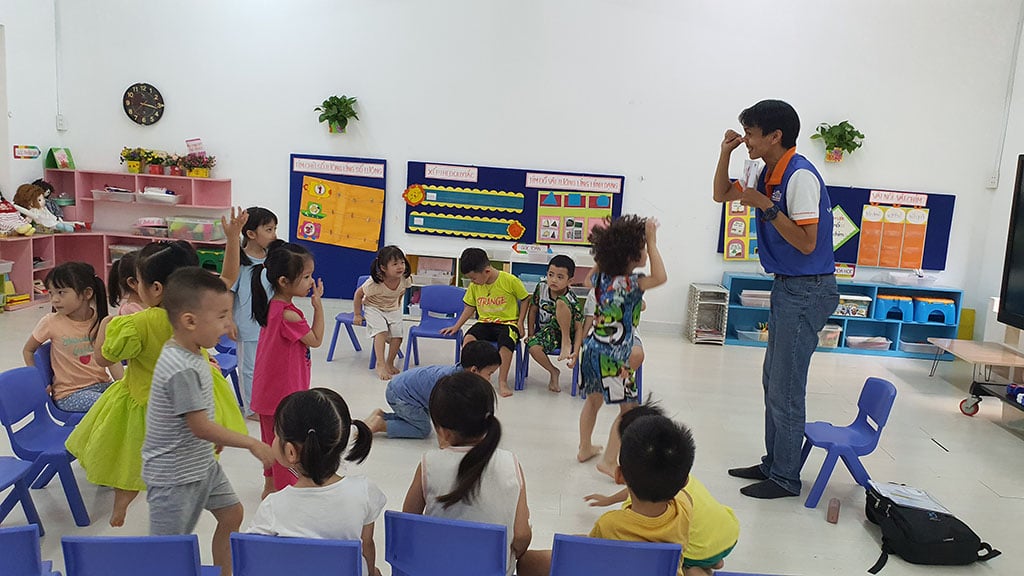
Preschool children in some activities to get acquainted with English.
If calculating the total rate of preschool children in Ho Chi Minh City participating in English familiarization programs, the whole city reaches 57.3%.
Ms. Le Thuy My Chau, Deputy Director of the Ho Chi Minh City Department of Education and Training, expressed concern about the fact that the number of preschools in Ho Chi Minh City is currently second only to Hanoi. There are nearly 500 public schools, over 800 non-public preschools, and especially nearly 1,700 independent private preschools. However, with these numbers (only 57.3% of preschool children are introduced to English - PV ), Ms. Chau said she was "a little worried".
"Education must ensure equality and fairness for all children. How can we increase this rate? This is a question that I think all those involved in education management must consider and find solutions for in each locality," Ms. Chau said.
DIFFICULTIES REGARDING TEACHERS AND FACILITIES
Many institutions report facing difficulties in securing teachers to help children learn English. Mr. Nguyen Ba Linh, a specialist at the Education and Training Department of Cu Chi District (Ho Chi Minh City), stated that there are currently no job openings for English teachers at the preschool level in public institutions. Hiring both foreign and Vietnamese teachers relies on contributions from parents, making the process often reactive. Furthermore, limited fees for this service create difficulties in contracting with teacher providers.
According to Mr. Linh, the number of qualified teachers to teach English to preschool children is limited because very few teachers have been trained in English teaching, or they have not participated in professional development courses on teaching English to preschool children.
Ms. Luong Thi Hong Diep, Head of the Preschool Education Department of the Ho Chi Minh City Department of Education and Training, said that introducing English to preschool children has many benefits. However, Ms. Diep acknowledged that difficulties still exist. For example, the number of children participating in English activities at independent group classes is low due to inadequate facilities. Preschool children in suburban districts from near-poor households cannot afford the organization fees, leading to a lack of opportunities for them to learn a foreign language. Furthermore, in some schools and classes, the number of children in a single English activity session is too high, affecting the quality of teaching.
"Some preschools, in collaboration with foreign language centers, are organizing English language introductions for preschool children in a manner that does not comply with regulations. There are also instances where teachers at these centers lack professional training certificates in early childhood education pedagogy or methods for introducing English to children, which are typically provided by colleges and universities that train preschool teachers," said Ms. Luong Thi Hong Diep.
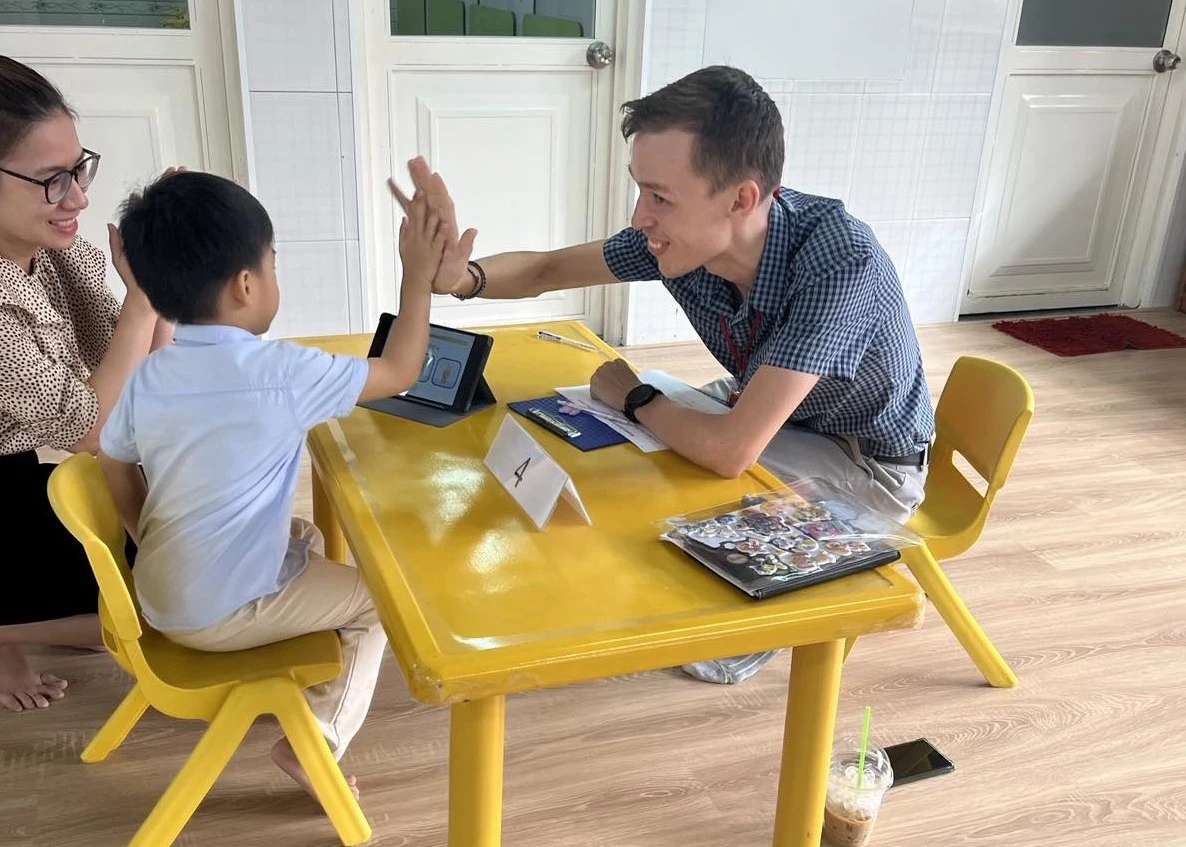
Preschool children in the pilot unit are using a tool to assess their English language proficiency.
Narrowing the Gap
Education is equitable; all children have the right to access education, ensuring fairness. Contributing their opinions at the workshop, education administrators and experts proposed recommendations to help increase the percentage of preschool children exposed to English.
Mr. Tran Huynh Tu, Director of Education Project Business at Viettel Enterprise Solutions Company, a branch of the Vietnam Telecommunications Industry Group, shared his insights on the application of technology and robots to support children's English learning in preschools. According to Mr. Tu, the application of technology and integration with the Ministry of Education and Training's English learning program helps digitize lessons, integrate robots, apps, interactive lessons, and AI applications. This helps leverage the strengths of teachers, allowing children to learn English through various activities with the support of preschool teachers, creating a level playing field where all children can participate.
The results obtained help institutions assess quality, adjust, and orient the methods and plans being implemented to introduce English to preschool children, based on available resources and the needs of parents. For example, with the permission of the Ho Chi Minh City Department of Education and Training, this unit recently piloted a survey of the results of English introduction activities for preschool children at three schools: City Kindergarten; South Saigon Kindergarten; and 19/5 City Kindergarten.
According to James Moran, Academic Director of EMG Education (a private educational organization), assessment tools must meet criteria such as adhering to the guidelines of Circular 50 of the Ministry of Education and Training; being based on international assessment standards; and focusing on developing age-appropriate assessment tools. In addition, interactive and visually engaging activities help children maintain attention and make the survey more enjoyable and interesting.
Inspection and management must be strengthened.
Data shows that Ho Chi Minh City currently has over 180 units (over 50 companies and over 150 foreign language centers) coordinating the implementation of English language familiarization programs for preschool children in early childhood education institutions and other forms. Ms. Le Thuy My Chau affirmed that the responsibility of state management officials lies in the matter of children learning English. Circular 50 of the Ministry of Education and Training is the legal basis, but implementation requires coordination and responsibility from the Department of Education and Training, foreign language centers, and schools.
Language centers need to focus on their teaching staff, helping native and foreign teachers understand Vietnamese culture to ensure appropriate teaching for children. The Department of Education and Training must strengthen quality control, thoroughly checking the qualifications of teachers, curricula, and developing plans at the local level. Ms. Chau noted that preschools should also survey needs and gather feedback from parents as a basis for implementing the program.
We need tools to assess the progress of children's English learning.
Speaking at the workshop, James Moran, Academic Director of EMG Education, stated that in addition to organizing programs to introduce children to English, evaluating the results is equally important.
A set of survey tools is needed to assess and collect information on children's English listening, speaking, and pre-reading/writing abilities based on the internationally standardized GSE Pre-Primary Framework developed by Pearson Education.
According to James Moran, the GSE Pre-Primary scale provides detailed Can-Do statements specifically for children in the pre-primary age group. The skills in the GSE Pre-Primary framework are finely broken down to suit the specific characteristics of preschool children who are in the process of learning language, with highly detailed descriptions of the skills and a tiered knowledge structure to show the child's progress through each stage.
Furthermore, this scale is also designed with an emphasis on flexibility and suitability to the context of each country. For example, for reading and writing skills, the scale provides optional skills in cases where children have not yet been introduced to reading and writing at this age as stipulated by the national preschool education program. In such cases, listening and speaking skills can still be applied to support teaching, organize English language activities, and assess results.
Source link


![[Photo] Closing Ceremony of the 10th Session of the 15th National Assembly](/_next/image?url=https%3A%2F%2Fvphoto.vietnam.vn%2Fthumb%2F1200x675%2Fvietnam%2Fresource%2FIMAGE%2F2025%2F12%2F11%2F1765448959967_image-1437-jpg.webp&w=3840&q=75)


![[Photo] Prime Minister Pham Minh Chinh holds a phone call with the CEO of Russia's Rosatom Corporation.](/_next/image?url=https%3A%2F%2Fvphoto.vietnam.vn%2Fthumb%2F1200x675%2Fvietnam%2Fresource%2FIMAGE%2F2025%2F12%2F11%2F1765464552365_dsc-5295-jpg.webp&w=3840&q=75)





![[E - Magazine] "Special mothers" sow knowledge in "deep mountains and remote valleys"](https://vphoto.vietnam.vn/thumb/402x226/vietnam/resource/IMAGE/2025/11/20/1763613534701_e-magazine-nhun-w1200t0-di2546d199d4111349t11920l1-chuyen-ve-nhung5.webp)






































![[OFFICIAL] MISA GROUP ANNOUNCES ITS PIONEERING BRAND POSITIONING IN BUILDING AGENTIC AI FOR BUSINESSES, HOUSEHOLDS, AND THE GOVERNMENT](https://vphoto.vietnam.vn/thumb/402x226/vietnam/resource/IMAGE/2025/12/11/1765444754256_agentic-ai_postfb-scaled.png)













































Comment (0)