Commissioned by Tsar Nicholas II as a gift for his mother in 1913, the Easter Egg (Winter Egg) found its way to an anonymous buyer after an auction at Christie's in London. This record-breaking price far exceeded Christie's pre-sale estimate of $26 million. This exorbitant price reflects the increasing rarity of Fabergé's Royal Eggs, as none had been offered at auction in over 23 years. The historic St. Petersburg jeweler only ever produced 50 of these eggs, and this Easter Egg is one of only seven remaining in private hands. The others are either lost or owned by institutions or museums, according to CNN.
In an email statement, Margo Oganesian, head of Christie's Fabergé and Russian art, said the new record "reaffirms the enduring importance" and "rarity and brilliant beauty of the work widely regarded as one of Fabergé's most exquisite creations, both technically and artistically. This is a unique and historic opportunity for collectors to own a work of unparalleled importance."
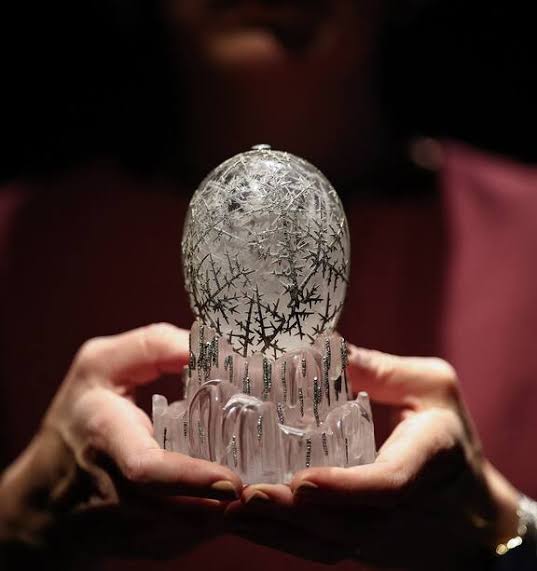
Easter eggs studded with thousands of diamonds.
PHOTO: AFP
The jeweled eggs were made for Nicholas II and his predecessor Alexander III, who gifted them as Easter presents to members of the family between 1885 and 1916. Each took about a year to design and produce, and the Tsars often ordered elaborately decorated pieces as soon as the latest one was delivered. Prior to Tuesday's auction, Oganesian described the Easter egg as "the most spectacular, the most artistically creative and the most unusual" of the 50.



"Most of them are based on historical styles—Rococo or Neoclassical—but Easter eggs have a style of their own," she told CNN over the phone, adding, "Their design is timeless—very modern."
Made primarily from crystal, or clear quartz, the Easter egg is designed to resemble a block of frosted ice. The outside of the egg features snowflake motifs made of platinum and 4,500 rose-cut diamonds. Inside is one of Fabergé's signature "surprises": a small hanging basket filled with wooden anemones made from white quartz, jade, and garnet. The design of the Easter egg was unusual at the time – the work of a female jeweler, Alma Pihl. Legend says that Pihl, granddaughter of Fabergé's chief jeweler, Albert Holmström, conceived the idea after seeing ice crystals forming in the window next to her grandmother's work desk.
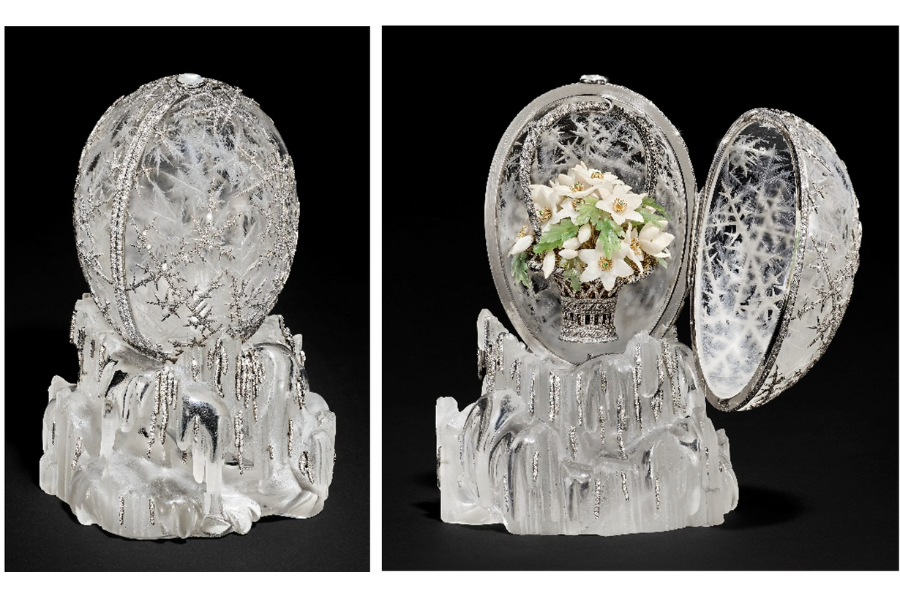
PHOTO: AP
According to the invoice released by Christie's, Nicholas II purchased it for 24,600 rubles, the third highest price Fabergé has ever charged for a piece. According to Kieran McCarthy, co-managing director at Wartski, a British antique jeweler specializing in works by Peter Carl Fabergé, the price of the Easter egg reflects the craftsmanship required to transform "precious materials into a moment of nature."
Thousands of diamonds are so small that they "have no intrinsic value," he added in a call with CNN before the auction. "The value comes only from the artistry and how they are used to create this sparkling frosty idea." "It's like holding a rock in your hand," he said.



The Easter egg passed through several private collections after the overthrow of Nicholas II's regime in the Russian Revolution of 1917. It was then held in various private British collections before disappearing in 1975. The egg reappeared in 1994, when it sold for $5.6 million at Christie's auction house in Geneva...
Source: https://thanhnien.vn/qua-trung-gia-gan-800-ti-dong-185251203074625329.htm


![[Image] National conference summarizing one year of operation of the overall organizational model of the political system, the three-tiered government model.](https://vphoto.vietnam.vn/thumb/1200x675/vietnam/resource/IMAGE/2026/07/01/1782882811691_ndo_br_1-jpg.webp)