

GIA LAI: Many orchards are gradually turning away from chemical fertilizers and pesticides, moving step by step towards organic and sustainable agriculture .
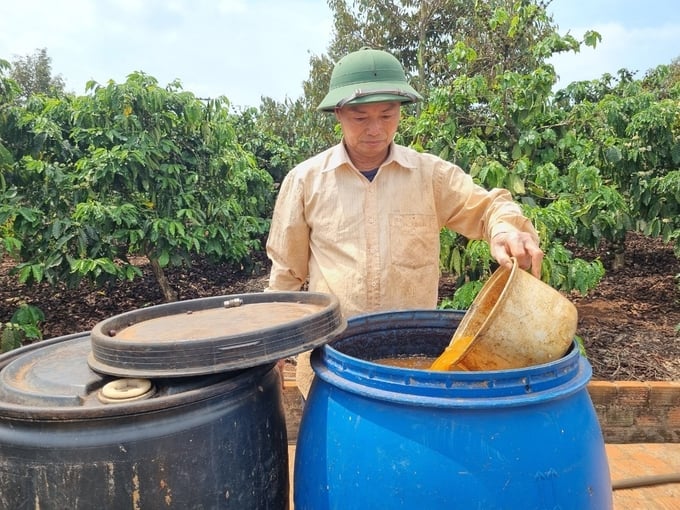
Mr. Pham Doanh Cach produces organic fertilizer from indigenous microbial preparations. Photo: Tuan Anh.
Growing coffee organically helps Mr. Pham Doanh Cach's family save costs, protect the environment, and improve the quality of their coffee.
Lush green coffee beans amidst the peak of the drought.
Under the scorching summer sun, the 3-hectare coffee plantation interspersed with hundreds of durian trees belonging to Mr. Pham Doanh Cach's family (Ngai Ngo village, Ia Hrung commune, Ia Grai district, Gia Lai province) remains lush and vibrant. A sprinkler system delivers cool water to each tree root, along with nutrients from organic fertilizer, helping the family's coffee and durian trees stand out with their vibrant green color in the vast space during the dry season.
Mr. Cach stated that, in the past, due to traditional farming methods, the excessive use of chemical fertilizers and uncontrolled spraying of pesticides led to soil degradation and toxicity, causing coffee plants to quickly decline, age prematurely, and yield unstable productivity. Furthermore, in recent years, the price of chemical fertilizers has increased significantly, and the quality of fertilizers has not been guaranteed, further hindering plant growth.
After a long period of deliberation on finding a direction for coffee cultivation, the family's main crop, Mr. Cach realized that only organic farming could ensure sustainable development over time. However, at that time, he had almost no knowledge of how to use organic fertilizers or what types of fertilizers would be effective for coffee plants.
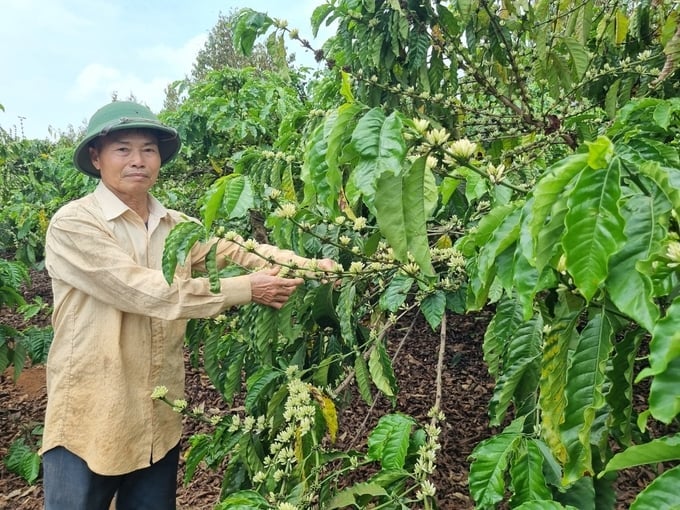
Thanks to the use of organic fertilizers, Mr. Cach's family coffee garden remains lush and green even during this severe drought. Photo: Tuan Anh.
It wasn't until 2022, during a chance visit to Chu Pah district to learn about sustainable coffee cultivation practices, that Mr. Cach came into contact with organic fertilizers produced from indigenous microbial preparations (IMO). There, he was guided on how to produce his own organic fertilizer from fish protein and soybeans to fertilize his coffee plantation.
“Last year, due to unfavorable weather, my family, like most people here, suffered a coffee crop failure. However, thanks to the use of organic fertilizer, the coffee cherries were still fresh and ripe red when harvested, unlike before when chemical fertilizers were used,” Mr. Cach shared.
According to Mr. Cach, in previous years, his family mainly used chemical fertilizers for coffee plants, with very large investments, not to mention the cost of pesticides and fungicides, so the total cost for the coffee plantation amounted to hundreds of millions of dong.
Over the past two years, the family has experienced a significant reduction in pressure as the cost of investing in organic fertilizers has decreased by more than a third compared to before. Most importantly, the coffee plants are always healthy and developing more sustainably.
“Since switching to organic fertilizers, my health and my family's health have improved significantly. Previously, when using chemical fertilizers, my family had to apply the fertilizer to each plant individually. With organic fertilizers, we can simply apply them through the irrigation system, which is both healthier and less labor-intensive. More importantly, the consistent application of fertilizer helps the plants grow more sustainably,” Mr. Cach shared.
Aiming for high-quality coffee.
Leading us around his coffee plantation, Mr. Cach explained that using organic fertilizer doesn't make coffee plants grow as quickly as with chemical fertilizers; instead, it's absorbed slowly into the soil, resulting in greener leaves and more abundant fruit. Furthermore, because his family aims for high-quality coffee, they mainly harvest ripe fruit, and using chemical fertilizers would cause the coffee beans to dry out and become of lower quality.
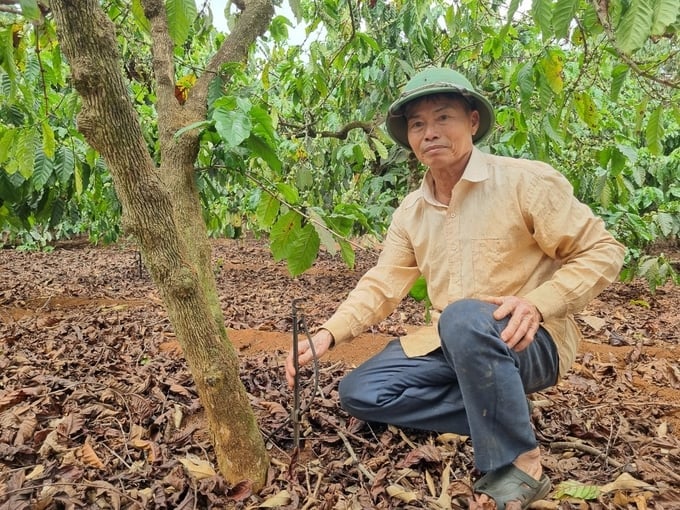
Mr. Cach's coffee plantation is equipped with a sprinkler irrigation system that targets the roots of the plants, aiming for high-quality coffee production. Photo: Tuan Anh.
Producing high-quality coffee saves Mr. Cach's family a lot of drying time, while the selling price is more than 10 million VND/ton higher than regular coffee. Last year, the coffee harvest was bountiful, with the family harvesting 5 tons of beans per hectare. With the current price of over 100,000 VND/kg, the family had a very successful coffee harvest.
Referring to the idea of developing high-quality coffee, Mr. Cach said that after researching high-quality coffee models in Dak Lak , he had been researching and purchasing equipment to implement the project. Developing high-quality coffee is becoming a trend that helps increase coffee productivity and quality, thereby increasing family income.
“If we harvest too many unripe coffee beans, the yield will decrease, and the quality of the coffee will also be affected. Aware of this, my family carefully harvests ripe coffee beans in multiple batches. Although it takes more effort, it helps protect the coffee branches. In addition, we use organic fertilizer to fertilize the plants. With this method, production costs are reduced by about 30% compared to before, but in return, the yield is higher, and the selling price of coffee is also higher,” Mr. Cach shared.
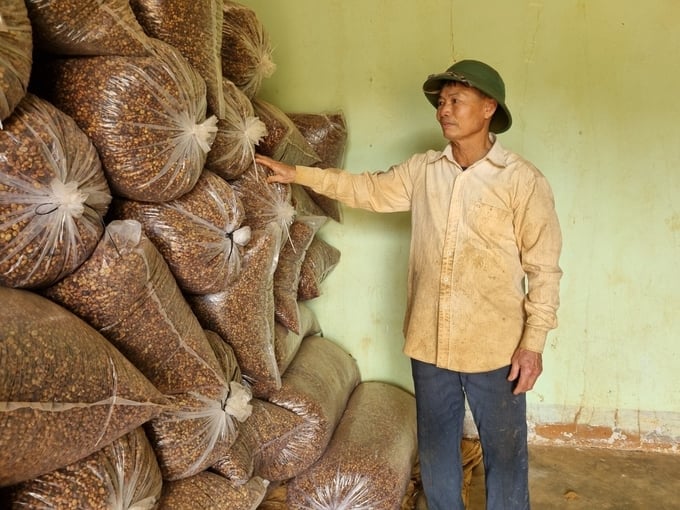
The high-quality green coffee beans are carefully preserved by Mr. Cach's family. Photo: Tuan Anh.
Immediately after Mr. Cach's family started producing high-quality coffee, many people in the area came to learn from them. Mr. Cach said that the most important factor in producing high-quality coffee is having the garden close to the house, and the house close to the garden, so that the coffee ripens evenly. If coffee is grown in a field far from the house, it is easy to steal it when the coffee starts to ripen and is not harvested. In addition, the family must have a three-phase electricity supply to provide water for irrigation and coffee processing.
In addition, to ensure high-quality coffee, the family had to build a concrete yard and invest in a well-organized greenhouse drying system for optimal efficiency.
Introducing his high-quality green coffee beans, Mr. Cach excitedly shared that his family still has 15 tons of green coffee beans, currently selling for over 100,000 VND/kg, with an expected revenue of more than 1.5 billion VND.
According to Mr. Phan Dinh Tham, Head of the Agriculture and Rural Development Department of Ia Grai district, aiming for sustainable coffee development, the Department has encouraged people to expand and apply appropriate water-saving irrigation technologies, promote organic coffee production, and obtain certifications such as 4C, VietGAP, and UTZ. At the same time, the district has implemented a coffee replanting program, prioritizing agricultural and forestry development funds to support people with high-yield coffee varieties grown organically.
Source: https://nongsanviet.nongnghiep.vn/quay-lung-hoa-chat-vuon-ca-phe-xanh-muot-giua-nang-han-khoc-liet-d384778.html
![[Photo] Closing Ceremony of the 10th Session of the 15th National Assembly](/_next/image?url=https%3A%2F%2Fvphoto.vietnam.vn%2Fthumb%2F1200x675%2Fvietnam%2Fresource%2FIMAGE%2F2025%2F12%2F11%2F1765448959967_image-1437-jpg.webp&w=3840&q=75)







































![[OFFICIAL] MISA GROUP ANNOUNCES ITS PIONEERING BRAND POSITIONING IN BUILDING AGENTIC AI FOR BUSINESSES, HOUSEHOLDS, AND THE GOVERNMENT](https://vphoto.vietnam.vn/thumb/402x226/vietnam/resource/IMAGE/2025/12/11/1765444754256_agentic-ai_postfb-scaled.png)







































Comment (0)