

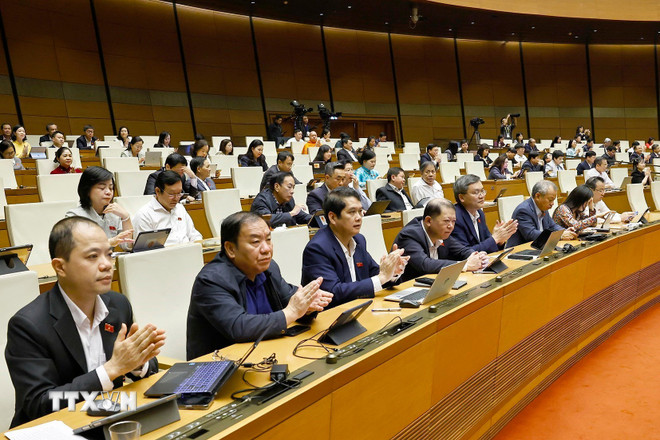
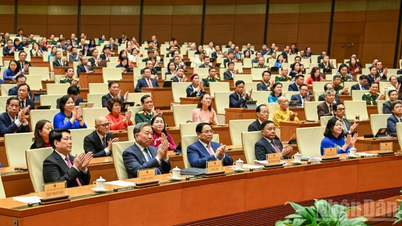
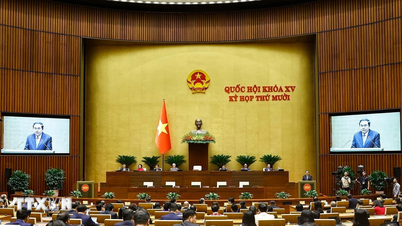
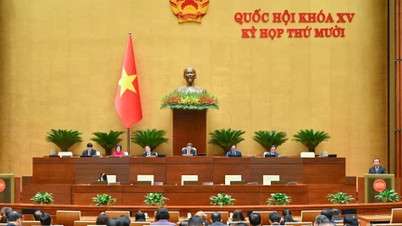
On the morning of December 11th, the National Assembly voted to approve the draft Law on Digital Transformation with 433 out of 442 attending National Assembly deputies voting in favor, representing 91.54% of the total number of deputies.
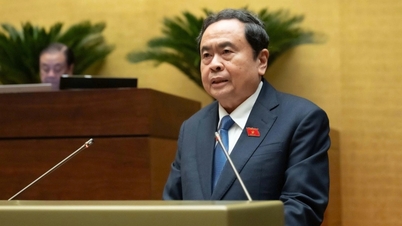
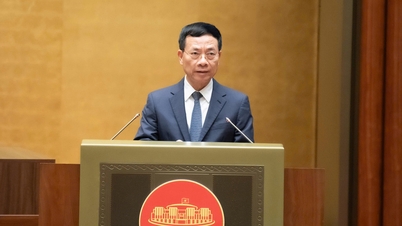
Presenting the report explaining, receiving feedback, and revising the draft Law on Digital Transformation, Minister of Science and Technology Nguyen Manh Hung stated that the Law on Digital Transformation is built on a "framework law" model - stipulating the principles, requirements, and major orientations, without delving into regulations within the scope of specialized laws, but playing a role in creating uniformity in the way of organizing and coordinating the digital transformation process nationwide.
The Law on Digital Transformation is designed to address the new challenges of the digital data and digital economy era, where the requirements for connecting, sharing, integrating, and operating digital platforms are crucial to national competitiveness.
The draft law, for the first time, codifies fundamental concepts of digital transformation – from digital transformation, digital systems, digital data, digital infrastructure, digital platforms to digital government, digital economy, and digital society. The government stated that it has thoroughly considered and revised these definitions to ensure scientific rigor and to unify the understanding across the entire political system and all stakeholders involved in digital transformation.
Another key point is to clarify the difference between digital transformation and information technology application: while information technology application only moves old operations to a digital environment, digital transformation is about changing the way operations are conducted, the governance model, and the methods of service delivery. This is considered the core philosophy of the law, reflecting the spirit of "transformation first, digitalization later."
Besides refining the conceptual framework, the draft law clearly defines macro-level governance tools such as the National Digital Transformation Program, the National Digital Architecture Framework, the Data Governance Framework, the Digital Competency Framework, and the National Digital Transformation Measurement Indicators Set. These tools are likened to a "central coordinating body," helping the State assess progress, promote implementation, and ensure synchronization between digital transformation at the national, ministerial, and local levels.
Representatives of the drafting agency affirmed that legalizing these frameworks will create uniformity in implementation, avoiding the fragmented investment and inconsistent approach seen in the past.
Another prominent aspect of the draft law is the policy to narrow the digital divide, especially in remote, border, and island areas. The draft law stipulates the principle of prioritizing resources to ensure these areas achieve the infrastructure level necessary to provide essential digital services such as online learning, telemedicine, and online public services. Simultaneously, the digital economy is considered a new growth engine; therefore, the law adds mechanisms to support small and medium-sized enterprises (SMEs) in applying digital platforms and participating in the digital economic value chain, with the expectation of contributing to double-digit growth in the coming period.
Modernizing national reserve operations.
With 436 out of 436 delegates voting in favor, representing 92.18% of the total number of delegates, the National Assembly passed the Law on National Reserves on the morning of December 11th.
Before voting to approve the bill, the National Assembly heard Minister of Finance Nguyen Van Thang present a summary report on the acceptance and explanation of the draft law.
Regarding strategic reserves, the Government has adopted and revised the principles for managing national reserves. Strategic reserves have become national reserves, and must be managed strictly, safely, and confidentially in accordance with the law on protecting state secrets, preventing loss and waste, and proactively and promptly meeting the objectives and requirements of national reserves.
Furthermore, the regulations on the State's policy regarding national reserves should be revised to prioritize investment, research, and development of science, technology, innovation, and digital transformation in the field of national reserves to modernize national reserve operations. The regulations on strategic reserves for natural resources, important minerals, and digital resources should be revised as follows: strategically important resources and minerals, national energy, and high-tech products that meet the requirements of economic security, energy security, and food security strategies.
Regarding the socialization of national reserves, the Government has incorporated and revised the draft to ensure that units, organizations, and enterprises participating in strategic reserves receive preferential treatment in terms of taxes, credit, and other preferential policies as stipulated by the Government in each period, guaranteeing the legitimate rights and interests of the State and all participants in strategic reserves.
The purchase and sale of strategic reserve goods, using both state budget and non-state budget funds, shall be conducted through agreements, voluntary participation, and contracts as prescribed by the Government and other relevant laws. The purchase and sale of strategic reserve goods from the legitimate sources of units, organizations, and enterprises shall be carried out by those units, organizations, and enterprises, with the State providing support for management, preservation, and other costs as prescribed by the Government.
Regarding the scope of strategic reserves, the draft law does not address the issue of reserves of money, gold, or foreign currency, as these are already governed by banking laws and other relevant legislation.
Regarding the pilot model of revolving reserves, the Government will study it when drafting the Decree to ensure feasibility, effectiveness, and avoid wasting state budget funds. Regarding policies and regulations for those working in national reserves, the draft law inherits and retains current regulations, without adding any new allowances.
Source: https://www.vietnamplus.vn/quoc-hoi-thong-qua-du-thao-luat-chuyen-doi-so-va-luat-du-tru-quoc-gia-post1082423.vnp












































![[OFFICIAL] MISA GROUP ANNOUNCES ITS PIONEERING BRAND POSITIONING IN BUILDING AGENTIC AI FOR BUSINESSES, HOUSEHOLDS, AND THE GOVERNMENT](https://vphoto.vietnam.vn/thumb/402x226/vietnam/resource/IMAGE/2025/12/11/1765444754256_agentic-ai_postfb-scaled.png)
















































Comment (0)