

In an article published in the international journal Applied Optics, Chinese scientists introduced radar technology that can detect objects at great depths with astonishing clarity, to the point of being likened to "finding a needle in a haystack."
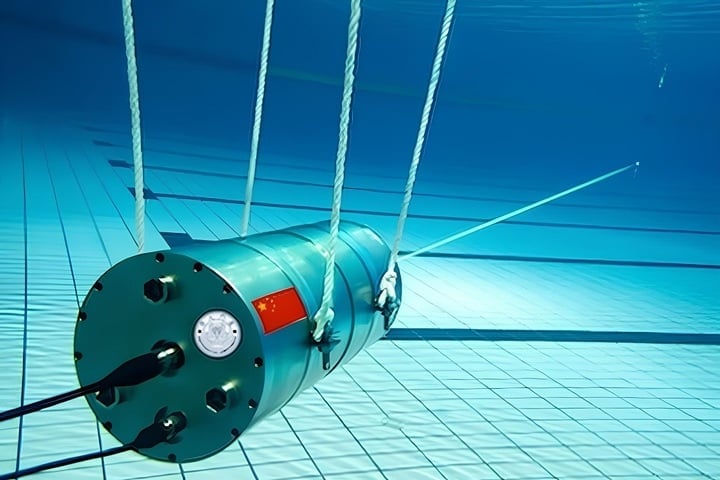
The photon Raman lidar system developed by Chinese scientists has significant potential for early detection of oil spills and other underwater applications. (Image: Xiamen University)
Accordingly, a research team led by Associate Professor Shangguan Mingjia at Xiamen University (Fujian Province, China) announced the world's first single-photon Raman lidar system, capable of operating at a depth of 1,000 meters below sea level.
Lidar, short for "light detection and ranging," is a technology that uses lasers to measure the distance to objects.
Single-photon detectors offer high sensitivity and low noise, overcoming the significant size and power consumption challenges of sub-ocean lidar systems and are also suitable for low-light conditions.
Meanwhile, Raman scattering—the phenomenon where laser light interacts with a material to produce vibrational changes—helps identify substances such as oil and dissolved CO2.
In addition to its ability to detect oil spills early, this system also shows enormous potential in detecting and identifying materials in complex aquatic environments, with applications in oceanographic surveys and deep-sea resource exploration.
According to the article, the research team's experiments were conducted using a cylindrical radar measuring 40 cm in length and 20 cm in diameter, with a power consumption of less than 100 watts.
Researchers say this radar successfully detects underwater oil spills from a distance of 12 meters using only a 1-microjoule laser pulse and a 22.4 mm telescope.
According to Optica, a professional association in the US, this system has significant potential applications in underwater material identification, coral detection, and manganese nodule exploration.
In addition, this technology is capable of capturing high-resolution laser images of small underwater targets, making it applicable in underwater archaeology, structural inspection, and military fields such as reconnaissance and submarine detection.
In the paper, scientist Shangguan Mingjia stated that the team's next plan is to develop another underwater lidar Raman system using shorter-wavelength lasers, such as blue lasers, to reduce the effects of chlorophyll luminescence from marine plants.
Shangguan's team has focused on developing underwater single-photon lidar technology for the past three years, creating various lidar systems and registering 50 invention patents in China and one patent in the United States.
According to an official report from Xiamen University, the group's radar technology is capable of detecting the optical properties of water, water particle configuration, bubbles, water depth, oil spills, and more.
“Such radar systems have been integrated into Xiamen University's research vessel Jia Geng, autonomous underwater vehicles (AUVs) and unmanned aerial vehicles (UAVs), playing an important role in marine surveying, deep-sea resource exploration, environmental monitoring, as well as underwater target imaging and identification,” the report said.
Source: https://vtcnews.vn/radar-trung-quoc-co-the-mo-kim-day-bien-ar912718.html




















































![[OFFICIAL] MISA GROUP ANNOUNCES ITS PIONEERING BRAND POSITIONING IN BUILDING AGENTIC AI FOR BUSINESSES, HOUSEHOLDS, AND THE GOVERNMENT](https://vphoto.vietnam.vn/thumb/402x226/vietnam/resource/IMAGE/2025/12/11/1765444754256_agentic-ai_postfb-scaled.png)





















































Comment (0)